
Paro hiking guide · Updated October 2026
Tiger’s Nest Hike: The Complete Guide to Paro Taktsang
Licensed operator No. 1052914
Local guides who walk this trail every week
Checked for 2026–2027 travel
Paro Taktsang at a glance
Tiger’s Nest hike: the short answer
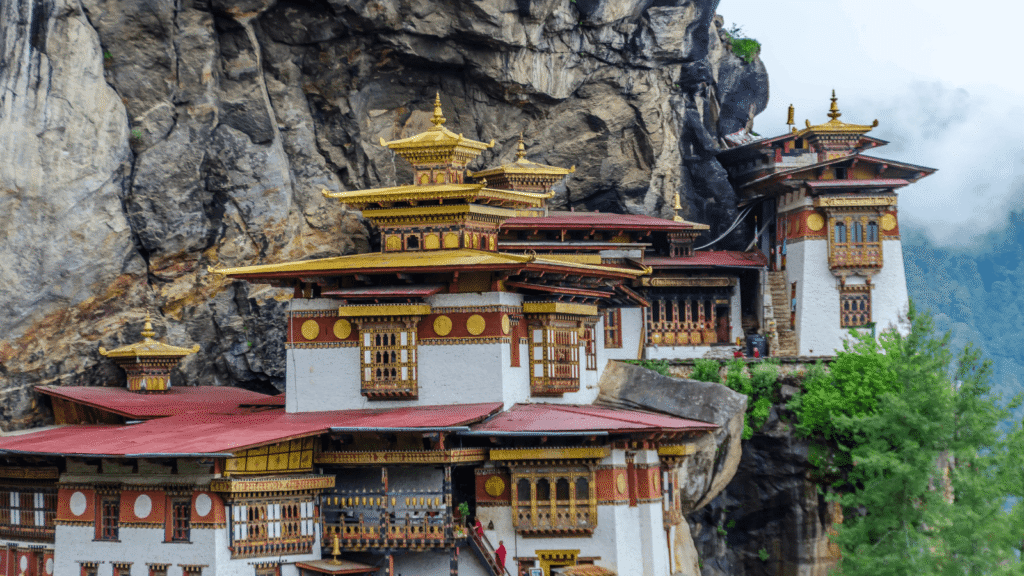
The Tiger’s Nest hike is a 4–6 hour round-trip walk of roughly 6–9 km from a trailhead at about 2,600 m to Paro Taktsang monastery at 3,120 m (10,240 ft), a net elevation gain of about 520 m. The trailhead is around 10 km north of Paro town, a 20–30 minute drive. The last stretch drops down several hundred stone steps into a gorge, past a waterfall, and climbs back up to the monastery gate. The entry fee in 2026 is Nu 1,000 per adult for all foreign visitors, Indian nationals included.
Almost everyone who visits Bhutan walks up to Taktsang. It is the picture on the guidebook cover, and for Bhutanese people it is one of the most sacred places in the Himalaya. It is also a real mountain walk at altitude, and the most common way to spoil it is to underestimate it.
We are a Thimphu-based team, and our guides walk this trail with guests most weeks of the year. This guide gives you honest ranges where sources disagree, tells you which end of the range to plan around, and does not pretend the day is easier than it is. If you are still shaping your trip, our Bhutan travel guide covers the bigger picture.
Tiger’s Nest facts (2026)
Monastery altitude
3,120 m (10,240 ft)
Trailhead altitude
about 2,600 m (Ramthangkha)
Net elevation gain
about 520 m
Total climbing, round trip
about 650–750 m (gorge counted)
Height above Paro valley
about 900 m
Round-trip distance
6–9 km, depending on car park
Time needed
4–6 hours, incl. ~1 hour inside
Steps
several hundred each way in the gorge
Distance from Paro town
about 10 km, 20–30 min drive
Entry fee (adult)
Nu 1,000 (Indian & international)
Children 6–17
50% (Nu 500); 5 and under free
Temples built
1692, Gyalse Tenzin Rabgye
Horses
trailhead to cafeteria only
Height, distance and gain
How high is Tiger’s Nest, and why do websites disagree?
If you have been researching, you will have seen the hike described as 4 km or 9 km, 520 m of climbing or 900 m, “easy” or “brutal”. They are not all wrong. They are measuring different things.
Altitude. Paro Taktsang sits at 3,120 m (10,240 ft) above sea level. For comparison, Paro town and the airport are at about 2,200–2,235 m, so you are already high when you arrive in Bhutan.
The famous “900 metres”. That figure is the height of the cliff above the Paro valley floor. It describes where the monastery hangs, not the walk you do. Your hike starts from a trailhead at about 2,600 m.
Tiger’s Nest hike elevation gain. From trailhead to monastery the net gain is about 520 m. The catch is the gorge: from the viewpoint the path drops into a ravine and climbs back up to the gate, and on the way home you reverse it. Counting those ups and downs, your legs do somewhere around 650–750 m of climbing over the whole day. That is why people who read “520 m” are still surprised by how tired they feel.
Distance. Most sources quote 4–4.5 km one way, or 8–9 km return. GPS tracks from the upper car park usually come in nearer 6–7 km return. The difference is where you start: there is a lower parking area and an upper one at Ramthangkha, with roughly a kilometre of road between them. Our drivers take guests to the upper trailhead, which saves a dull stretch of tarmac at the start and, more importantly, at the end when your knees have had enough.
How far is Tiger’s Nest from Paro? The trailhead is about 10 km north of Paro town, roughly 20–30 minutes by car up the valley past Drukgyel. From Paro airport it is about 30 minutes; from Thimphu allow 1.5–2 hours, which is why we always have guests sleep in Paro the night before.
Fees for 2026–2027
Tiger’s Nest entry fee for Indian and international visitors
Visitor
Taktsang entry fee
Notes
International tourists (adult)
Nu 1,000 (about US$12)
Paid separately from the SDF; included in our tour packages
Indian nationals (adult)
Nu 1,000 (= ₹1,000)
Same rate as other visitors; ngultrum and rupee are at par
Bangladeshi and Maldivian nationals
Nu 1,000
Regional visitors pay the same monument fee
Children aged 6–17
Nu 500
50% concession applies at all fee-charging sites
Children 5 and under
Free
Carry ID or passport copies for the gate
Horse to the cafeteria (optional)
roughly Nu 700–1,200 one way
Paid to the horse owner at the trailhead; prices vary
Trekking pole hire (optional)
roughly Nu 50–100
Available at the trailhead
The story of the cliff
Why is Tiger’s Nest so sacred? Guru Rinpoche and Taktsang Pelphug
Taktsang is sacred because of a cave, and because of who meditated in it. In the 8th century Guru Rinpoche (Padmasambhava), the tantric master credited with bringing Buddhism across the Himalaya, is said to have flown to this cliff on the back of a tigress. In the most popular telling the tigress was his consort Yeshe Tsogyal, transformed for the journey; other accounts say he came from Singye Dzong in what is now eastern Bhutan.
He arrived as Dorje Drolö, one of his eight manifestations: a wrathful form, riding the tigress, invoked for overcoming obstacles. Here he subdued the local spirits that resisted the new teaching and meditated in the cave, traditionally for three years, three months, three weeks, three days and three hours. The cave became known as Taktsang Pelphug, “the Tiger’s Lair cave”, and the whole site as Taktsang, from tak (tiger) and tsang (nest).
1692: the temples. The legend is 8th-century; the buildings are not. The temple complex was founded in 1692 by Gyalse Tenzin Rabgye, the fourth Druk Desi (temporal ruler of Bhutan), who is said to have laid the foundation during the Paro Tshechu season of that year. Today the complex holds four main temples and residential quarters, built into and around eight caves, four of them relatively easy to reach. Everything is linked by rock-cut stairs and short bridges.
The main sacred cave is opened to the public only once a year, on a date set by the lunar calendar. If your trip happens to coincide, your guide will know. It is one of many reasons we suggest pairing Taktsang with time at other sacred sites; our list of monasteries in Bhutan worth visiting is a good next read.
Paro Taktsang in numbers
Tiger’s Nest Bhutan in eight numbers
3,120 m
Monastery altitude (10,240 ft)
~2,600 m
Trailhead at Ramthangkha
~520 m
Net elevation gain
4–6 h
Typical round trip
6–9 km
Round-trip distance
1692
Temples founded
1998
Fire in the main building
2005
Restoration completed
1998 and after
What happened in the 1998 fire, and how was Taktsang rebuilt?
On 19 April 1998 a fire broke out in the main building of Taktsang. It is generally attributed to butter lamps igniting hanging cloth, or to an electrical short circuit; accounts differ. A monk lost his life, and much of the main structure and its contents were destroyed.
Restoration was carried out under the government and His Majesty the Fourth King, Jigme Singye Wangchuck, using traditional methods and materials, at an estimated cost of about Nu 135 million. The work was completed in 2005.
So a good part of what you photograph is around twenty years old. Some visitors find that disappointing. We would gently disagree. Rebuilding sacred structures after fire is normal in Himalayan Buddhism, because the sanctity lies in the cave and the site rather than in the age of the timber. And think about how it was done: every beam, roof sheet and pot of paint was carried up the same path you are about to walk.
Taktsang is not a museum with a good view. It is a working monastery and a living pilgrimage site. The people climbing beside you may be on their third visit this year, some of them elderly, some carrying children, some in thin canvas shoes under a gho or kira. Knowing that changes the walk.
Stage by stage
What is the Tiger’s Nest hike like, stage by stage?
01
Trailhead to the cafeteria
~2,600 m → ~2,900 m · 1–2 hours
02
Cafeteria and halfway viewpoint
~2,900 m · 10–30 minute break
03
Cafeteria to the main viewpoint
~2,900 m → ~3,100 m · 30–45 minutes
04
The steps, the waterfall and the gate
~3,100 m → 3,120 m · 20–40 minutes
05
Inside the monastery
3,120 m · 45–60 minutes
06
The return
1.5–2 hours down
The final section
How many steps to Tiger’s Nest?
Nobody has an official count, and figures online range from “about 700” to well over a thousand, depending on whether people count one way or both, and whether they count the uneven sections as steps. Our own working figure, after walking it many times: roughly 700 steps from the viewpoint down into the gorge and about 200 back up to the gate. You repeat that on the return, so the steps are a bigger part of the day than the map suggests.
What matters more than the exact number is how they feel:
- Going down is hard on knees and thighs. The steps are irregular in height and some are worn smooth.
- Near the waterfall they are often wet, and in winter they can ice over after snow.
- The climb back out on the return comes when you are already tired. Budget energy for it.
- The path is narrow in places. Stand aside and let pilgrims and monks pass. It costs you fifteen seconds and it is noticed.
The waterfall itself is a sacred spot, with a small shrine and a hermitage built against the rock. Most visitors walk straight past it on the way to the gate. Slow down here, and if you are curious, ask your guide about the story of the place. If you love walks like this, our Bhutan trekking tours go further into the mountains.

Hour by hour
A sample Tiger’s Nest hike day, hour by hour
Time
What happens
07:00
Breakfast at your Paro hotel. Eat properly; your next real meal will be around 1 pm.
07:40
Drive from Paro town to the upper trailhead at Ramthangkha, about 20–30 minutes.
08:00
Hire poles, decide on a horse if you want one, start walking.
09:15
Reach the cafeteria. Ten-minute stop for water, a photo and your breath.
10:00
The main viewpoint. Morning light is usually on the monastery face.
10:30
Steps down into the gorge, past the waterfall, up to the gate.
10:45
Security, lockers, shoes off. An unhurried hour inside with your guide.
11:50
Leave the monastery and cross back over the gorge.
12:40
Lunch at the cafeteria, with Taktsang in front of you.
13:30
Forest descent, poles out, no hurry.
14:45
Back at the trailhead and into the car.
16:00
Hot stone bath (dotsho) at a Paro farmhouse, booked that morning or the day before.
Fitness and timing
How hard is the Tiger’s Nest hike, honestly?
Who you are
Up to the monastery
Full round trip
Fit and acclimatised
1.5–2 hours
about 4 hours
Average fitness
2–3 hours
about 5 hours
Slow and steady, older walkers or families with children
3–4 hours
6–7 hours
Cafeteria only
1–2 hours
2.5–3.5 hours
Cafeteria and main viewpoint
1.5–2.5 hours
3.5–4.5 hours
Preparing your body
How should you prepare for the altitude and the climb?
Hike on day 3 or later
Train uphill for four weeks
Train the downhill too
Know normal altitude effects
Know the warning signs
Check with your doctor
Riding part of the way
Can you ride a horse up to Tiger’s Nest?
Horses are hired at the trailhead from local owners, usually for roughly Nu 700–1,200 one way; prices vary with season and demand, so your guide will confirm on the day. They are for the uphill only. Riding down is not offered, because the steep, rooty descent is not safe on horseback.
Should you? If you are unsure about your fitness, yes. A horse saves you the longest and most tiring climb and leaves you energy for the better half of the walk. If you are a confident walker, we would skip it: the forest is lovely, and your legs will be better warmed up for the steps. Some travellers decline on animal-welfare grounds. That is a fair position; look at the animals at the trailhead and decide for yourself.
Things to know if you ride: wear long trousers, keep your weight centred and lean forward on steep sections, and let the horse handler lead. Tell your guide in advance if you might want one, especially in October and April when demand is high.
Horses at a glance
Where they go
Trailhead to the cafeteria
Where they stop
The cafeteria (~2,900 m)
Riding down
Not offered
You still walk
Viewpoint, gorge steps, monastery
Typical cost
roughly Nu 700–1,200 one way
What it saves
About 1–1.5 hours of the steepest climbing
Etiquette and dress code
What are the rules inside Tiger’s Nest monastery?
No photography inside
Bags and phones in lockers
Dress code
Shoes and hats off
Walk clockwise
Opening hours
Days closed to tourists
Offerings are welcome
A guide goes with you
Season and time of day
When is the best time to hike Tiger’s Nest?
Season
Conditions on the trail
Our verdict
Spring · Mar–May
Mild days, rhododendrons in flower, mostly dry trail; haze can build by afternoon.
Excellent
Monsoon · Jun–Aug
Rain, mud and leeches in the lower forest; cloud can hide the monastery entirely. Very quiet.
Possible, start at 8 am
Autumn · Sep–Nov
Clearest air of the year, dry stone steps, cool mornings. October is busiest; late September and November are nearly as good and calmer.
The best
Winter · Dec–Feb
Cold, bright and uncrowded. After snowfall the gorge steps can ice over.
Good, with care
Clothing and kit
What should you wear and pack for the Tiger’s Nest hike?
Long trousers and sleeves
Shoes with grip
Layers
1.5–2 litres of water
Sun protection
Snacks
Trekking poles
Small cash
Planning the day into your trip
Where does the Tiger’s Nest hike fit in a Bhutan itinerary?
Because Paro is where you land and leave, most itineraries start with a gentle day in Paro or Thimphu, travel east to Punakha and beyond, then finish back in Paro with Taktsang. By then you have had several days at altitude, your legs have done some walking, and the hike becomes the high point of the trip rather than an ordeal at the start of it. Our 6-day Bhutan cultural tour and 11-day Bhutan cultural tour are both built this way, and the Paro and Tiger’s Nest page shows what else to see in the valley.
Keep the afternoon free. Guests who plan a dzong for 4 pm rarely make it. A hot stone bath, an early dinner and a stroll down Paro’s main street is the right finish.
Accessibility. The trail is not suitable for wheelchairs, and there is no road or cable car to the monastery. Travellers with limited mobility can usually reach the cafeteria on horseback for the first full view, or see Taktsang from below in the valley; the steps in the gorge are the real barrier. Children from about eight upwards usually manage the full walk at their own pace; younger ones often enjoy the cafeteria as a goal.
Safety. The trail is well used and our guides walk it constantly, but take it seriously: keep to the inside when horses pass, hold the rail on the gorge steps, do not photograph while walking, and turn back without guilt if you feel unwell. Mobile signal is patchy. In an emergency in Bhutan dial 112 for an ambulance or 113 for police, but on the trail your guide is your first call. More on general safety in our is Bhutan safe to visit guide.
Other ways to see it
Arrive from above: the Bumdrak route
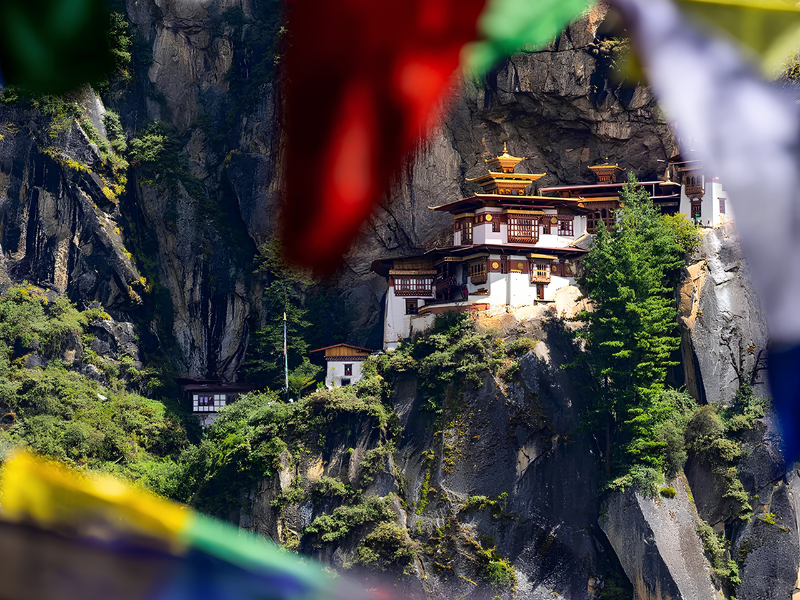
For something quieter, a short overnight walk climbs to Bumdrak, a small temple and campsite at around 3,800 m on the ridge above Taktsang. You sleep above the valley, then descend to Tiger’s Nest from above the next morning, often before the day hikers reach the cafeteria. It is moderate, it is mostly downhill on day two, and it needs a little planning around camping gear and weather. If that appeals, tell us when you enquire and we will build it into a customised Bhutan tour.
Questions we are asked
Tiger’s Nest hike: frequently asked questions
Short, direct answers to what travellers ask us most. Anything else? Write to hello@kingdomofhappinesstours.com or see our general Bhutan FAQs.
How high is Tiger’s Nest?
What is the Tiger’s Nest hike elevation gain?
How long does the Tiger’s Nest hike take?
How far is Tiger’s Nest from Paro?
How long is the trail?
How many steps are there to Tiger’s Nest?
What is the Tiger’s Nest entry fee for Indian visitors?
What is the entry fee for international visitors?
Can I hike Tiger’s Nest without a guide?
Can I take photos inside Tiger’s Nest?
What should I wear to Tiger’s Nest?
Can I ride a horse to Tiger’s Nest?
Is the Tiger’s Nest hike difficult?
What time should I start the hike?
What are the opening hours of Taktsang?
Is there food or a toilet on the trail?
Can children or older travellers do the hike?
When is the best time to hike Tiger’s Nest?
Hike Tiger’s Nest with a local guide
Walk Paro Taktsang with people who know every switchback
- Licensed operator, licence No. 1052914
- Bhutanese-owned, based in Thimphu
- Reply within 48 hours
Plan my trip to Bhutan
Free itinerary and itemised quote