Jakar Festival Tour Bumthang's Castle of the White Bird
Jakar Dzong takes its name — meaning “Castle of the White Bird” — from a genuine local legend: when lamas searching for a site for the dzong saw a single white bird circle overhead before settling on a particular hilltop, they took it as an auspicious sign and built there. The dzong has stood on that hill above the Chamkhar Valley since the 17th century, and its annual Tshechu — confirmed for 18–21 October 2026 — remains one of Bumthang’s most significant festivals, held in the spiritual heartland of the entire kingdom.
Discover Bhutan's Cultural Heart at the Castle of the White Bird
Bumthang holds an unusual concentration of significant Bhutanese festivals within a single valley — the Jambay Lhakhang Drup, the Jambay Lhakhang Singye Cham, the Thangbi Mani, the Nimalung and Kurjey festivals, and the Jakar Tshechu, the focus of this tour, are all held in this region within a span of just a few months each autumn and winter. Each is a genuinely distinct event, with its own venue, its own legend, and its own specific dances — and the Jakar Tshechu is the one most directly tied to the dzong that gives Bumthang’s main town, Jakar, its name.
Jakar Dzong’s origin story is one of the more charming in Bhutanese architectural history. According to local tradition, lamas searching for an auspicious site for a new fortress watched a single white bird circle continuously overhead before settling on a particular hill above the Chamkhar Valley. Taking this as a favourable sign, they built the dzong there, and named it accordingly — Jakar, “Castle of the White Bird.” Constructed in the 17th century (with some sources citing 1549 and others 1667, reflecting the structure’s later rebuilding), the dzong’s distinctively tall central tower, the Utse, rises some 50 metres and is unusual even among Bhutan’s many dzongs for its height. The fortress historically served as the seat of defence for the eastern districts of the kingdom, and Bhutan’s first king, Ugyen Wangchuck, ruled the country from here before the monarchy’s seat moved west.
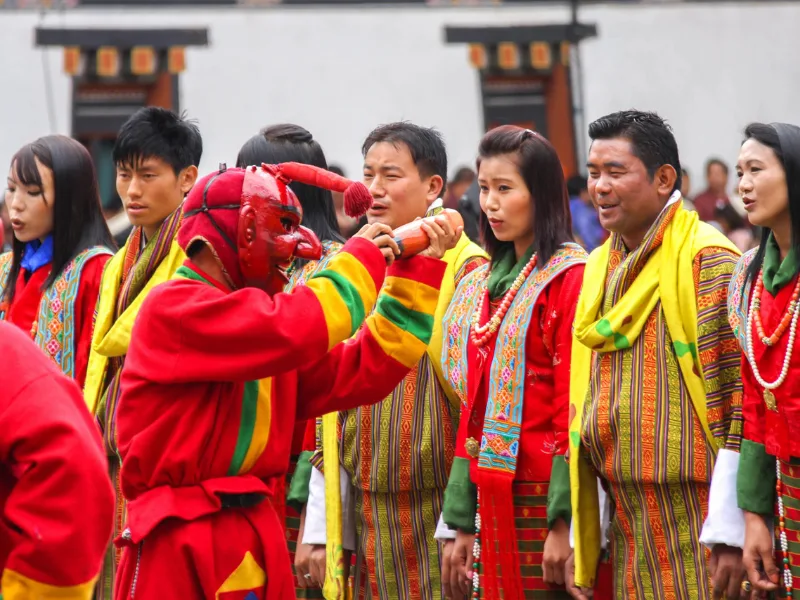
The Jakar Tshechu itself is a four-day festival, observed annually in mid-autumn following the Bhutanese lunar calendar, organised by the Jakar Dzong monastic body. It honours Guru Rinpoche, the 8th-century master who introduced Vajrayana Buddhism to Bhutan, through sacred Cham mask dances, and concludes with the dawn unveiling of a Thongdrel — a massive sacred tapestry believed by devotees to grant blessings and purification simply through being witnessed.
“A single white bird, centuries ago, decided where this dzong would stand — and the festival held in its courtyard each autumn still draws Bumthang’s communities together in exactly the spirit that legend describes.”
This 11-day journey takes the full route from Paro through Thimphu, Punakha, and Gangtey before reaching Bumthang specifically for the Jakar Tshechu, with time to properly explore the valley’s other ancient temples — Jambay Lhakhang, Kurjey Lhakhang, and Tamshing Lhakhang — that make Bumthang the spiritual centre of the kingdom.
🐦 We confirm exact dates before booking
As a lunar-calendar festival, the Jakar Tshechu’s date can shift slightly. We verify against current published sources before finalising your itinerary.
Tour at a Glance
Everything you need to know about this Jakar Festival Tour at a glance.
🗓️ Duration
11 Days / 10 Nights
📍Destinations
Paro–Thimphu–Punakha–Gangtey–Bumthang
🎭 Festival Focus
Jakar Tshechu
🏨 Accommodation
3-Star Hotels & Resorts
🚙 Throughout
Private Vehicle & Guide
👥 Group Size
1 – 10 Guests
💰 Starting Price
From USD $2,280 Per Person
🛂 Documents Needed
Entry Permit + Special Area Permit
The Legend of the White Bird — How Jakar Dzong Got Its Name
The story behind Jakar — “Jaka” relating to bird, and the dzong taking its full name as “Castle of the White Bird” — is told consistently across Bhutanese tradition. When a group of lamas were searching the Chamkhar Valley for a suitable, auspicious site to build a new fortress, a single white bird appeared and circled continuously overhead, eventually settling on a particular hill. Reading this as a favourable omen, the lamas chose that hill as the site for the dzong, and named the resulting fortress in the bird’s honour.
The dzong’s most distinctive architectural feature is its Utse, the central tower, which rises approximately 50 metres — notably taller and more prominent than the central towers of most other Bhutanese dzongs. Historically, Jakar Dzong served as the principal seat of defence for Bhutan’s eastern districts, and its strategic hilltop position above the Chamkhar Valley reflects this military function alongside its religious one. Bhutan’s first king, Ugyen Wangchuck, ruled the country from this dzong before the seat of governance eventually moved to the western valleys.
Bumthang Hosts Several Distinct Festivals — Here's Where Jakar Tshechu Fits
Bumthang is unusually rich in autumn and winter festivals, and several tour operators blur them together. We won’t — here is an honest map of what’s actually happening, and when.
Jakar Tshechu — 18–21 October 2026
Held at Jakar Dzong itself, a four-day festival organised by the dzong’s monastic body, central to the town of Jakar and the Chamkhar Valley specifically.
Jambay Lhakhang Drup — 26–29 October 2026
Held at the separate Jambay Lhakhang temple, famous for its midnight Tercham (naked dance) and Mewang fire ritual — a different venue, different rituals, about a week after Jakar Tshechu.
Thangbi Mani — Late September 2026
Held at Thangbi Mani Lhakhang in Choekhor, organised by local villages with lay monks (Gomchens) performing the rituals — smaller and earlier in the season than Jakar Tshechu.
Nimalung & Kurjey Festivals — Late June 2026
Held at separate monasteries a short drive from Jakar town, in early summer rather than autumn — a completely different time of year from this tour.
If you specifically want to combine the Jakar Tshechu with one of these other Bumthang festivals — and given how close together some of them fall in October, this is sometimes genuinely possible — please tell us your dates and we will advise honestly on what can realistically be combined.
What Actually Happens at the Jakar Tshechu
A four-day religious festival held in the courtyard of Jakar Dzong, honouring Guru Rinpoche through sacred Cham dances.
🎭 Shana Cham — Black Hat Dance
A ritual dance performed to dispel negative energy and bless the festival ground before the main celebrations begin.
💀 Durdag Cham — Dance of the Lords of Cremation Grounds
Performed by dancers in skeleton masks, symbolising the impermanence of life and the guardian spirits of sacred burial grounds.
🙏 Guru Tshengye — Eight Manifestations
One of the most colourful and revered dances of the festival, depicting the eight aspects of Guru Rinpoche in vivid costume and mask.
The festival concludes with the unfurling of a Thongdrel — a massive appliqué tapestry depicting Guru Rinpoche — at dawn on the final day. Devotees believe that simply viewing the Thongdrel grants liberation from negative karma, and crowds gather from before sunrise specifically for this moment. Throughout the festival, locals from across the Bumthang valley attend in their finest traditional gho and kira, making the dzong courtyard a genuine community gathering point, not simply a tourist viewing event.
Why Bumthang Is Considered Bhutan's Spiritual Heartland
Jakar Tshechu sits within a valley unusually dense with significant religious history.
An Extraordinary Concentration of Ancient Temples
Jambay Lhakhang (7th century), Kurjey Lhakhang (where Guru Rinpoche's body imprint is said to remain visible), and Tamshing Lhakhang (founded 1501) all sit within a short distance of Jakar town.
The Story of Pema Lingpa
Tamshing Lhakhang was founded by Pema Lingpa, one of Bhutan's most revered treasure-revealers, whose legacy runs through much of Bumthang's religious history and several of its temples.
The "Burning Lake" — Mebar Tsho
According to legend, Pema Lingpa discovered hidden religious treasures concealed by Guru Rinpoche within this sacred lake in the 14th century — a site still visited by pilgrims today.
A Genuinely Distinct High-Valley Character
At roughly 2,600–2,800 metres, Bumthang's climate and architecture differ noticeably from the warmer western valleys most visitors see first.
An Unusual Density of Festivals
Few single valleys in Bhutan host as many distinct annual Tshechus and religious festivals as Bumthang — a reflection of just how spiritually significant this region has been for centuries.
The First King's Original Seat
Bhutan's first monarch ruled initially from Jakar Dzong, tying this specific festival and site directly to the founding of the modern Bhutanese state.
What Makes This Jakar Tshechu Tour Different
Several Bumthang festival tours blur multiple distinct events together. We build this trip with precision around the Jakar Tshechu specifically.
We Name the Correct Festival, Clearly
This is the Jakar Tshechu, at Jakar Dzong, 18–21 October 2026 — not the Jambay Lhakhang Drup or any of Bumthang's other autumn festivals, which we describe separately and honestly.
A Complete Western & Central Route
This itinerary properly covers Paro, Thimphu, Punakha, and Gangtey before reaching Bumthang — not a rushed flight-in, flight-out festival visit.
Genuinely Researched Festival & Legend Detail
The white bird legend, the Utse tower height, the specific Cham dances performed — all verified against multiple sources, because even a well-known festival deserves accurate description.
Bumthang's Other Temples Properly Included
Jambay Lhakhang, Kurjey Lhakhang, and Tamshing Lhakhang are all built into this itinerary, not left as a rushed afterthought around the festival itself.
Comfortable Accommodation Throughout
3-star hotels and resorts at every stop on this route, including Bumthang and Gangtey.
Full Support Before, During & After
Visa, SDF, all bookings — handled entirely. We remain available throughout your trip and after you return home.
11-Day Jakar Festival Tour Itinerary — Day by Day
Every site, every cultural detail, every reason this route is sequenced this way — described in full.
DAY 1
Arrival Day · Paro
📍 Paro International Airport · Sightseeing
Arrival and sightseeing in the Paro Valley — Ta Dzong (1649), now the National Museum, and Rinpung Dzong, built in 1646.
Paro International Airport arrival
Ta Dzong 1649
DAY 2
Tiger’s Nest Day
📍Hiking to Paro Taktsang — Tiger's Nest Monastery
The hike to Paro Taktsang, built around the cave where Guru Rinpoche is said to have meditated in the 8th century.
Tiger’s Nest hike
DAY 3
Paro → Thimphu
📍Drive to Thimphu · Capital Sightseeing
Drive to Thimphu (around 1 hour) for an afternoon exploring Tashichho Dzong and the National Memorial Chorten.
Tashichho Dzong
DAY 4
Thimphu → Punakha
📍Dochula Pass · Punakha Dzong (1637) · Suspension Bridge
Drive to Punakha via Dochula Pass. Visit Punakha Dzong, built in 1637 by Zhabdrung Ngawang Namgyal, and the 160-metre suspension bridge.
Dochula Pass
Punakha Dzong 1637
DAY 5
Punakha → Gangtey
📍Wangdue Phodrang Dzong · Chimi Lhakhang · Gangtey Goemba
Visit Wangdue Phodrang Dzong (1638) and Chimi Lhakhang (1499). Continue to Gangtey/Phobjikha Valley, home to Gangtey Goemba monastery (1613) and the winter roosting ground of the black-necked crane.
Wangdue Phodrang Dzong 1638
Chimi Lhakhang 1499
DAY 6
Gangtey → Bumthang
📍Trongsa Dzong (1648) · Ta Dzong · Drive to Bumthang
Drive to Bumthang via Trongsa, visiting Trongsa Dzong and the Ta Dzong watchtower, now a royal heritage museum, before crossing Yotongla Pass (3,551m) into the Bumthang Valley.
Trongsa Dzong 1648
Yotongla Pass 3,551m
DAY 7
The Festival · Jakar Tshechu, Day One
📍Witness the Jakar Tshechu — Castle of the White Bird
A full day at Jakar Dzong, witnessing the opening dances of the Jakar Tshechu — the Shana Cham (Black Hat Dance) and other sacred Cham performances, in the courtyard of the dzong named for the legendary white bird that chose its site.
🐦 Inside the Castle of the White Bird
Standing in the courtyard of Jakar Dzong during the Tshechu, with the dzong’s unusually tall 50-metre central tower rising above the festival crowds in their finest traditional dress, is a genuinely powerful introduction to Bumthang’s particular blend of history, legend, and living religious practice.
Jakar Tshechu day 1
Shana Cham Black Hat Dance
DAY 8
Festival Continues · Bumthang Temples
📍Jakar Tshechu Day Two · Jambay Lhakhang & Kurjey Lhakhang
Return to the festival for further Cham dances, including the revered Guru Tshengye (Eight Manifestations of Guru Rinpoche). Between sessions, visit Jambay Lhakhang, one of Bhutan’s oldest temples (7th century), and Kurjey Lhakhang, where Guru Rinpoche’s body imprint is said to remain visible in the rock.
DAY 9
Final Festival Day · The Thongdrel
📍The Jakar Tshechu Concludes — Dawn Unveiling of the Thongdrel · Tamshing Lhakhang
An early start to witness the festival’s most sacred moment: the dawn unveiling of the Thongdrel, the massive tapestry depicting Guru Rinpoche, believed to grant blessings and purification to all who view it. Afterward, visit Tamshing Lhakhang, founded in 1501 by Pema Lingpa.
DAY 10
Return Journey · Departure
📍Bumthang → Paro (via Flight or Overland)
After breakfast, begin your journey from Bumthang towards Paro, either by scenic domestic flight or an overland drive depending on the travel arrangement and weather conditions.
If travelling by flight, enjoy a breathtaking aerial view of Bhutan’s Himalayan landscapes, deep valleys, and winding rivers as you fly towards Paro. Upon arrival, transfer to your hotel and relax.
If travelling overland, drive through Bhutan’s stunning central and western regions, passing high mountain passes, lush forests, and traditional villages along the way. The journey offers a remarkable experience of Bhutan’s diverse landscapes and cultural richness.
Upon arrival in Paro, check in to your hotel and enjoy the evening at leisure.
DAY 11
Departure
📍Paro → Paro International Airport · Departure Transfer
After breakfast, check out from your hotel and transfer to Paro International Airport for your departure flight. Enjoy a short scenic drive through the beautiful Paro Valley, passing by traditional houses, rivers, and mountain views along the way.
As your Bhutan journey comes to an end, take with you unforgettable memories of the kingdom’s natural beauty, peaceful atmosphere, and rich cultural heritage.
Why Book With Us?
We provide a real Bhutan experience with expert guides and smooth planning. You will enjoy the Jakar Festival comfortably while connecting with local culture in a meaningful way.
What’s Included
What's Included & Excluded
Complete transparency — exactly what your festival tour covers.
✓ Included in This Tour
- All meals — breakfast, lunch, dinner and evening tea throughout
- Accommodation throughout on twin/double sharing basis (single supplement available)
- All ground transportation, including airport transfers
- Licensed English-speaking guide for the entire trip
- Government Sustainable Development Fee (SDF)
- One-time non-refundable Bhutan visa processing fee
- All monument and dzong entry fees
- Full support before, during and after your tour
✕ Not Included
- International flights to/from Paro International Airport
- Jakar Tshechu festival entry fee (approx. USD $12 per person, per day, paid separately)
- Domestic flight Bumthang–Paro if chosen over overland route (quoted separately)
- Bottled drinks and alcoholic beverages
- Travel and medical insurance (strongly recommended)
- Personal expenses — laundry, phone calls, shopping
- Tips and gratuities for guide and driver (appreciated, entirely your choice)
- Unforeseen costs from flight cancellations or weather disruption
This Tour Is Made for You If —
📖 You're Drawn to Bhutan's Origin Stories and Legends
The white bird legend behind Jakar Dzong is exactly the kind of layered local history that makes Bhutanese travel meaningful beyond the photographs.
🎭 You Want the Full Four-Day Festival Experience
This itinerary builds in time across all four days of the Jakar Tshechu, including the climactic dawn Thongdrel unveiling.
🗺️ You Want Bumthang's Full Temple Concentration Properly Covered
Jambay Lhakhang, Kurjey Lhakhang, and Tamshing Lhakhang are all genuinely included, not rushed past.
📅 Your Dates Suit Mid-to-Late October
If you're already planning an autumn Bhutan trip, this festival and the wider Bumthang region add genuine depth to that window.
🔍 You've Researched Bumthang's Multiple Festivals Carefully
If you specifically want the Jakar Tshechu rather than one of Bumthang's several other distinct autumn festivals, this tour respects that distinction.
✅ You Value Precision Over Generic Festival Marketing
If you'd rather book a tour that names the correct festival, dzong, and legend accurately, this is built on exactly that principle.
Why Book Your Jakar Festival Tour With Kingdom of Happiness Tours?
We provide a real Bhutan experience with expert guides and smooth planning. You will enjoy the Jakar Tshechu comfortably while connecting with local culture in a meaningful and accurately informed way.
We Name the Correct Festival Precisely
We will never blur the Jakar Tshechu with Bumthang's other autumn festivals to make any of them sound more impressive.
Completely Private, Always
Every tour we run is private for your specific party — no merging with strangers.
A Guide Who Knows Bumthang's Festival Calendar
We assign guides with genuine familiarity with this valley's multiple distinct religious traditions.
Genuinely Researched Content
Every legend, date, and historical detail on this page is accurate and verifiable.
Comfortable Accommodation Throughout
Carefully selected hotels on every leg of this route, including Bumthang and Gangtey.
Full Support Before, During & After
Visa, SDF, all bookings — handled entirely, with support throughout your trip and after you return.
Book Your Jakar Festival Tour 2026
Complete the form below and our team will confirm current festival dates, availability, and send you full itinerary and pricing details within 24 hours.
October is a popular month for Bumthang travel, given the concentration of festivals in this period. We recommend enquiring at least 10–12 weeks ahead.
USD $2,280
📞 +975 16108730
💬 WhatsApp: +975 16108730
✉ hello@kingdomofhappinesstours.com
Tour Highlights
- Jakar Tshechu — all four festival days
- Dawn Thongdrel unveiling included
- Jambay, Kurjey & Tamshing Lhakhangs
- Tiger’s Nest hike included
- Punakha, Gangtey & Trongsa fully covered
- All meals, transport, visa, SDF included
🐦 Festival Dates
Confirmed for 18–21 October 2026 at Jakar Dzong. We reconfirm exact dates closer to your travel period.
Frequently Asked Questions
Honest, complete answers about this distinctive Bumthang festival.
It is less crowded than Bhutan’s major western festivals — Paro Tshechu and Thimphu Tshechu — simply because Bumthang requires more travel time to reach from Paro International Airport. Local attendance is strong, as the festival draws communities from across the Bumthang valley, but international visitor numbers remain notably lower than at the western festivals, giving a more peaceful, intimate viewing experience.
Yes — this itinerary combines the full western Bhutan circuit (Paro, Thimphu, Punakha, Gangtey) most first-time visitors want with the addition of Bumthang and this specific festival, making it an excellent comprehensive introduction to the country.
This itinerary travels overland from Paro through Thimphu, Punakha, Wangdue, and Trongsa before reaching Bumthang — a route that lets you properly see central Bhutan along the way. Alternatively, a domestic flight from Paro to Bumthang’s Bathpalathang Airport takes around 25–30 minutes and can be used for the return leg if you prefer to save time. We’re happy to discuss which option suits your schedule.
Yes — we can adjust the days before or after the festival, add the Tang Valley or Ura Valley as extensions, choose between the overland or flight return route, or combine this with the Jambay Lhakhang Drup festival if your dates allow (it falls roughly a week after the Jakar Tshechu). Please tell us your priorities when you enquire.
No. The famous Tercham (naked dance) and Mewang (fire ritual) belong to the separate Jambay Lhakhang Drup festival, held at a different temple in Bumthang, typically about a week after the Jakar Tshechu. This tour is built specifically around the Jakar Tshechu at Jakar Dzong, which features its own distinct programme of Cham dances and the Thongdrel unveiling, without the naked dance or fire ritual. If you specifically want the Jambay Lhakhang Drup, please let us know and we will quote that itinerary.
Witness the Castle of the White Bird, 2026
Ten days. A 17th-century dzong named for a single white bird’s flight. Sacred Cham dances honouring Guru Rinpoche. A dawn unveiling believed to grant blessings to all who see it. This is Bumthang’s spiritual heart, accurately described and properly explored.
“Gross National Happiness is more important than Gross National Product.” — His Majesty Jigme Singye Wangchuck, Fourth King of Bhutan