Paro Tshechu Festival Tour The Thongdrel That Survived Fire
In 1906, a devastating fire tore through Rinpung Dzong, nearly destroying the fortress entirely. One sacred object survived untouched: the Thongdrel — an 18th-century appliqué tapestry of Guru Rinpoche, woven by Lama Nawang Rabgay from materials brought from Lhasa. That same Thongdrel is still unveiled at dawn each spring on the final morning of the Paro Tshechu, and Buddhists believe that simply viewing it can wash away a year of accumulated sin. It is the emotional and spiritual centrepiece of what is widely regarded as Bhutan’s most iconic festival.
Witness Bhutan's Most Celebrated Spring Festival
Rinpung Dzong — “Fortress on a Heap of Jewels” — has stood above the Paro Valley since 1644–1646, when Zhabdrung Ngawang Namgyal ordered its construction following the transfer of an earlier, smaller fortress from local lords known as the Gyelchok and Gyelzom brothers, descendants of the Tibetan saint Phajo Drugom Zhigpo. It served for centuries as a defensive stronghold against repeated Tibetan invasions, and survived the catastrophic 1897 Assam earthquake largely intact, only to be struck by fire in 1906 — a blaze that destroyed much of the dzong’s interior, including precious relics and artifacts. Remarkably, the dzong’s most treasured possession, a 20-metre Thongdrel tapestry depicting Guru Rinpoche, crafted in the 18th century by Lama Nawang Rabgay from materials brought from Tibet, survived the fire completely untouched.
That same Thongdrel — one of Bhutan’s oldest surviving sacred treasures — remains the centrepiece of the Paro Tshechu today. The festival, introduced in its present form by Gyalse Tenzin Rabgye in 1687, was originally held inside the dzong itself, but moved outdoors following the 1906 reconstruction. Each spring, on the final morning of a five-day festival, the great tapestry is unveiled at dawn on the dzong’s outer wall and displayed for only a few hours before being rolled away again — Buddhists believe the image loses its sacred power if exposed to direct sunlight for too long, and that simply viewing it cleanses a year’s accumulated sin.
The Paro Tshechu honours the birth anniversary of Guru Rinpoche (Padmasambhava), the 8th-century master who introduced Vajrayana Buddhism to Bhutan and Tibet. Held from the 11th to the 15th day of the second lunar month, the festival is preceded by a full day and night of constant prayer and ritual, before the public Cham mask dances and the Dzongdrakha Tshechu — a smaller companion festival held simultaneously at nearby Dzongdrakha Monastery — bring the wider community together for several days of devotion, celebration, and shared meals in their finest traditional dress.
“A fire that nearly destroyed an entire fortress left one thing untouched — the very tapestry that thousands now travel each spring to see unveiled at dawn.”
For 2026, the Paro Tshechu is confirmed for 29 March to 2 April — widely considered Bhutan’s premier festival, and the natural starting point for any first Bhutan journey.
⚔️ Both festivals back to back
We can extend this itinerary to cover both the Drubchen and the Tshechu that follows immediately after — please ask if you want the complete back-to-back experience.
Tour at a Glance
Everything you need to know about this Paro Tshechu Festival Tour at a glance.
🗓️ Duration
8 Days / 7 Nights
📍Destinations
Paro – Thimphu – Punakha
🎭 Festival Focus
Paro Tshechu
🏨 Accommodation
3-Star Hotels & Resorts
🚙 Throughout
Private Vehicle & Guide
👥 Group Size
1 – 10 Guests
💰 Starting Price
From USD $2,150 Per Person
🛂 Documents Needed
Entry Permit + Special Area Permit
The Fire That Spared a Sacred Treasure
The story of the 1906 fire is central to why the Thongdrel unveiling carries such weight at the Paro Tshechu. Rinpung Dzong had already withstood the powerful 1897 Assam earthquake — one of the most severe seismic events ever recorded in the Himalayan region — emerging largely intact. Less than a decade later, fire swept through the fortress, destroying much of its interior and a significant portion of its precious contents. Yet the great 20-metre Thongdrel, created in the 18th century by Lama Nawang Rabgay using materials carried from Lhasa, emerged from the blaze completely undamaged.
1646
18th C.
1897
1906
The dzong was rebuilt in 1909 under Penlop Dawa Penjor, led by master carpenters from Paro, preserving the original architectural design. The Thongdrel that survived the fire is the very same tapestry unveiled at dawn each year today — making the ceremony not simply a religious tradition, but a direct, physical connection to an object that has outlasted earthquake and fire across more than two centuries.
The Sacred Dances of Paro Tshechu
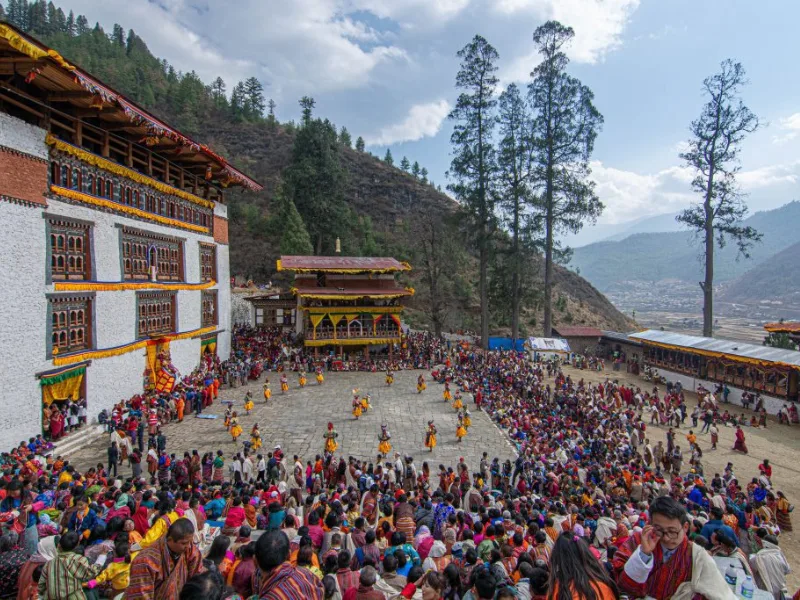
Across five days, the festival’s Cham dances tell stories from Buddhist mythology and re-enact episodes from Guru Rinpoche’s life.
👹 Dance of the Gings
Performed on the festival’s fifth day, dancers embodying protective deities use ritual implements in a dynamic performance representing the subjugation of negative forces.
🃏 Atsara Clowns
Comic figures who move between the formal Cham dances, providing levity and interpreting the dances’ meaning for the watching crowd between more solemn performances.
🌅 The Thongdrel Unveiling
The festival’s true climax: at dawn on the final day, the 18th-century tapestry is unveiled on the dzong’s outer wall, displayed only briefly before being rolled away.
According to tradition, all of these dances and their precise choreography have remained unchanged for centuries, considered exact reenactments of episodes witnessed by Bhutan’s great Buddhist saints. The festival also includes the Dzongdrakha Tshechu, a smaller companion celebration held simultaneously the day before and after the main festival at nearby Dzongdrakha Monastery — an option worth considering for visitors with extra time in the valley.
From a Pauper's Fortress to Bhutan's Most Famous Dzong
Rinpung Dzong’s origin story is more layered than its grand 17th-century reconstruction suggests. In the 15th century, two brothers — Gyelchok and Gyelzom, descendants of the Tibetan saint Phajo Drugom Zhigpo — settled in the Paro Valley. While Gyelzom established himself at Gangtakha Monastery, Gyelchok travelled to Tibet to study theology. Upon his return, however, he was rejected by the local community for his poverty, and even renounced by his own brother. Undeterred, Gyelchok built a modest five-storied structure at a site called Humrelkha — the building that would eventually grow into Rinpung Dzong.
In 1644, recognising the rising authority of Zhabdrung Ngawang Namgyal, Gyelchok formally handed over the fort. The Zhabdrung then expanded it into the grand fortress that stands today, completed by 1646, with La Ngonpa Tenzin Drugda installed as the first Penlop (governor) overseeing both spiritual and temporal governance across the region. What began as one impoverished man’s modest structure became, within two centuries, the venue for what is now considered Bhutan’s most celebrated annual festival.
Why Paro Tshechu Is Bhutan's Premier Festival
Among Bhutan’s nearly twenty annual Tshechus, several genuine factors set Paro apart.
A Thongdrel With a Genuine Survival Story
Few sacred objects in Bhutan carry the same weight of documented history — surviving both a major earthquake and a devastating fire across more than two centuries.
Held at One of Bhutan's Most Architecturally Significant Dzongs
Rinpung Dzong is on Bhutan's Tentative List for UNESCO World Heritage status, and has featured in international film productions including 1993's Little Buddha.
A Full Five-Day Programme
Unlike shorter regional festivals, Paro Tshechu's five-day duration allows visitors genuine time to absorb the full ritual sequence, not just a single highlight day.
Located Just Minutes From the Airport
Rinpung Dzong sits roughly two kilometres from Paro International Airport — making this Bhutan's most logistically accessible major festival.
Spring Weather at Its Finest
Late March and early April bring mild temperatures, rhododendron bloom in the surrounding hills, and excellent mountain visibility.
A Companion Festival Next Door
The simultaneous Dzongdrakha Tshechu at nearby Dzongdrakha Monastery offers visitors an additional, smaller-scale festival experience within the same valley.
What Makes This Paro Tshechu Tour Different
Many operators treat Paro Tshechu as a routine highlight. We build this trip around the festival’s genuine history and significance.
The Real Thongdrel Story, Properly Told
The 1906 fire, the dzong's earlier history, the 15th-century origin story of Gyelchok and Gyelzom — all verified against multiple sources, because this festival's depth comes from understanding what you are actually witnessing.
Positioned for the Dawn Unveiling
We plan your final festival morning specifically around early arrival for the Thongdrel ceremony, since the best viewing positions fill quickly before dawn.
A Complete Western Circuit
Paro, Thimphu, and Punakha are all properly covered, including the Tiger's Nest hike, not just the festival days.
A Guide Who Explains Every Dance
We assign guides who can properly explain the significance of dances like the Dance of the Gings as they happen.
Accommodation Secured Early
Given how much demand the Paro Tshechu generates, we prioritise securing your accommodation as early as possible.
Full Support Before, During & After
Visa, SDF, all bookings — handled entirely. We remain available throughout your trip and after you return home.
8-Day Paro Tshechu Tour Itinerary — Day by Day
Every site, every festival day, every reason this route is sequenced this way — described in full.
DAY 1
Arrival Day · Paro
📍 Paro International Airport · Sightseeing & Acclimatisation
Arrival in Paro, just two kilometres from Rinpung Dzong itself. An afternoon visit to Kyichu Lhakhang, believed founded in the 7th century, and a gentle walk through Paro town.
DAY 2
Festival Preparation
📍Rinpung Dzong & Ta Dzong (National Museum) · Paro Valley
Visit Rinpung Dzong’s grounds before the festival begins in earnest, and Ta Dzong, the 1649 watchtower now housing Bhutan’s National Museum, just above the dzong.
DAY 3
The Festival · Day One
📍Witness Paro Tshechu — Opening Cham Dances at Rinpung Dzong
A full day at Rinpung Dzong witnessing the festival’s opening sacred Cham dances, performed by monks and lay dancers in elaborate costume to the sound of drums, cymbals, and horns.
🎭 Inside the Fortress on a Heap of Jewels
The atmosphere within Rinpung Dzong’s historic courtyard during the festival’s opening days is genuinely extraordinary — thousands of Bhutanese in their finest gho and kira, gathered in a fortress that has stood since 1646 and survived both earthquake and fire.
DAY 4
The Festival · Thongdrel Day
📍Dawn Unveiling of the Thongdrel — the 18th-Century Tapestry That Survived Fire
A pre-dawn start to secure a good position for the festival’s spiritual climax: the unveiling of the great Thongdrel — the same 18th-century tapestry that survived the 1906 fire — displayed briefly on the dzong’s outer wall before being rolled away.
🌅 A Moment of Genuine Stillness
Thousands gather in silence and devotion as the tapestry is revealed, many believing the simple act of viewing it cleanses a year of accumulated sin. It is, by most accounts, the most moving single moment of the entire Bhutanese festival calendar.
DAY 5
Tiger’s Nest Day
📍Hiking to Paro Taktsang — Tiger's Nest Monastery
The hike to Paro Taktsang, built around the cave where Guru Rinpoche is said to have meditated in the 8th century, sitting roughly 900 metres above the valley floor.
DAY 6
DAY 7
Return to Paro
📍Return to Paro From Punakha being Thimphu
After breakfast, depart from Punakha and drive towards Paro via the scenic Dochula Pass. Along the way, enjoy breathtaking views of the Himalayan mountains, lush forests, and traditional Bhutanese villages. Upon arrival in Paro, check in to your hotel and spend the rest of the day at leisure, exploring the charming valley or relaxing before your departure.
DAY 8
Departure Day
📍Paro International Airport Departure
After breakfast, transfer to Paro International Airport for your onward flight. As your journey through Bhutan comes to an end, take with you cherished memories of stunning Himalayan landscapes, ancient monasteries, vibrant traditions, and the warm hospitality of the Bhutanese people.
We wish you a safe and pleasant journey and look forward to welcoming you back to Bhutan in the future.
Why Book With Us?
We provide authentic Bhutanese experiences, expert guidance, and smooth planning. With us, you’ll enjoy Paro Tshechu safely and comfortably while connecting deeply with Bhutanese traditions.
What’s Included
What's Included & Excluded
Complete transparency — exactly what your festival tour covers.
✓ Included in This Tour
- All meals — breakfast, lunch, dinner and evening tea throughout
- Accommodation throughout on twin/double sharing basis (single supplement available)
- All ground transportation, including airport transfers
- Licensed English-speaking guide for the entire trip
- Tiger’s Nest hike with guide
- Government Sustainable Development Fee (SDF)
- One-time non-refundable Bhutan visa processing fee
- All monument and dzong entry fees
- Full support before, during and after your tour
✕ Not Included
- International flights to/from Paro International Airport
- Bottled drinks and alcoholic beverages
- Travel and medical insurance (strongly recommended)
- Personal expenses — laundry, phone calls, shopping
- Tips and gratuities for guide and driver (appreciated, entirely your choice)
- Unforeseen costs from flight cancellations or weather disruption
This Tour Is Made for You If —
🆕 You're a First-Time Bhutan Visitor
The festival's proximity to the airport, full five-day programme, and easy combination with standard sightseeing make this an ideal introduction.
📸 You Want the Single Most Iconic Bhutanese Image
The dawn Thongdrel unveiling is widely considered the most photographically and spiritually significant single moment in Bhutan's festival calendar.
🌸 You Want Spring's Finest Weather
Late March and early April bring mild temperatures and rhododendron bloom across the western valleys.
📜 You're Drawn to Genuine Historical Detail
The story of a tapestry surviving both earthquake and fire across two centuries adds real depth beyond generic festival description.
⛰️ You Want to Combine the Festival With Tiger's Nest
This itinerary naturally combines Bhutan's most famous festival with its most iconic hike, in the same valley.
✅ You Want Accurate Festival History
If you'd rather understand the genuine origins of Rinpung Dzong and its Thongdrel than receive generic descriptions, this tour is built on exactly that principle.
Why Book Your Paro Tshechu Tour With Kingdom of Happiness Tours?
We provide a smooth and authentic Bhutan experience with expert guides and careful planning. You will enjoy the Paro Tshechu comfortably while connecting with Bhutanese culture in a genuinely informed way.
Accurate Festival History
We tell the genuine story of Rinpung Dzong, the 1906 fire, and the surviving Thongdrel — not a generic festival description.
Completely Private, Always
Every tour we run is private for your specific party — no merging with strangers.
Positioned for the Dawn Ceremony
We plan your final festival morning specifically around early arrival for the Thongdrel unveiling.
Genuinely Researched Content
Every date, dzong history detail, and historical fact on this page is accurate and verifiable.
Early Accommodation Booking
Given the festival's popularity, we prioritise securing your accommodation as early as possible.
Full Support Before, During & After
Visa, SDF, all bookings — handled entirely, with support throughout your trip and after you return.
Book Your Paro Tshechu Festival Tour 2026
Complete the form below and our team will confirm current festival dates, availability, and send you full itinerary and pricing details within 24 hours.
As Bhutan’s most popular spring festival, Paro Tshechu sees significant demand for accommodation and flights. We recommend enquiring at least 3–4 months ahead.
USD $2,150
📞 +975 16108730
💬 WhatsApp: +975 16108730
✉ hello@kingdomofhappinesstours.com
Tour Highlights
- Paro Tshechu — multiple festival days
- Dawn Thongdrel unveiling
- Tiger’s Nest hike included
- Punakha Dzong & Dochula Pass
- Thimphu sightseeing included
- All meals, transport, visa, SDF included
🎭 Festival Dates
Confirmed for 29 March – 2 April 2026 at Rinpung Dzong. We reconfirm exact dates closer to your travel period.
Frequently Asked Questions
Honest, complete answers about Bhutan’s most iconic festival.
Yes — it is one of Bhutan’s most popular festivals, drawing thousands of Bhutanese and a significant number of international visitors, particularly for the dawn Thongdrel unveiling on the final day. Arriving early for the best viewing positions is essential. Despite the crowds, the festival remains genuinely manageable with proper guided planning.
Yes, genuinely well-suited. Paro Tshechu is held just two kilometres from the airport, requiring minimal additional travel, and easily combines with the country’s standard highlights — Tiger’s Nest, Punakha Dzong, and Thimphu’s major sites. As Bhutan’s most famous festival, it also gives first-time visitors a comprehensive introduction to Bhutanese Cham dance tradition.
Paro International Airport is Bhutan’s only international airport, served by direct flights from several regional hubs. The dzong itself is only a few minutes’ drive from the airport, making Paro the most logistically accessible major festival location in the country.
Yes — we can extend the itinerary to include Bumthang or Phobjikha, adjust the number of days in Paro or Punakha, or rearrange the route to suit your interests. Please tell us your priorities when you enquire.
The Thongdrel is a massive appliqué tapestry, in this case an 18th-century work depicting Guru Rinpoche, created by Lama Nawang Rabgay using materials brought from Lhasa, Tibet. It famously survived a devastating 1906 fire that destroyed much of Rinpung Dzong’s interior. Each year, it is unveiled on the dzong’s outer wall before dawn and displayed for only a few hours, as tradition holds the sacred image loses its spiritual power if exposed to direct sunlight for too long. Viewing the Thongdrel is believed by Buddhists to cleanse sins and bring spiritual merit.
Witness the Tapestry That Survived Fire, 2026
Seven days. A fortress that has stood since 1646. A sacred tapestry that survived both earthquake and fire. The dawn unveiling that thousands travel across the kingdom to witness each spring. This is Bhutan’s most iconic festival, accurately described and properly experienced.
“Gross National Happiness is more important than Gross National Product.” — His Majesty Jigme Singye Wangchuck, Fourth King of Bhutan