Is Bhutan Safe to Visit

Is Bhutan Safe to Visit? An Honest 2026 Safety Guide

Yes — and the things that will actually hurt you here have nothing to do with crime. What four governments say, the real risks ranked by likelihood with police data behind them, the insurance clause that quietly voids half of all policies, and what our own drivers do differently.

Is Bhutan Safe

Bhutan is one of the safest countries in Asia for travellers — and the things that will actually hurt you there have nothing to do with crime.

Every major government advisory places Bhutan in its lowest risk tier. Violent crime against tourists is close to non-existent. There are no touts, no scams, no pickpocket districts. But “safe” gets used lazily in travel writing, and it hides the real picture. The honest version is a ranking, not a reassurance: 

Risk
Actual Likelihood on Your Trip
Being a victim of crime
Very low
A road accident
The single biggest risk you face
Altitude sickness
Moderate, and widely underestimated
Needing medical care far from a hospital
Moderate — facilities thin out fast outside Thimphu
Monsoon landslides blocking your route
High in June–September
A stray dog encounter
Common, rarely serious
An earthquake or glacial flood
Low probability, high consequence

This guide takes each in turn, with real numbers. The police accident data, the glacial-lake research, the calculated fatality rate and the insurance analysis below do not appear in other Bhutan travel safety articles, and they are the parts that would actually change a decision.

What the governments actually say

Start with primary sources rather than blogs. As of August 2026:

Government
Advisory Level
Last Reviewed
United States (State Department)
Level 1 — Exercise Normal Precautions (lowest of four)
Reissued 20 October 2025 after periodic review, without changes
Australia (Smartraveller)
Exercise normal safety precautions (lowest of four)
Current
United Kingdom (FCDO)
No active travel warnings for any part of the country
Updated 10 December 2025

For context: Level 1 is the tier the US assigns to Japan, Iceland and most of Western Europe. Very few countries in Asia hold it.

One consequence worth knowing before you go. The US, Australia and the UK have no embassy in Bhutan. American and Australian consular assistance is provided from New Delhi. If something goes seriously wrong, help is a phone call and a border away, not a taxi ride. India, Bangladesh and a handful of other countries maintain missions in Thimphu.

That single fact should shape one decision: buy travel insurance with genuine medical evacuation cover, and read the altitude clause. There is a whole section on that below, because most people get it wrong.

Bhutan safety for tourists: crime

This is the part everyone worries about, and the part that matters least.

Australia’s Smartraveller states plainly that “Bhutan’s crime rate is low” and “violent crime is not common.” Independent safety assessments consistently rank Bhutan among the safest countries in the world, and the lowest-crime country in South Asia.

What that means on the ground
  • No touts. Nobody will follow you down a street in Thimphu trying to sell you anything. This is genuinely disorienting if you have arrived from elsewhere in South Asia.
  • No scams. There is no taxi scam, no gem scam, no “the temple is closed today” scam. The infrastructure of tourist exploitation simply has not developed here.
  • No aggressive haggling culture. Prices are largely fixed and largely honest.
  • Violent crime against foreigners is close to unheard of.
What does happen
  • Petty theft, particularly in Thimphu and Phuentsholing — opportunistic, from unattended bags and hotel rooms, not from your person.
  • Drug and alcohol-related arrests have risen, per the Australian advisory. This mostly concerns young Bhutanese, but the penalties apply to visitors too and they are severe.
  • Phuentsholing, as a busy open border town, has more ordinary petty crime than anywhere else you will go.

Still do the basics: use the hotel safe, don’t leave a bag on a café chair, split your cash between two places, and keep a photo of your passport and permit somewhere separate. Not because Bhutan is dangerous, but because losing your permit in a country with no embassy for your nationality is an expensive inconvenience.

For context: Level 1 is the tier the US assigns to Japan, Iceland and most of Western Europe. Very few countries in Asia hold it.

1. Roads — by a wide margin the biggest risk

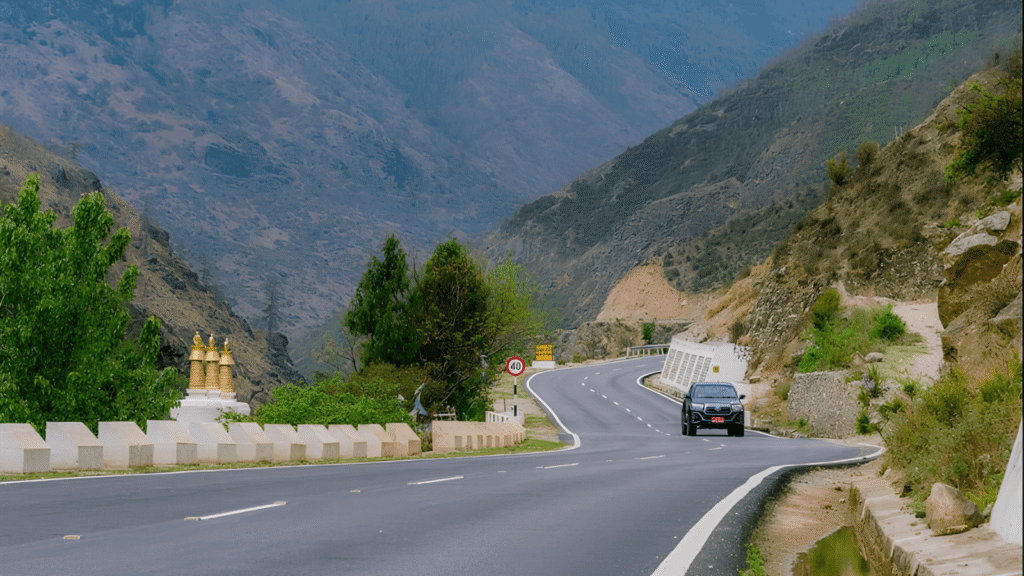
Every advisory says the same thing, and they are right. Smartraveller flags “narrow, winding mountain roads” that deteriorate after heavy rain. Bhutan’s own safety guidance calls road traffic “the highest safety risk for travellers in Bhutan.”

The real numbers, from the Royal Bhutan Police
Year
Accidents
Deaths
Injuries
2022
780
2023
1,062
~105
1,063
2024
~1,120
~90
~630

Thimphu records the most accidents — around 300 in 2024 — followed by Phuentsholing and Punakha. Single-vehicle accidents are the most common type, at 534 in 2024, followed by two-vehicle collisions. Police cite speeding, drunk driving and poor vehicle maintenance as the leading causes.
Putting that in perspective — our own calculation, so you can check it. Roughly 90 road deaths in a population of about 802,000 gives a road fatality rate of approximately 11 per 100,000 people per year (90 ÷ 802,000 × 100,000 = 11.2). That is several times the rate in Western Europe. The good news buried in the same data: deaths and injuries fell between 2023 and 2024 even as accident numbers rose — crashes appear to be getting less severe.

Why the roads are demanding. The Phuentsholing–Thimphu highway climbs from about 300 m to 2,300 m over roughly 170 km. Continuous hairpins, frequent single-lane sections, sheer drops without guardrails, and an average highway speed of 30–35 km/h. Nothing about it is reckless; it is simply mountain driving, all day, every day.

How to reduce this risk to almost nothing

Use a licensed driver.

Bhutanese tourist drivers are professional, cautious and know every corner.

Never travel by road at night.

No street lighting, free-roaming cattle, no shoulder on the drop side.

Wear a seatbelt

 back seats included.

Don't rush your itinerary.

Pressure on a driver to make up time is how mountain accidents happen.

Avoid self-driving

unless experienced on mountain roads. A local driver often costs less than the vehicle green tax anyway.

Sit on the inside

on exposed stretches if it makes you calmer. People do this; nobody minds.

What our drivers actually do differently

“Use a licensed driver” is advice every article gives and none explains. This is what it means in practice, from our own operating rules — and they are reasonable questions to ask any operator you are considering.

01

A departure cut-off, not a departure time

Every leg has a latest-start time calculated backwards from sunset, and it moves with the season. If a group is running late enough to breach it, the leg is shortened or the night is moved — the driver does not make it up on the road.

02

The long eastern legs are never squeezed

Bumthang to Mongar over Thrumshing La at 3,780 m is six to seven hours in good conditions. In monsoon it is split across two days, or it is not offered at all.

03

Vehicles are checked on brakes and tyres, not on looks

Continuous descent from a 3,400 m pass is brake work, not engine work. Ask an operator when the vehicle’s brakes were last serviced. The answer tells you a great deal.

04

The guide carries the itinerary's slack, and knows it

Guides are told in advance which sight is droppable on each day. That is what stops a delayed morning turning into a rushed mountain afternoon.

05

A 24-hour number that reaches a person in Bhutan

Not a call centre and not an email address — someone who can reroute a vehicle, call a hospital in Thimphu, or talk to a hotel at 23:00.

Ask us these directly. How many years has the driver been on this route? How old is the vehicle and when were the brakes last done? What is the latest we will still start the Punakha leg in December? Who answers the phone at midnight? We would rather answer that before you book than have you find out afterwards — and an operator who cannot answer them is telling you something.

2. Altitude

Australia’s advisory is blunt: altitude sickness “can be life-threatening. It can affect anyone, even if you’re physically fit.” Risk begins around 2,500 m, and a standard Bhutan itinerary lives above that from the moment you land.

The Elevation Ladder
Punakha
~1,250 m
Paro (airport)
2,235 m
Thimphu
2,320 m
Bumthang
~2,600–2,800 m
Phobjikha
~3,000 m
Dochula Pass
~3,100 m
Tiger's Nest
3,120 m
Chele La Pass
3,988 m
Trekking passes
4,500–5,300 m

Symptoms to know: headache, nausea, breathlessness, dizziness, poor sleep, loss of appetite. Mild symptoms between 2,300 m and 3,100 m are common and usually resolve within a day or two.

Warning signs that mean descend immediately: confusion, loss of coordination, breathlessness at rest, a persistent cough, or a headache that does not respond to painkillers. These can indicate HACE or HAPE, both of which are emergencies. Tell your guide the moment any of them appear — descending 500 m is the treatment, and in Bhutan that is usually a short drive rather than a rescue.

A 48-hour altitude plan that actually works

This is the pacing we build into every western-valley itinerary, and it costs nothing to follow.

Day 1
Land at Paro, 2,235 m. Valley-floor sightseeing only — Rinpung Dzong, the National Museum, Kiychu. No climbing, no pass. Drink far more water than feels necessary and go easy on alcohol. An early night beats an evening out.
Day 2
Thimphu, 2,320 m. Still essentially flat. Buddha Dordenma, the Memorial Chorten, the market. If anyone in the group has a headache, this is the day it shows — and it is the day to say so, not to push through.
Day 3
A short walk with real gain — Tango or Cheri, about an hour up. This is a deliberate test: it tells you and your guide how the group handles ascent before the day that matters.
Day 4
Tiger's Nest, finishing at 3,120 m. By now you have had three nights above 2,200 m and one honest practice climb. This is the single most effective change most itineraries could make.

Other rules that matter: on treks, take the acclimatisation days — they are in the itinerary for a reason and skipping one to gain a day is the commonest cause of a trek being abandoned. And talk to your doctor about acetazolamide before you travel if you are going high or have had altitude problems before.

3. Medical care and evacuation

This is the risk most visitors do not think about, and the one most worth insuring against.

Thimphu has the national referral hospital, JDWNRH. Outside the capital, facilities thin out quickly — Australia’s advisory notes that “medical facilities outside Thimphu are limited.” There is no reciprocal healthcare agreement with most countries, so you pay for everything. Serious cases are evacuated to India or Thailand, and from a trekking route or eastern Bhutan that can mean a helicopter first.

Facility Phone
JDWNRH — national referral hospital, Thimphu +975-2-322496 / 328091
Paro General Hospital +975-8-271260
Phuentsholing General Hospital +975-5-252204
Trashigang District Hospital +975-4-521113

Pharmacies exist in Thimphu and Paro but stock is limited. Bring everything you personally need, in original packaging, with a copy of the prescription. Do not assume you can replace a medication in Bhutan.

The insurance clause that quietly voids policies

Proof of travel insurance forms part of the visa application for international visitors, so almost everyone buys something. Most people buy the cheapest policy that satisfies the paperwork, and a great many of those policies would not pay out for the thing most likely to happen in Bhutan.

The problem is the altitude exclusion. Standard leisure policies commonly cap cover at 2,000 m, 2,500 m, 3,000 m or 4,000 m, and exclude “mountaineering” or “trekking above” a stated height. Read that number against the ladder above:

If your policy caps at... What it excludes in Bhutan
2,000 m Effectively your entire trip. Paro airport alone is 2,235 m.
2,500 m Phobjikha, Dochula, Tiger's Nest, Chele La, Bumthang — most of the itinerary's highlights.
3,000 m Tiger's Nest (3,120 m), Dochula (3,100 m), Chele La (3,988 m), all trekking.
4,000 m All trekking above Jomolhari base camp; Nyile La is 4,890 m.
No stated cap, hiking included Usually fine for a cultural itinerary. Still confirm trekking is named.
Four things to check before you buy
  1. The altitude limit, in metres — and whether it applies to “trekking”, “hiking” or both. Tiger’s Nest is a day hike on a maintained trail, but it finishes at 3,120 m.
  2. Helicopter evacuation, named explicitly. “Medical evacuation” in a policy summary does not always mean rotary-wing rescue from a valley with no road.
  3. Repatriation, not just treatment. Treatment may happen in Bangkok; getting home afterwards is a separate line.
  4. Whether the insurer has a 24-hour line that answers from a +975 number. Test it before you fly. It takes two minutes.

We are not selling insurance and we do not take a commission on it. We say this because the advice is worth more coming from someone with nothing to gain: buy the policy that names your maximum altitude and includes helicopter evacuation, even if it costs three times the cheapest one that satisfies the visa requirement. The gap between those two prices is smaller than one night in a Bangkok hospital.

4. Monsoon: landslides and flooding

Smartraveller warns that “flooding and landslides can occur with little warning,” particularly June to September. This is less a danger than a logistics risk. Landslides regularly close Bhutanese highways for hours and occasionally for a day or more. Combined with Paro’s weather-dependent flights, monsoon travel means real schedule uncertainty.

If you travel June to August: build slack into the itinerary, keep a buffer night before any international flight, and accept that a day may be lost. Do not book anything unmissable for the day after you leave Bhutan. Our month-by-month weather guide has the rainfall figures behind this.

5. Stray dogs

Bhutan has a large free-roaming dog population, especially in Thimphu and Paro. They are generally placid by day and gather into barking packs at night.

Don’t walk alone through towns late at night, don’t approach or feed them, and don’t run past them. If you are bitten or scratched, wash the wound thoroughly with soap and running water and seek medical attention promptly — rabies exists in the region and post-exposure treatment is time-sensitive. If you are planning a long trip, remote trekking, or travelling with children, discuss pre-exposure rabies vaccination with a travel clinic.

You will also lose some sleep. Earplugs are a serious recommendation, not a joke — they are the single most-thanked item in our pre-departure notes.

6. Earthquakes

Bhutan sits in a seismically active zone along the Himalayan collision front, and Australia’s advisory notes simply that earthquakes “can happen anytime.”

The probability of one during a one-week trip is very low. Know the basics — drop, cover, hold on; move away from windows; expect aftershocks — and move on. The traditional rammed-earth buildings you will admire are, honestly, not the strongest structures in an earthquake, but this should not change your plans.

7. Glacial lake outburst floods

Almost no travel article covers this, and it is a genuinely Bhutan-specific hazard worth understanding. As Himalayan glaciers melt, meltwater pools behind unstable moraine dams. When a dam fails, the lake empties down the valley in a matter of hours.

Research published in 2026 assessed 278 glacial lakes in Bhutan and classified one as very high hazard, five as high hazard and 22 as moderate hazard. Thorthormi Tsho is the most critical. The study found downstream exposure of more than 11,000 people, 2,500 buildings, 250 km of roads, 400 bridges and four hydropower dams, across all seven of Bhutan’s major river basins — with the Punatsangchu basin containing the most lakes studied.

Bhutan operates 13 monitoring stations across three basins, but coverage is partial: the study found at least 41% of exposed buildings lack early-warning coverage, and some communities would receive only 15–30 minutes of warning.

What this means for you. On a normal cultural itinerary, essentially nothing — the probability during your specific week is very small and the exposure is overwhelmingly to residents and infrastructure rather than tourists. It matters if you are trekking the high northern valleys — Lunana, Laya, upper Punakha — where you would be inside an exposed corridor. Trek with a licensed operator who monitors conditions, and if a guide tells you to move camp, move without debating it.

8. Wildlife and leeches

Bhutan has tigers, leopards, bears and snakes, and you will almost certainly see none of them. Himalayan black bears are the one to respect on remote trails — make noise while walking.

Leeches are a certainty on lower forest trails during monsoon. Harmless, revolting, and best handled with salt, DEET on your boots and socks tucked into trousers.

Dengue and malaria occur in the southern lowlands — Phuentsholing, Gelephu, Samdrup Jongkhar — not in the high valleys where most itineraries stay. Use repellent in the south.

Bhutan travel safety: health, food and water

  • Water: don’t drink the tap water. Bottled and filtered water is universally available; better still, carry a bottle with a filter and cut the plastic.
  • Food: hotel and restaurant food is generally safe and hygiene standards are good. Bhutanese food is very chilli-heavy, so the most common digestive complaint among visitors is simply heat, not contamination. Ease into ema datshi.
  • Vaccinations: check with a travel clinic well ahead. Routine vaccinations up to date; hepatitis A and typhoid commonly advised; rabies pre-exposure worth discussing for longer or remote trips. A yellow fever certificate is required only if you are arriving from a country with risk of transmission.
  • Sun: at 3,000 m the UV is severe even when the air is cold. Sunburn and snow-glare are genuine, common problems — in January as much as in June.

Is Bhutan safe for solo female travellers?

Yes — it is one of the most comfortable destinations in Asia for women travelling alone.

Harassment is rare, and women hold a traditionally high social standing in Bhutanese culture. Inheritance in much of Bhutan passes through the female line, which is unusual in the region and shapes attitudes in ways visitors notice within a day.

  • You can request a female guide. Most operators can arrange one — ask at the point of booking rather than on arrival.
  • The usual night-time caution applies, mostly because of dogs, unlit streets and uneven pavements rather than people.
  • Dress modestly, which you will be doing anyway for temple access.
  • Solo travel means paying for a whole guide and vehicle yourself, so the real barrier for solo women in Bhutan is cost, not safety. Our cost guide shows exactly how that arithmetic works.

Is Bhutan safe for LGBTQ+ travellers?

Legally, yes — and this changed recently. Bhutan decriminalised consensual same-sex activity between adults when the Penal Code (Amendment) Act received royal assent on 17 February 2021, following a joint sitting of both houses of parliament on 10 December 2020. Section 213, which had criminalised “unnatural sex,” was amended to state explicitly that homosexuality between adults is not an offence.

Socially, it is more nuanced. Bhutan is a conservative, traditional society. There is no visible LGBTQ+ scene, same-sex marriage is not recognised, and legal protections are limited. Reports of hostility toward visitors are rare, but public displays of affection — of any orientation — are not part of Bhutanese public culture, and discretion is the norm for everyone.

In practice: same-sex couples travel in Bhutan without difficulty. Book a twin room if you would rather not have a conversation about it, though a double is unlikely to raise comment. The change in the law is recent and real, and Bhutan handled it with considerably more grace than several of its neighbours.

Families and older travellers

Families: Bhutan is excellent for children. Low crime, clean air, a gentle pace, and under-fives pay no SDF and no monument entry fees. The real constraints are altitude — go gently for the first two days — long winding drives, where motion sickness is common, and limited paediatric care outside Thimphu.

Older travellers: entirely feasible and common. The considerations are altitude, the amount of walking on uneven stone inside dzongs, and the Tiger’s Nest hike, where the cafeteria and the viewpoint are legitimate turnaround points that nobody should feel short-changed by. Discuss altitude with your doctor if you have cardiac or respiratory conditions.

Laws that catch visitors out

Bhutan is gentle, but its laws are not always what you expect.

  • Drugs: penalties are severe. Australia’s advisory flags this explicitly. There is no leniency for tourists.
  • Smoking is banned in public places. Tobacco carries heavy duty; declare what you bring.
  • Alcohol should be consumed in licensed venues. Tuesday has traditionally been observed as a dry day, with sales restricted — check locally.
  • Do not criticise the monarchy, including on social media. Smartraveller specifically warns against offensive comments about the royal family. The King is genuinely revered; this is not a rule people resent.
  • Drones require prior written permission and restrictions are enforced.
  • No photography inside temples. At Tiger’s Nest, phones and cameras go into lockers at the entrance.
  • Mountaineering above 6,000 m is banned out of respect for the deities said to inhabit the peaks.
  • Modest dress is expected, not only at religious sites — see our dress code guide.
  • Currency limits apply to Indian nationals: notes up to ₹500 and a ₹25,000 total, with anything above that in ₹100s or lower. Declare foreign currency over USD 10,000.

If something does happen: what to actually do

Four situations account for nearly everything we have dealt with in practice. Here is the sequence for each. 

Bite

A dog bite or scratch

Wash the wound with soap under running water for a full fifteen minutes — this is the step that matters most and the one people rush. Tell your guide immediately. Get to a hospital the same day; post-exposure rabies treatment is time-sensitive and available in Thimphu and Paro. Do not wait to see whether it looks infected.

Head

Altitude symptoms that are not improving

Say so out loud rather than pushing on. Stop ascending. If a headache does not respond to painkillers, or there is confusion, unsteadiness or breathlessness at rest, descend — in the western valleys that means driving to Punakha at 1,235 m, which is usually two to three hours and is the definitive treatment.

Road

A landslide blocks the route

Your guide calls the operator, not the other way round. Expect a wait of hours rather than days; the Department of Roads clears the main highways quickly. The decision that matters is whether to wait, reroute or stop for the night — and it should be made against the sunset cut-off, not against the itinerary.

Flight

Your Paro flight is cancelled

This is why the buffer night exists. Drukair and Bhutan Airlines rebook onto the next available service, but seats are finite in October and November. If you have no buffer night and an onward international connection, the overland route to Bagdogra or Guwahati is the fallback — a long day, but it works. Our flights guide covers the connection rules.

Emergency numbers

Save these before you land — not on arrival, when you may have no data.

Save to your phone now
Police 113
Ambulance 112
Fire 110
Tourist helpline 1199
Disaster management 233
US Embassy, New Delhi +91 11 2419 8000

These work from any Bhutanese mobile — local SIM or roaming — and from landlines, but you need mobile coverage, and coverage disappears on trekking routes and in remote eastern valleys.

Also save: your guide’s number, your operator’s 24-hour line, your hotel, your insurer’s emergency line, and the number of your country’s mission in New Delhi if it has no embassy in Thimphu. Buy a local SIM at the border or airport — Bhutan Telecom or TashiCell, around ₹200–400 — which is cheaper than roaming and more reliable in the valleys. 

Fifteen precautions that actually matter

  1. Never travel by road at night. The highest-value rule in this entire guide.
  2. Buy insurance with medical evacuation, and check the altitude limit in metres.
  3. Schedule Tiger’s Nest for day three or four, not day one.
  4. Keep a buffer night before any international flight out of Paro.
  5. Save the emergency numbers and your guide’s number before you arrive.
  6. Photograph your passport, permit and insurance policy; store copies offline and email them to yourself.
  7. Don’t drink the tap water.
  8. Carry your own medication in original packaging with the prescription.
  9. Wash any dog bite or scratch thoroughly and seek care the same day.
  10. Wear a seatbelt, back seats included.
  11. Take altitude symptoms seriously. Tell your guide rather than pushing through.
  12. Don’t rush your driver. Ever.
  13. Carry cash in two places and use the hotel safe.
  14. Register with your government’s traveller programme — STEP for US citizens, or the equivalent.
  15. Trek only with a licensed operator. It is the rule, and in the high valleys it is also the safety system.

Frequently asked questions

Yes. The US State Department rates Bhutan Level 1, “Exercise Normal Precautions” — its lowest risk tier, reissued in October 2025 — and Australia and the UK give equivalent guidance. Crime against tourists is very rare; the main Bhutan travel safety risks are road accidents, altitude and limited medical access outside Thimphu.

Four things: use a licensed driver and never travel by road after dark, schedule Tiger’s Nest for day three or four so you acclimatise first, buy insurance with medical evacuation cover and check its altitude limit in metres, and leave a buffer night before your flight home. Those four decisions address almost every real risk.

Road travel, by a wide margin. Bhutan’s mountain highways are narrow and winding, and the Royal Bhutan Police recorded around 1,120 accidents and roughly 90 deaths in 2024 — a fatality rate of about 11 per 100,000 people. Using a licensed driver and never travelling at night reduces this risk dramatically.

Yes — it is among the most comfortable countries in Asia for women travelling alone. Harassment is rare and women have traditionally high social standing, with inheritance passing through the female line in much of the country. You can request a female guide when booking. The main barrier for solo travellers is cost, since guide and vehicle are charged per day regardless of group size.

Very little. Australia’s advisory states that Bhutan’s crime rate is low and violent crime is uncommon. Petty theft occurs, mainly in Thimphu and Phuentsholing, and drug and alcohol-related arrests have been rising. There are no touts and no tourist-scam infrastructure at all.

Yes — proof of travel insurance forms part of the visa application for international visitors. Buy a policy with medical evacuation and repatriation cover that names helicopter evacuation explicitly, and check its altitude limit. Many standard policies exclude cover above 2,500 m or 3,000 m, which would exclude Tiger’s Nest at 3,120 m and most of a normal itinerary.

Is Bhutan Safe

Bhutan is safe, and the reasons it is safe are structural rather than lucky. Low crime, a tourism model built on quality rather than volume, licensed guides and drivers, and a society where visitors are treated as guests rather than as a resource.

What that means is that Bhutan safety for tourists is mostly about the mountain, not the people. The genuine risks are a winding road after dark, a headache at 3,120 m ignored for too long, a hospital four hours away, and a monsoon landslide between you and your flight home.

Every one of those is manageable with the same four decisions: use a licensed driver and never travel after dark, acclimatise before you climb, buy insurance that covers evacuation at your actual maximum altitude, and leave slack in your itinerary. Do that, and Bhutan will be one of the least stressful countries you ever travel in.

Ask us the questions this page raises

Driver experience and vehicle servicing, how we pace altitude, what our 24-hour line actually does, and what your insurance policy needs to say. We will answer all of it before you book, in writing, and we will tell you if your existing policy has an altitude cap that would exclude the trip you are planning.