Pemagatshel Tshechu Festival Tour The Blissful Land of the Lotus
Pemagatshel translates from Dzongkha as “Blissful Land of the Lotus” — a name given to the district by the revered Buddhist master Dudjom Rinpoche, who is said to have observed that the surrounding landscape, viewed from a particular vantage point, resembles a fully bloomed lotus flower. This is one of Bhutan’s smallest and least-visited districts, reached only after a genuinely long overland journey through the country’s eastern dzongkhags — and its annual Tshechu, held at a dzong built only in the early 1980s, is among the youngest dzong-based festival traditions anywhere in the kingdom.
Discover Bhutan's Far Southeast — Genuinely Beyond Where Most Tours Reach
We want to be completely honest from the outset: Pemagatshel is among the most remote and least internationally visited districts in all of Bhutan. It is one of the country’s smallest dzongkhags by land area — just 517.8 square kilometres of highly dissected mountain terrain, steep slopes, and narrow valleys with very little flat ground — and reaching it requires a substantial overland journey through nearly the entire length of the country, continuing east past Mongar and Trashigang along Bhutan’s southern highway corridor.
The district’s name carries a genuinely lovely story. Until 1970, this area was known as Khoi Dung. It was the revered Nyingma Buddhist master Dudjom Rinpoche who renamed it Pemagatshel — “Pema” meaning lotus, “gatshel” meaning blissful land — after observing that the surrounding landscape, when viewed from the site of the old Pemagatshel dzong, resembles a fully bloomed lotus flower. The district remains true to that name in character: forested, agriculturally rich, and known across Bhutan for crafts found nowhere else in quite the same form — finely woven raw silk kiras using techniques called Lungsermo and Aiekapur, hand-crafted ritual instruments including jalings (oboe-like horns) and dhungs (long ceremonial trumpets) used in monasteries throughout the kingdom, and a distinctive local sweet called Tsatsi Buram, made from the region’s abundant sugarcane.
What makes the Pemagatshel Tshechu itself unusual is its youth. Unlike Punakha Dzong (1637) or Trongsa Dzong (1648), Pemagatshel Dzong was constructed only in the early 1980s — meaning the three-day Tshechu now held there annually is among the most recently established dzong-based festival traditions in the entire country, a living demonstration that Bhutan’s Tshechu tradition has continued to grow and adapt even in the modern era, not simply a relic preserved from the distant past.
“A master once looked at this valley and saw a lotus in bloom. Reaching it today still takes the better part of two weeks from Paro — and that, more than anything else, is what keeps it genuinely blissful.”
This 12-day journey takes the complete west-to-far-east route through Bhutan, covering the standard western circuit before continuing through Trongsa, Bumthang, Mongar, and Trashigang to reach Pemagatshel specifically for its Tshechu. Festival dates follow the Bhutanese lunar calendar and can shift slightly year to year; we confirm current dates with official sources before finalising your booking.
🪷 We confirm exact dates before booking
As a lunar-calendar festival, the Pemagatshel Tshechu’s date can shift slightly. We verify against current published sources before finalising your itinerary.
Tour at a Glance
Everything you need to know about this Pemagatshel Tshechu Festival Tour at a glance.
🗓️ Duration
12 Days / 11 Nights
📍Destinations
Samdrup Jongkhar → Pemagatshel→ Mongar-Bumthang-Trongsa-Punakha-Thimphu-Paro
🎭 Festival Focus
Pemagatshel Tshechu
🏨 Accommodation
3-Star Hotels & Resorts
🚙 Throughout
Private Vehicle & Guide
👥 Group Size
1 – 10 Guests
💰 Starting Price
From USD $2,950 Per Person
🛂 Documents Needed
Entry Permit + Special Area Permit
The Lotus Legend — How a Revered Master Renamed This District
Before 1970, the district now known as Pemagatshel was called Khoi Dung. Its renaming is attributed to Dudjom Rinpoche, one of the most revered lamas of the Nyingma school of Tibetan Buddhism in the 20th century. According to local tradition, Dudjom Rinpoche observed the landscape surrounding the site of the old Pemagatshel dzong and noted that, viewed from this particular vantage point, the terrain resembles a fully bloomed lotus flower — its valleys and ridgelines forming the petals of the sacred Buddhist symbol. He renamed the district accordingly: Pema, meaning lotus, and gatshel, meaning blissful land — together, “the Blissful Land of the Lotus.”
The district lives up to this poetic origin in tangible ways. Over half of Pemagatshel remains covered by broadleaf and coniferous forest, with the remainder given to farmland producing maize, potatoes, oranges, bananas, and sugarcane. The district’s elevation ranges from 1,000 to 3,500 metres across its compact 517.8 square kilometres — a remarkable range of altitude and microclimate packed into one of Bhutan’s smallest dzongkhags.
What Pemagatshel Is Known For — Genuine Local Specialties
Beyond the festival itself, Pemagatshel is recognised across Bhutan for specific traditional crafts and produce found in this concentrated form nowhere else in the country.
🧵
Bura Silk Weaving
Pemagatshel’s weavers produce fine kiras from raw silk (bura), with the Lungsermo and Aiekapur patterns recognised as particular regional specialties.
🎺
Jalings & Dhungs
Hand-crafted ritual instruments — oboe-like jalings and long ceremonial trumpets called dhungs — made here are prized and sold across Bhutan for use in monastery ceremonies nationwide.
🍬
Tsatsi Buram
A distinctive local sweet made from Pemagatshel’s abundant sugarcane harvest, well-liked throughout the country as a regional delicacy.
🎵
The Ausa Folk Song
Pemagatshel’s most notable folk song, traditionally sung during the departure of family members, friends, and relatives — a genuine piece of regional oral tradition.
One of Bhutan's Youngest Tshechu Traditions
The story behind the Singye Cham is one of the more unusual and tender narratives in Bhutanese religious tradition.
Most of Bhutan’s great Tshechu festivals are held at dzongs built in the 17th century, during the consolidation of the country under Zhabdrung Ngawang Namgyal. Pemagatshel Dzong is a striking exception — constructed only in the early 1980s, it represents one of the most recently established dzong-based festival traditions anywhere in the kingdom, a clear demonstration that Bhutan’s living religious culture has continued to expand and formalise well into the modern era.
The Pemagatshel Tshechu has been celebrated annually over a three-day period since the dzong’s construction — meaning this is a tradition with genuine, recent, living history, established within living memory of many Bhutanese still alive today.
Why Pemagatshel Is Worth the Distance
The journey east is genuinely long. Here is what it delivers in return.
A Genuine Lotus-Shaped Landscape
The legend behind Pemagatshel's name is not abstract — the district's compact, dramatically folded terrain genuinely produces the visual effect Dudjom Rinpoche is said to have observed.
Craft Traditions Found Nowhere Else in This Form
Pemagatshel's bura silk weaving and ritual instrument-making supply monasteries and households across the entire country — this is genuinely productive cultural heritage, not preserved-for-tourism craft.
One of the Most Recently Established Tshechu Traditions
Witnessing a festival tradition still within living memory of its founding offers a different perspective on Bhutanese religious culture than the country's ancient festivals.
Genuinely Minimal International Visitor Presence
Pemagatshel's remoteness from Paro International Airport means very few international visitors ever reach this specific district — a direct, honest consequence of distance, not a marketing claim.
A Complete Cross-Section of Bhutan En Route
The journey east passes through nearly every major region of the country — western valleys, central spiritual heartland, and the linguistically and culturally distinct eastern districts.
The Yongla Gonpa Monastery Nearby
Pemagatshel is home to Yongla Riwo Pelbar Dargeychhoeling Gonpa, widely known as Yongla Gonpa, one of the district's most significant monasteries.
What Makes This Pemagatshel Tour Different
Very few operators properly plan or describe a journey this far east. We build it with the honesty and structure it requires.
A Genuinely Honest 12-Day Structure
We do not compress this journey to make it sound more accessible than it is. Twelve days reflects the real distance involved, not a marketing shortcut.
The Complete Western, Central & Eastern Route
Paro, Thimphu, Punakha, Trongsa, Bumthang, Mongar, and Trashigang are all properly covered route — not rushed past on the way to the festival.
Pemagatshel's Craft Heritage Included
Time built in to see the district's distinctive bura silk weaving and ritual instrument-making — genuine local specialties rarely mentioned in standard Bhutan itineraries.
Genuinely Researched Content
Every distance, date, and historical detail on this page is accurate and verifiable — because a journey this substantial deserves accurate description.
A Guide Who Knows the Far East
We assign guides with genuine familiarity with Bhutan's eastern and southeastern districts, not generalist knowledge of the western circuit alone.
Full Support Before, During & After
Visa, SDF, all bookings — handled entirely. We remain available throughout your trip and after you return home.
12-Day Pemagatshel Tshechu Festival Tour
Every site, every long drive, every reason this route is sequenced this way — described in full.
DAY 1
Arrival at Guwahati Airport → Samdrup Jongkhar
📍 Distance: 110 km | Duration: 3–4 Hours
Upon arrival at Guwahati Airport, meet your Bhutanese guide and begin your journey towards Samdrup Jongkhar, Bhutan’s gateway to the eastern region. As you cross into Bhutan, notice the gradual transition from the bustling plains of Assam to the peaceful Himalayan foothills.
Complete your immigration formalities and enjoy a leisurely evening exploring the border town before settling into your hotel.
DAY 2
Samdrup Jongkhar → Pemagatshel
📍Distance: 150 km | Duration: 6–7 Hours
After breakfast, embark on a scenic mountain drive to Pemagatshel, a beautiful district known for its untouched landscapes, traditional villages, and authentic Bhutanese culture. The winding road climbs through dense forests, terraced farmlands, and charming settlements, offering breathtaking views along the way.
Upon arrival, enjoy the tranquil atmosphere of this lesser-visited region and prepare for the upcoming festival celebrations.
DAY 3
Experience the Pemagatshel Tshechu Festival
📍 Attend Pemagatshel Tshechu
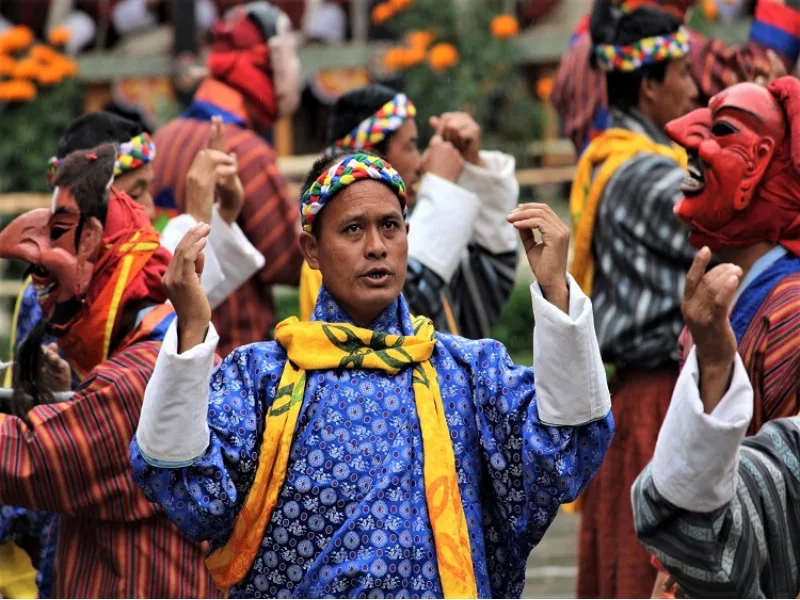
Today is dedicated to one of the highlights of your journey—the vibrant Pemagatshel Tshechu. Join local communities gathered in their finest traditional attire as they celebrate Bhutan’s rich spiritual heritage through sacred mask dances, religious rituals, and cultural performances.
Witness centuries-old traditions brought to life by monks and lay performers who perform dances believed to bestow blessings and ward off negative energies. The festival offers a rare opportunity to experience Bhutanese culture in its most authentic form while interacting with local families and pilgrims.
DAY 4
Pemagatshel → Mongar
📍Distance: 145 km | Duration: 5–6 Hours
Continue your journey through eastern Bhutan towards Mongar, a picturesque hill town perched on a mountainside. Along the route, enjoy spectacular views of forested valleys, traditional villages, and winding mountain roads.
Upon arrival, visit Mongar Dzong, an impressive fortress-monastery built in traditional Bhutanese architectural style without the use of nails. Explore the local town and enjoy panoramic views of the surrounding mountains.
DAY 5
Mongar → Bumthang
📍Distance: 180 km | Duration: 6–7 Hours
Travel westward through some of Bhutan’s most dramatic mountain scenery. Cross the beautiful Thrumshing La Pass, one of the highest motorable passes in Bhutan, offering spectacular Himalayan vistas.
Arrive in Bumthang, often referred to as the spiritual heartland of Bhutan. This beautiful region is home to some of the country’s oldest temples, monasteries, and sacred sites.
DAY 6
Bumthang Cultural Exploration
📍Explore Bumthang
Spend the day discovering Bumthang’s rich religious and cultural heritage. Visit Jambay Lhakhang, one of Bhutan’s oldest temples dating back to the 7th century, and Kurjey Lhakhang, one of the kingdom’s most sacred pilgrimage sites.
Continue to Tamshing Monastery, renowned for its ancient Buddhist murals, before exploring Jakar Dzong, which overlooks the valley from a strategic hilltop position.
DAY 7
Bumthang → Punakha
📍Distance: 180 km | Duration: 6–7 Hours
After breakfast, begin your journey to Punakha through central Bhutan’s scenic mountain landscapes. Travel across beautiful valleys, forests, and high mountain passes while experiencing Bhutan’s ever-changing natural beauty.
Arrive in Punakha, the former capital of Bhutan and one of the country’s most picturesque valleys.
DAY 8
Punakha Sightseeing → Transfer to Thimphu
📍Distance: 70 km | Duration: 3–4 Hours
Begin the day with a visit to the magnificent Punakha Dzong, widely regarded as Bhutan’s most beautiful fortress. Located at the confluence of the Pho Chhu and Mo Chhu rivers, the dzong plays an important role in Bhutanese history and religion.
Visit Chimi Lhakhang, famously known as the Fertility Temple, before driving to Thimphu via the scenic Dochula Pass, where 108 memorial chortens offer breathtaking views of the Himalayan range.
DAY 9
Thimphu Sightseeing
📍Explore Capital Thimphu
Explore Bhutan’s vibrant capital city and its unique blend of tradition and modernity. Visit the towering Buddha Dordenma statue, Memorial Chorten, Takin Preserve, Folk Heritage Museum, and the bustling local market.
Learn about Bhutan’s philosophy of Gross National Happiness while discovering the country’s cultural and artistic heritage.
DAY 10
Thimphu → Paro | Valley Exploration
📍Distance: 50 km | Duration: 1–1.5 Hours
Drive to the beautiful Paro Valley, home to many of Bhutan’s most important historical and cultural landmarks. Visit the National Museum housed in the ancient Ta Dzong watchtower and explore the sacred Kyichu Lhakhang, one of Bhutan’s oldest temples.
Enjoy a leisurely stroll through Paro town and soak in the valley’s peaceful atmosphere.
DAY 11
Hike to Paro Taktsang (Tiger’s Nest Monastery)
📍Hike to Tiger's Nest
Embark on one of Bhutan’s most iconic experiences—a hike to the legendary Tiger’s Nest Monastery. Perched dramatically on a cliff face 900 meters above the valley floor, this sacred monastery is among the most revered pilgrimage sites in the Himalayas.
The hike offers breathtaking views, spiritual significance, and unforgettable photographic opportunities.
DAY 12
Departure
📍Departure from Paro International Airport
After breakfast, transfer to Paro International Airport for your onward flight. As your Bhutan adventure comes to an end, depart with unforgettable memories of sacred festivals, majestic mountains, ancient monasteries, and the warm hospitality of the Bhutanese people.
Why Book With Us?
We provide a real Bhutan experience with expert guides and smooth planning. Our tours focus on authentic culture, less crowded destinations, and personal service, ensuring your journey is comfortable and memorable.
What’s Included
What's Included & Excluded
Complete transparency — exactly what your festival tour covers.
✓ Included in This Tour
- All meals — breakfast, lunch, dinner and evening tea throughout
- Accommodation throughout on twin/double sharing basis (single supplement available)
- All ground transportation across the full west-to-east route
- Licensed English-speaking guide for the entire trip
- Government Sustainable Development Fee (SDF)
- One-time non-refundable Bhutan visa processing fee
- All monument and dzong entry fees
- Full support before, during and after your tour
✕ Not Included
- International flights to/from Paro International Airport
- Optional Yonphula Airport domestic flight if used to shorten part of the journey
- Bottled drinks and alcoholic beverages
- Travel and medical insurance (strongly recommended)
- Personal expenses — laundry, phone calls, shopping
- Tips and gratuities for guide and driver (appreciated, entirely your choice)
- Unforeseen costs from road closures, flight cancellations or other disruption
This Tour Is Made for You If —
🗺️ You Want the Most Remote Corner of Bhutan
Pemagatshel is genuinely among the least-visited districts in the country — this is as far off the standard route as a tour can realistically go.
⏳ You Have Two Weeks Available
This journey requires real time. Twelve days is the honest minimum for the full west-to-east route and return.
🧵 You Care About Bhutanese Craft Traditions
Pemagatshel's silk weaving and ritual instrument-making are genuine living traditions, not preserved-for-tourism demonstrations.
📖 You're Drawn to Bhutan's Lesser-Told Place Names and Legends
The lotus legend behind Pemagatshel's name is exactly the kind of detail that rewards genuine curiosity about the country.
📅 Your Dates Align With Mid-to-Late October
If you're already planning a substantial autumn Bhutan trip, this festival and the far east add genuine depth.
✅ You Want Honest Logistics, Not Oversimplified Marketing
If you'd rather understand the real distances and driving days involved than be sold a vague "easy add-on," this tour is built on exactly that principle.
Why Book Your Pemagatshel Tshechu Tour With Kingdom of Happiness Tours?
We provide a real Bhutan experience with expert guides and honest planning. Our tours focus on authentic culture, less crowded destinations, and personal service, ensuring your journey is comfortable and genuinely informed.
Honest Logistics, Always
We will never understate how far Pemagatshel actually is or how long the journey takes.
Completely Private, Always
Every tour we run is private for your specific party — no merging with strangers.
A Guide Who Knows the Far Southeast
We assign guides with genuine familiarity with Bhutan's eastern and southeastern districts.
Genuinely Researched Content
Every distance, date, and historical detail on this page is accurate and verifiable.
Comfortable Accommodation Throughout
Carefully selected hotels even on the most remote legs of this route.
Full Support Before, During & After
Visa, SDF, all bookings — handled entirely, with support throughout your trip and after you return.
Book Your Pemagatshel Tshechu Festival Tour 2026
Complete the form below and our team will confirm current festival dates, availability, and send you full itinerary and pricing details within 24 hours.
Given the substantial duration and remote logistics involved, we recommend enquiring at least 10–12 weeks ahead.
USD $2,950
📞 +975 16108730
💬 WhatsApp: +975 16108730
✉ hello@kingdomofhappinesstours.com
Tour Highlights
- Pemagatshel Tshechu — full festival day
- Bura silk weaving & craft heritage
- Drametse Ngacham — UNESCO heritage site
- Tiger’s Nest hike included
- Full western & central Bhutan circuit
- All meals, transport, visa, SDF included
🪷 Festival Dates
Confirmed for 18–21 October 2026 at Pemagatshel Dzong. We reconfirm exact dates closer to your travel period.
Frequently Asked Questions
Honest, complete answers about this remote southeastern festival.
No — it is significantly less crowded than Bhutan’s major festivals, primarily because Pemagatshel is one of the most remote districts in the country, requiring a substantial overland journey to reach. Local attendance reflects the genuine community character of the festival, but international visitor numbers remain very low.
Photography is generally permitted at most Bhutanese Tshechus, including Pemagatshel’s. As always, it’s respectful to ask before photographing monks directly and to follow your guide’s specific guidance on any moments where particular customs apply.
Yes — we can adjust the route to exit via Samdrup Jongkhar rather than returning the same way, extend further to Samdrup Jongkhar’s own Tshechu if your dates allow, or adjust time spent in any of the western or central districts. Please tell us your priorities and time constraints when you enquire.
We would honestly recommend this primarily for travellers who have either already experienced western and central Bhutan on a previous trip, or who have a genuine two weeks available and want the most comprehensive possible introduction to the entire country in a single journey. The itinerary does cover the standard western highlights (Tiger’s Nest, Punakha Dzong) along the way, but the primary value of this specific tour is reaching genuinely remote eastern Bhutan, which rewards travellers with some prior context for what they’re seeing.
Yes — all international visitors require a Bhutan visa, except citizens of India, Bangladesh, and the Maldives. We handle the entire visa application and SDF payment on your behalf. All international visitors must travel through a licensed Bhutanese tour operator with a licensed guide — Kingdom of Happiness Tours is fully licensed and manages all documentation.
Journey to the Blissful Land of the Lotus
Twelve days. Eight districts. A dzong built within living memory, in a valley a revered master once saw as a blooming lotus. This is Bhutan’s far southeast, accurately described and genuinely, substantially reached.
“Gross National Happiness is more important than Gross National Product.” — His Majesty Jigme Singye Wangchuck, Fourth King of Bhutan