10-Day Bhutan Pilgrimage Tour Walking the Path of Guru Rinpoche
In 810 AD, the Bhutanese calendar’s Year of the Iron Tiger, a king named Sindhu Raja lay dying in Bumthang, his life-force stolen by a local deity. His healers and astrologers had failed him. In desperation, he summoned a tantric master from across the Himalayas — Guru Rinpoche, also called Padmasambhava, the “Lotus-Born.” What followed was not a single miracle but the actual founding of Buddhism in Bhutan: a real, documented journey across the kingdom that left specific caves, temples, and footprints still visited today. This tour does not take you to generic “sacred sites.” It retraces the documented route of one specific 8th-century pilgrimage.
The Actual Story Behind Bhutan's Sacred Sites
Most Bhutan itineraries describe dzongs and temples as simply “sacred” without explaining why. This pilgrimage is built around a specific, documented narrative: Guru Rinpoche’s three visits to Bhutan in the 8th century, beginning with his journey to save the life of King Sindhu Raja of Bumthang. According to the account preserved in Bhutanese tradition, the local deity Shelging Karpo had taken hold of the dying king’s life-force. Having exhausted every local remedy, Sindhu Raja sent for the renowned tantric master from across the mountains. Guru Rinpoche travelled to Bhutan, entered into deep meditation in a cave, subdued Shelging Karpo — transforming the deity from a malevolent force into a protective one, as he did at many of the sites he visited — and restored the king to health. So impressed were the local rulers that they ordered their subjects to convert to Buddhism. That cave, now enclosed within the walls of Kurjey Lhakhang in Bumthang, remains the single most historically important Buddhist site in the entire kingdom.
This was not Guru Rinpoche’s only visit. According to tradition, he travelled extensively through Bhutan’s valleys, blessing dozens of specific locations now known as Neys — sacred sites where he meditated, subdued local spirits, and concealed spiritual treasures (Ter) for future generations to discover. In Bumthang alone he is said to have blessed Tang Rimochen Lhakhang, Thowadrak Monastery, Kunzangdrak Monastery, and the Burning Lake of Membartsho, where centuries later the great treasure-revealer Pema Lingpa would retrieve hidden relics. From Bumthang, tradition holds that he and his consort Yeshe Tsogyal flew on the back of a tigress to a cliff above the Paro Valley — the site that would become Paro Taktsang, the Tiger’s Nest, where he meditated for what tradition records as four months.
Bhutanese Buddhist cosmology organises the most significant of these sites into a framework of Five Bodies — sacred locations representing the body, speech, mind, qualities, and activity of enlightened wisdom. Four of the five lie in Tibet; the fifth, representing activity, is Singye Dzong in the remote east of Bhutan, considered by many serious pilgrims to be the most sacred site in the country, reachable only by a multi-day trek.
“This is not a journey to places that are simply called holy. It is a journey along the actual route a real historical figure is recorded to have taken — a route the Bhutanese royal household has only recently begun formally restoring as the ‘Lotus Born Trail.'”
This 10-day pilgrimage follows the accessible core of this story — Tiger’s Nest in Paro, Kurjey Lhakhang and the Burning Lake in Bumthang, and the temples and dzongs that punctuate the journey between them — built for travellers who want genuine context for what they are visiting, not generic “spiritual” language.
🪷 Time for stillness, not just sightseeing
We build genuine quiet time into each sacred site for meditation or simply sitting in presence — this itinerary deliberately avoids rushing.
Tour at a Glance
Everything you need to know about this 10-Day Bhutan Pilgrimage Tour at a glance.
🗓️ Duration
10 Days / 9 Nights
🪷 Experience Type
Paro–Thimphu–Punakha–Phobjikha–Bumthang
⛩️ Focus
Guru Rinpoche's Path
🚐 Transport
Private Vehicle
🏨 Hotel Brands
3-Star Hotels & Resorts
👥 Group Size
1 – 10 Pilgrims
💰 Starting Price
From USD $1,980 Per Person
The Five Sacred Bodies — Bhutan's Place in a Wider Cosmology
Bhutanese Buddhist tradition organises Guru Rinpoche’s most significant sacred sites into a framework known as the Five Bodies (Ku-Sung-Thuk-Yonten-Trinley) — representing his enlightened body, speech, mind, qualities, and activity respectively. Four of these five principal sites lie in Tibet. The fifth — representing activity — is Singye Dzong, in the remote far east of Bhutan, considered by serious pilgrims among the most sacred locations in the entire kingdom. It comprises eight individual sacred sites, all referred to as Dzongs, reachable only by a demanding multi-day trek through Lhuentse district.
$Body
Speech
Mind
Qualities
Activity
While this 10-day pilgrimage does not reach the remote Singye Dzong itself — a journey requiring significant additional time and trekking capability — understanding this wider cosmology gives genuine context to the sites the itinerary does cover, all of which sit within the same tradition of Neys (sacred places) that Guru Rinpoche is said to have personally blessed.
The Neys on This Itinerary — What Each Site Actually Commemorates
Each major stop on this pilgrimage has a specific, documented story behind its sacred status.
🏔️ Paro Taktsang — Tiger's Nest
Where Guru Rinpoche, having flown from Bumthang on the back of a tigress (some traditions say the transformed yogini Yeshe Tsogyal herself), meditated in a cliffside cave for a period tradition records as four months — subduing obstructive forces and blessing the entire valley below.
🔥 Kurjey Lhakhang — The Body Imprint
Built around the actual cave where Guru Rinpoche subdued the deity Shelging Karpo and healed King Sindhu Raja. The temple takes its name from the body imprint (kur-je) tradition holds he left in the rock during his meditation.
💧 Membartsho — The Burning Lake
Where Guru Rinpoche concealed sacred treasures (Ter) for future discovery. In the 14th century, the treasure-revealer Pema Lingpa dove into the lake and emerged with hidden relics and a lit butter lamp still burning — the origin of the lake's name.
⛰️ Kyichu Lhakhang
Believed founded in 659 CE by Tibetan King Songtsen Gampo, predating Guru Rinpoche's own visits by over a century, and considered one of the very oldest Buddhist structures anywhere in the Himalayan world.
🌲 Jambay Lhakhang
Also attributed to Songtsen Gampo's 7th-century 108-temple project, said to pin down the left knee of a demoness obstructing Buddhism's spread across the Himalayas.
🙏 Chimi Lhakhang
Built in 1499 by Lama Drukpa Kunley — a later but equally significant figure in Bhutanese Buddhist history, revered for unorthodox teaching methods that subdued negativity through humour and directness.
Why This Pilgrimage Is Genuinely Different From Standard Sightseeing
The distinction between a tour and a pilgrimage lies in what you understand about where you are standing.
A Single Continuous Narrative, Not a Checklist
Every site on this itinerary connects to the same documented 8th-century story, rather than being a disconnected list of "must-see" locations.
Genuine Time for Stillness
This itinerary deliberately builds in unhurried time at each sacred site for quiet reflection or meditation, rather than rushing between photo stops.
The Royal Household's Own Restoration Effort
Bhutan's royal family has recently begun formally developing the "Lotus Born Trail" connecting these sites — recognition that this pilgrimage tradition deserves living, active preservation.
Sites That Remain Genuinely Active
These are not preserved relics — monks still chant in Kurjey Lhakhang, pilgrims still circumambulate Membartsho, and devotion continues exactly as it has for centuries.
Five Regions, Five Different Chapters of the Story
Paro, Bumthang, and the sites between them each represent a different part of Guru Rinpoche's documented journey, giving the pilgrimage genuine narrative structure.
Suitable for Both Devout Practitioners and the Genuinely Curious
Whether you approach this as Buddhist practice or as a deeply researched cultural and historical journey, the itinerary rewards both approaches equally.
What Makes This Pilgrimage Tour Different
Most “pilgrimage” tours are standard sightseeing relabelled. We build this trip around genuine documented history.
The Real Story, Properly Told
King Sindhu Raja's healing, the Kurjey body imprint, the Burning Lake's treasure — all verified against multiple sources, because a pilgrimage built on misunderstood history isn't really a pilgrimage.
Time Built In for Practice
We do not schedule these sites back-to-back like standard sightseeing. Time is held open at each Ney for meditation, quiet sitting, or simply absorbing the place.
A Complete Western & Central Route
Paro, Thimphu, Punakha, Phobjikha, and Bumthang are all covered, following the actual geography of Guru Rinpoche's documented travels.
A Guide Versed in This Specific Tradition
We assign guides with genuine knowledge of the Ney tradition and Guru Rinpoche's biography, not generalist dzong-history knowledge.
Comfortable Accommodation Throughout
3-star hotels and resorts at every stop, including Bumthang and Phobjikha.
Full Support Before, During & After
Visa, SDF, all bookings — handled entirely. We remain available throughout your trip and after you return home.
10-Day Bhutan Pilgrimage Tour Itinerary — Day by Day
Every site, every documented story, every reason this route follows the path it does — described in full.
DAY 1
Arrival · Kyichu Lhakhang
📍 Paro International Airport · Kyichu Lhakhang — One of Bhutan's Oldest Temples
Arrival in Paro and a visit to Kyichu Lhakhang, believed founded in 659 CE by Tibetan King Songtsen Gampo — predating Guru Rinpoche’s own arrival in Bhutan by over a century, and among the very oldest Buddhist structures in the Himalayan world.
Paro International Airport arrival
Kyichu Lhakhang 659 CE
DAY 2
The Climax · Tiger’s Nest
📍Hiking to Paro Taktsang — Where Guru Rinpoche Arrived by Tigress
According to tradition, Guru Rinpoche and his consort Yeshe Tsogyal flew from Bumthang to this cliff on the back of a tigress, where he meditated in the cave now enclosed within the monastery for a period tradition records as four months.
🐅 Meditating Where the Guru Meditated
Many pilgrims who undertake this hike specifically request time inside the inner cave shrine for meditation — the same space where, according to unbroken tradition, the master who brought Buddhism to Bhutan once sat for months in retreat. We build genuine quiet time into this visit rather than treating it as a photo stop.
Tiger’s Nest hike
Guru Rinpoche meditation cave
DAY 3
Paro → Thimphu
📍Drive to Thimphu · National Memorial Chorten · Tashichho Dzong
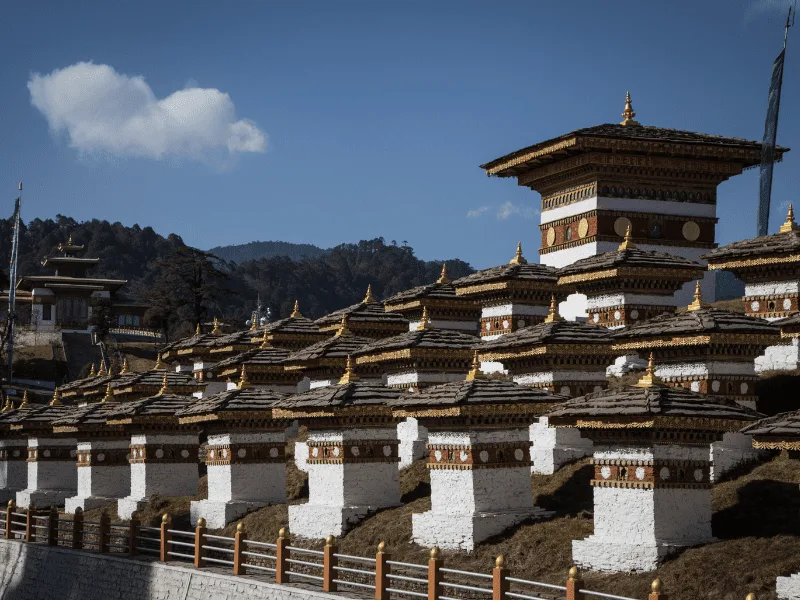
Drive to Thimphu for the National Memorial Chorten, where elderly devotees circumambulate continuously throughout the day, and Tashichho Dzong, the seat of Bhutan’s Royal Government.
National Memorial Chorten
Tashichho Dzong
DAY 4
Thimphu → Punakha
📍Dochula Pass · Punakha Dzong (1637) · Chimi Lhakhang
Drive to Punakha via Dochula Pass. Visit Punakha Dzong, then take the gentle walk to Chimi Lhakhang, built in 1499 by Lama Drukpa Kunley, revered for subduing negativity through unorthodox, humour-filled teaching.
Dochula Pass
Punakha Dzong 1637
Chimi Lhakhang 1499
DAY 5
Punakha → Phobjikha
📍Wangdue Phodrang Dzong · Gangtey Goemba · Phobjikha Valley
Visit Wangdue Phodrang Dzong before continuing to the Phobjikha (Gangtey) Valley, home to Gangtey Goemba monastery, founded in 1613 by the grandson of treasure-revealer Pema Lingpa.
Wangdue Phodrang Dzong
Gangtey Goemba 1613
DAY 6
Phobjikha → Bumthang
📍Trongsa Dzong · Drive to Bumthang — Following the Guru's Documented Route
Drive to Bumthang via Trongsa, visiting Trongsa Dzong before crossing Yotongla Pass into the valley where, according to tradition, Guru Rinpoche’s first and most consequential visit to Bhutan unfolded.
Trongsa Dzong 1648
Yotongla Pass
DAY 7
📍Kurjey Lhakhang — The Cave Where the King Was Healed
A full day at Kurjey Lhakhang, built around the actual cave where Guru Rinpoche healed King Sindhu Raja and subdued the deity Shelging Karpo in 810 AD. Three temples now stand on the site — the oldest, built in 1652, marks the meditation site itself; the second houses the body imprint tradition holds he left in the rock.
🔥 Where Buddhism in Bhutan Actually Began
This is, by most serious accounts, the single most historically significant Buddhist site in the entire kingdom — not because of its scale or architecture, but because this is the documented location where the events that brought Buddhism to Bhutan are recorded to have unfolded. The cypress tree near the entrance is said to have grown from Guru Rinpoche’s own walking staff, planted into the ground after his meditation concluded.
Kurjey Lhakhang body-imprint cave
King Sindhu Raja healing site
810 AD founding event
DAY 8
📍The Burning Lake · Jambay Lhakhang (7th Century)
Visit Membartsho, the “Burning Lake,” where Guru Rinpoche concealed sacred treasures and where, centuries later, the treasure-revealer Pema Lingpa famously dove in and emerged holding hidden relics and a still-lit butter lamp. Visit Jambay Lhakhang, attributed to the same 7th-century, 108-temple project as Kyichu Lhakhang.
Membartsho Burning Lake
Pema Lingpa treasure legend
Jambay Lhakhang 7th century
DAY 9
📍Bumthang → Paro (via Flight or Overland)
Return to Paro by domestic flight or the scenic overland route, retracing the geography of the journey in reverse.
Return to Paro
DAY 10
📍Final Reflection · Paro International Airport Departure
A final breakfast and an unhurried morning before transfer to Paro International Airport, carrying with you a genuine understanding of the journey one historical figure made through this kingdom, twelve centuries ago.
Final reflection
Why Book With Us?
We create the best Bhutan Pilgrimage Tours with care, experience, and deep local knowledge to give you a peaceful, meaningful, and comfortable journey in Bhutan. Our team of local experts understands the spiritual importance of each place and designs every tour with personal attention to your needs. As a trusted travel company, we provide reliable service, quick response, and full support from the moment you contact us until your journey ends, ensuring your 10 Days Bhutan Pilgrimage Tour is smooth, memorable, and truly special.
What’s Included
What's Included & Excluded
Complete transparency — exactly what your pilgrimage covers.
✓ Included in This Tour
- All meals — breakfast, lunch, dinner and evening tea throughout
- Accommodation throughout on twin/double sharing basis (single supplement available)
- All ground transportation, including airport transfers
- Licensed English-speaking guide with genuine knowledge of the Ney tradition
- Tiger’s Nest hike with guide
- Government Sustainable Development Fee (SDF)
- One-time non-refundable Bhutan visa processing fee
- All monument and dzong entry fees
- Full support before, during and after your tour
✕ Not Included
- International flights to/from Paro International Airport
- Optional domestic flight Bumthang–Paro if chosen over overland route (quoted separately)
- Bottled drinks and alcoholic beverages
- Travel and medical insurance (strongly recommended)
- Personal expenses — laundry, phone calls, shopping
- Tips and gratuities for guide and driver (appreciated, entirely your choice)
- Unforeseen costs from flight cancellations or weather disruption
What Is the Best Time for This Pilgrimage?
March to May and September to November offer the most comfortable conditions for visiting sacred sites across multiple altitude zones and for unhurried time at each location without weather pressure.
This Pilgrimage Is Made for You If —
🙏 You Want Genuine Spiritual Context, Not Generic Sightseeing
If you'd rather understand the documented story behind each sacred site than receive vague "this is holy" descriptions, this tour is built on exactly that principle.
🧘 You Practice Buddhism or Are Genuinely Curious About It
This itinerary accommodates both devout practitioners seeking meaningful practice time and curious travellers wanting real historical depth.
📖 You're Drawn to a Single Coherent Narrative
Rather than disconnected highlights, this pilgrimage follows one documented 8th-century journey from start to finish.
⏱️ You Want Unhurried Time at Sacred Sites
This itinerary deliberately avoids the rushed pace of standard sightseeing tours.
🌸 Your Dates Suit Spring or Autumn
Both seasons offer ideal conditions for visiting sacred sites across Bhutan's full range of altitude zones.
✅ You Value Accuracy Over Generic Spiritual Marketing
Every story on this page is grounded in documented Bhutanese Buddhist tradition, not invented "mystical" language.
Why Book Your Pilgrimage With Kingdom of Happiness Tours?
We create pilgrimage tours with genuine knowledge of the Ney tradition, expert guidance, and full support — designed to give you a peaceful, meaningful, and accurately informed journey through Bhutan’s sacred sites.
We Tell the Real Story
King Sindhu Raja, the Kurjey body imprint, the Burning Lake — explained accurately, not blurred into generic "ancient and mystical" language.
Completely Private, Always
Every pilgrimage we run is private for your specific party — no merging with strangers.
Genuine Time for Practice
We build unhurried time into each sacred site, recognising that pilgrimage requires stillness, not a packed schedule.
Genuinely Researched Content
Every legend, date, and historical detail on this page is accurate and verifiable.
Comfortable Accommodation Throughout
Carefully selected hotels on every leg of this route.
Full Support Before, During & After
Visa, SDF, all bookings — handled entirely, with support throughout your trip and after you return.
Book Your 10-Day Bhutan Pilgrimage Tour
Complete the form below and our team will confirm availability and send you full itinerary and pricing details within 24 hours.
We recommend enquiring at least 8–10 weeks ahead, particularly for spring and autumn departures.
USD $1,980
📞 +975 16108730
💬 WhatsApp: +975 16108730
✉ hello@kingdomofhappinesstours.com
Pilgrimage Highlights
- Tiger’s Nest — Guru Rinpoche’s meditation cave
- Kurjey Lhakhang — the body imprint cave
- Membartsho — the Burning Lake
- Kyichu & Jambay Lhakhang — 7th century
- Punakha, Phobjikha & Trongsa included
- All meals, transport, visa, SDF included
🪷 Best Seasons
March–May and September–November offer the most comfortable conditions for this pilgrimage.
Frequently Asked Questions
Honest, complete answers about this genuinely researched pilgrimage journey.
March to May and September to November offer the most comfortable conditions, with mild temperatures and clear skies across the western and central regions this pilgrimage covers, from the lower Paro Valley to the higher altitudes around Phobjikha and Bumthang.
Yes — this pilgrimage is designed to be meaningful for both practicing Buddhists and genuinely curious travellers without prior religious background. The focus is on understanding the actual documented history and stories behind each site, which is valuable and accessible regardless of your own spiritual practice. Your guide adapts explanations to your interest and background.
Yes — we can extend the itinerary to include the more remote Singye Dzong (requiring additional trekking days), add specific monasteries connected to other historical figures such as Pema Lingpa, or adjust the pace to allow more or less time for meditation at each site. Please tell us your priorities when you enquire.
A Ney is a sacred site in Bhutanese Buddhist tradition — typically a location where Guru Rinpoche or another significant master meditated, subdued a local spirit, or concealed spiritual treasures. Understanding which sites are genuine Neys, and the specific documented story behind each one, is what distinguishes a real pilgrimage from generic sightseeing at temples described only as “ancient” or “holy.”
Yes — all international visitors require a Bhutan visa, except citizens of India, Bangladesh, and the Maldives. We handle the entire visa application and SDF payment on your behalf. All international visitors must travel through a licensed Bhutanese tour operator with a licensed guide — Kingdom of Happiness Tours is fully licensed and manages all documentation.
Walk the Path of Guru Rinpoche
Ten days. A dying king healed in 810 AD. A body imprint left in solid rock. A burning lake that gave up hidden treasure centuries later. A cave where the master who brought Buddhism to Bhutan once meditated for months. This is the documented story behind Bhutan’s sacred sites — and the journey that actually retraces it.
“Gross National Happiness is more important than Gross National Product.” — His Majesty Jigme Singye Wangchuck, Fourth King of Bhutan