Jambay Lhakhang Singye Cham The Lion Dance Festival, Bumthang
If you’ve researched Bhutanese festivals, you’ve likely encountered the Jambay Lhakhang Drup — the famous four-day October festival with its midnight naked dance and fire ritual, held at the same 7th-century temple. The Singye Cham is a different, separate event entirely: a single sacred day, weeks later in the Bhutanese calendar, built around the Lion Dance and a tender legend involving three sibling temples reuniting once a year. It draws far fewer visitors than its better-known counterpart, and that is exactly the point of going.
Experience Bhutan's Genuinely Lesser-Known Lion Dance Festival
We need to be precise about what this tour is, because several other operators online describe the Singye Cham incorrectly — conflating it with the much larger Jambay Lhakhang Drup. They are not the same event. The Drup is a famous, four-day festival held in late October or early November, drawing significant crowds for its midnight Tercham (naked dance) and Mewang fire ritual. The Singye Cham, the focus of this tour, is a separate, single-day festival held at the same temple, several weeks later in the Bhutanese lunar calendar — most commonly falling in late November or early December. It centres on an entirely different ritual: the Singye Cham, or Lion Dance, performed by dancers in elaborate lion costume and mask.
The legend behind it is genuinely touching. According to tradition, the sacred Jowo statue in Lhasa, Tibet, and the Jowo images enshrined at Jambay Lhakhang in Bumthang and Kyichu Lhakhang in Paro are considered to be siblings — three sacred figures connected across the Himalayas. The Singye Cham marks their symbolic annual reunion, with the lion representing the protector that accompanied the Jowo statue on its original journey from Lhasa. This is a substantially different spiritual narrative from the Drup’s commemoration of Guru Rinpoche’s consecration of the temple, even though both festivals honour the same sacred site.
Because the Singye Cham is genuinely smaller, less internationally known, and held outside the main October festival rush, it offers something the Drup increasingly cannot: a courtyard where you are one of relatively few outside visitors, surrounded almost entirely by Bumthang locals attending a festival that means something specific and personal to their own community.
“Most people who book a Bumthang festival trip book the famous one. This tour is for the traveller who wants the same temple, a different legend, and a courtyard that still feels like it belongs to the people who actually live there.”
This 9-day journey takes you through the full western and central Bhutan route — Paro, Thimphu, Punakha, the Gangtey/Phobjikha Valley, and Bumthang — arriving in Bumthang specifically timed for the Singye Cham. As with all Bhutanese Tshechus following the lunar calendar, exact dates shift slightly year to year; we confirm current dates with official sources before finalising your booking.
🦁 We confirm exact dates before booking
As a lunar-calendar festival, the Singye Cham’s date shifts year to year. We verify against current published sources before finalising your itinerary.
Tour at a Glance
Everything you need to know about this Jambay Lhakhang Singye Cham at a glance.
🗓️ Duration
9 Days / 8 Nights
📍Destinations
Paro–Thimphu–Punakha–Gangtey–Bumthang
🎭 Festival Focus
Singye Cham (Lion Dance)
🏨 Accommodation
3-Star Hotels & Resorts
🚙 Throughout
Private Vehicle & Guide
👥 Group Size
1 – 10 Guests
💰 Starting Price
From USD $2,180 Per Person
🛂 Documents Needed
Entry Permit + Special Area Permit
Singye Cham vs. Jambay Lhakhang Drup — An Honest, Necessary Distinction
This is the single most important thing to understand before booking. Several Bhutan tour websites use these two festival names almost interchangeably — we won’t.
🦁 Jambay Lhakhang Singye Cham — This Tour
Duration: A single sacred day
Centrepiece: The Singye Cham (Lion Dance), honouring the lion that accompanied the sacred Jowo statue from Lhasa
Legend: The symbolic annual reunion of three “sibling” Jowo images — in Lhasa, at Jambay Lhakhang, and at Kyichu Lhakhang in Paro
Timing: Typically late November to early December, on the 15th day of the 10th lunar month
Visitor numbers: Genuinely modest — most international visitors have never heard of it
🔥 Jambay Lhakhang Drup — A Different, More Famous Festival
Duration: Four days
Centrepiece: Mewang (fire ritual) and the midnight Tercham — the famous “naked dance,” performed by masked men at midnight
Legend: Commemorates Guru Rinpoche’s consecration of the temple and the building of 108 temples by King Songtsen Gampo
Timing: Late October to early November
Visitor numbers: Significant — widely covered in travel media, books out hotels in advance
Both festivals are held at the same temple, Jambay Lhakhang, but several weeks apart in the calendar, and they honour different aspects of Bhutanese Buddhist tradition. If the famous naked dance and fire ritual specifically interest you, that is the Drup, not this tour — we are glad to arrange that itinerary separately and will tell you plainly which festival fits what you’re looking for.
The Legend Behind the Lion Dance — Three Sacred Statues, One Family
The story behind the Singye Cham is one of the more unusual and tender narratives in Bhutanese religious tradition.
According to tradition, the revered Jowo statue — a sacred image of the Buddha — originally came from Lhasa, Tibet, and is considered to have spiritual “siblings”: the Jowo images enshrined at Jambay Lhakhang in Bumthang and at Kyichu Lhakhang in Paro, both among Bhutan’s oldest temples, said to have been built by Tibetan King Songtsen Gampo in the 7th century. Once a year, these three sacred figures are believed to symbolically reunite — and the Singye Cham, the Lion Dance, is performed in honour of the lion that is said to have accompanied the original Jowo statue on its long journey from Lhasa, protecting it along the way.
Jowo of Lhasa
Jambay Lhakhang
Kyichu Lhakhang
Dancers in the Singye Cham wear elaborate lion costumes and masks, the performance symbolising strength, courage, and the protective power associated with Guru Rinpoche’s triumph over negative forces. It is a quieter, more intimate ritual than the dramatic midnight events of the Drup festival — and that intimacy is precisely what makes it worth experiencing.
Why Jambay Lhakhang Itself Is Worth the Journey
Regardless of which festival brings you here, the temple itself is one of the most historically significant sites in the Himalayan Buddhist world.
One of Bhutan's Oldest Temples
Founded in the 7th century AD by Tibetan King Songtsen Gampo, Jambay Lhakhang is consistently cited as among the very oldest religious structures in the country.
Part of a 108-Temple Legend
According to tradition, the king built 108 temples across the Himalayas in a single day to subdue a demoness obstructing the spread of Buddhism — Jambay Lhakhang is said to pin down her left knee.
Located in Bumthang's Spiritual Heartland
The Choekhor Valley, where the temple sits, is considered the spiritual centre of Bhutan, with an unusually dense concentration of ancient temples and sacred sites nearby.
Genuinely Active, Not Preserved for Tourism
The temple continues to function as a living site of worship and pilgrimage for Bhutanese Buddhists, with both major annual festivals drawing devout local attendance.
Bumthang's Distinct High-Valley Character
Kurjey Lhakhang, where Guru Rinpoche's body imprint is said to remain visible in the rock, and Tamshing Lhakhang, founded in 1501, are both close by.
Genuinely Lower Tourist Density Throughout
At roughly 2,600–2,800 metres, Bumthang has a noticeably different climate and architectural character from the warmer western valleys most visitors see first.
What Makes This Singye Cham Tour Different
Several operators sell a “Jambay Lhakhang festival tour” without specifying which festival, or which dates. We build this trip around precision.
We Tell You Exactly Which Festival This Is
This is the Singye Cham specifically — not the Drup. We confirm this distinction clearly so you know exactly what you're booking.
A Complete Western & Central Bhutan Route
This itinerary properly covers Paro, Thimphu, Punakha, and Gangtey on the way to Bumthang, rather than rushing straight to the festival.
Genuinely Researched Festival Detail
The legend, the dates, the distinction from the Drup — all verified against multiple sources, because we believe even a lesser-known festival deserves accurate description.
A Guide Who Understands Bumthang's Festival Calendar
We assign guides with genuine familiarity with Bumthang's specific festival traditions, not generalist knowledge of Bhutan's better-known western festivals.
Comfortable Accommodation Throughout
3-star hotels and resorts at every stop, including Bumthang, where accommodation quality can vary more than in the well-developed western valleys.
Full Support Before, During & After
Visa, SDF, all bookings — handled entirely. We remain available throughout your trip and after you return home.
9-Day Jambay Lhakhang Singye Cham Tour Itinerary — Day by Day
Every site, every cultural detail, every reason this route is sequenced this way — described in full.
DAY 1
Arrival Day · Paro
📍Paro International Airport · Sightseeing
Arrival and a private transfer into the Paro Valley. Depending on arrival time, an introductory visit to Paro’s main sites — including the area around Rinpung Dzong — before settling into your hotel for the night.
Paro International Airport arrival
DAY 2
Paro → Thimphu
📍Drive to Thimphu · Capital Sightseeing
Drive to Thimphu (around 1 hour) and an afternoon exploring the capital — Tashichho Dzong, the National Memorial Chorten built in 1974, and Thimphu’s markets and artisan workshops.
Tashichho Dzong
National Memorial Chorten
DAY 3
Thimphu → Punakha
📍Dochula Pass · Punakha Dzong (1637) · Suspension Bridge
Drive to Punakha via Dochula Pass (108 chortens). Visit Punakha Dzong, built in 1637 by Zhabdrung Ngawang Namgyal, and walk the longest suspension bridge in Bhutan, 160 metres, over the Pho Chhu river.
Dochula Pass
Punakha Dzong 1637
DAY 4
Punakha → Gangtey
📍Wangdue Phodrang Dzong · Chimi Lhakhang · Gangtey Goemba
Visit Wangdue Phodrang Dzong (built 1638) and Chimi Lhakhang — the fertility temple built in 1499 by Lama Drukpa Kuenley. Continue to the Gangtey/Phobjikha Valley, founded around Gangtey Goemba monastery (1613), one of Bhutan’s most beautiful glacial valleys and the winter roosting ground of the rare black-necked crane.
Wangdue Phodrang Dzong 1638
Chimi Lhakhang 1499
DAY 5
Gangtey → Bumthang
📍Trongsa Dzong · Ta Dzong · Drive to Bumthang
Drive to Bumthang via Trongsa, visiting Trongsa Dzong (built 1648, ancestral seat of Bhutan’s monarchy) and Ta Dzong, now the royal heritage museum. Arrive in Bumthang by evening.
Trongsa Dzong 1648
Ta Dzong royal heritage museum
DAY 6
Bumthang Sightseeing
📍Jakar Dzong · Tamshing Lhakhang · Kurjey Lhakhang
A day exploring Bumthang’s remarkable concentration of ancient sites: Jakar Dzong (1667), Tamshing Lhakhang (founded 1501 by Pema Lingpa), and Kurjey Lhakhang, where Guru Rinpoche’s body imprint is said to remain visible in the rock.
Jakar Dzong 1667
Tamshing Lhakhang 1501
DAY 7
The Festival Day · Jambay Lhakhang Singye Cham
📍Witness the Jambay Lhakhang Singye Cham — The Lion Dance (Full Day)
The centrepiece of this journey. A full day at Jambay Lhakhang, witnessing the Singye Cham — the sacred Lion Dance performed in honour of the protector lion that accompanied the Jowo statue from Lhasa to Bhutan.
🦁 A Genuinely Intimate Festival Day
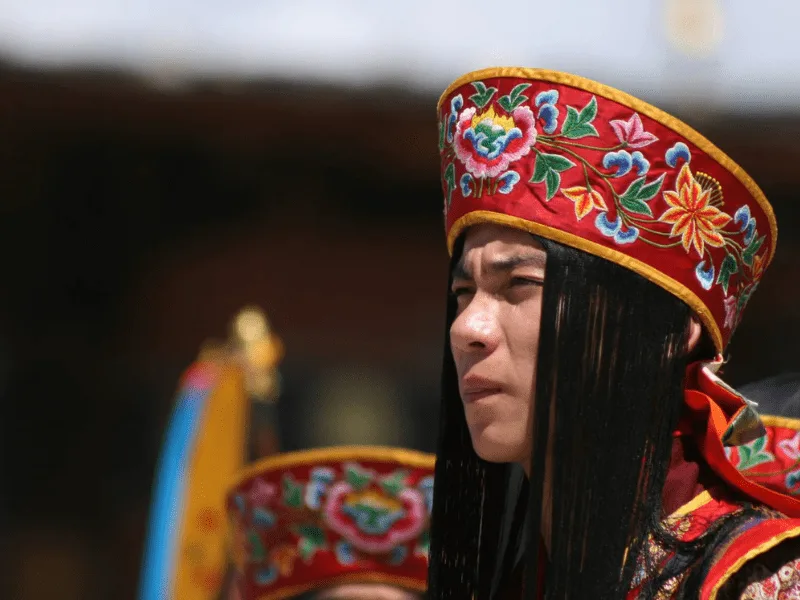
Expect mask dances performed by monks, folk songs and traditional performances by locals, displays of local arts and handicrafts, and Bumthang families gathered in their finest traditional dress. The atmosphere is warm and community-centred rather than spectacle-driven — you are witnessing a festival that means something specific to the people of this valley, not a tourism set-piece.
Jambay Lhakhang Singye Cham
Lion Dance
DAY 8
Bumthang → Paro
📍Return Journey — Domestic Flight or Overland Drive
Depending on flight availability, return to Paro either by short domestic flight (around 25–30 minutes from Bumthang’s Bathpalathang Airport) or by the scenic overland route retracing the journey via Trongsa and Wangdue.
DAY 9
Departure Day
📍Final Breakfast · Paro International Airport Departure
A final breakfast before transfer to Paro International Airport, carrying with you a genuinely uncommon Bhutan experience — a festival that almost no other international visitor shared with you this year.
Why Book With Us?
We make your festival experience smooth, authentic, and unforgettable. Enjoy Jambay Lhakhang Singye Chham with expert guides, careful planning, and full support. Experience Bhutanese culture like a local, away from crowds, and create memories that last a lifetime.
What’s Included
What's Included & Excluded
Complete transparency — exactly what your festival tour covers.
✓ Included in This Tour
- All meals — breakfast, lunch, dinner and evening tea
- Accommodation throughout on twin/double sharing basis (single supplement available)
- All ground transportation, including airport transfers
- Licensed English-speaking guide for the entire trip
- Government Sustainable Development Fee (SDF)
- One-time non-refundable Bhutan visa processing fee
- All monument and dzong entry fees
- Full support before, during and after your tour
✕ Not Included
- International flights to/from Paro International Airport
- Domestic flight Bumthang–Paro if chosen over the overland route (quoted separately)
- Bottled drinks and alcoholic beverages
- Travel and medical insurance (strongly recommended)
- Personal expenses — laundry, phone calls, shopping
- Tips and gratuities for guide and driver (appreciated, entirely your choice)
- Unforeseen costs from flight cancellations or weather disruption
This Tour Is Made for You If —
📖 You're Drawn to Bhutan's Lesser-Told Legends
The sibling-temple story behind the Lion Dance is genuinely unusual even within Bhutan's rich festival tradition.
🤝 You Want Genuine Local Connection
In a courtyard with few other outside visitors, your experience of the festival feels markedly more personal.
🗺️ You Want the Full Bhutan Route, Not Just Bumthang
This itinerary covers Paro, Thimphu, Punakha, and Gangtey properly on the way, rather than treating them as a rushed prelude.
📅 Your Dates Suit Late November or Early December
If you're already considering a late-autumn Bhutan trip, this festival adds genuine cultural depth to that window.
🔍 You've Already Researched Bhutan's Festivals Carefully
If you've specifically sought out the Singye Cham rather than the more famous Drup, you already understand the distinction this tour respects.
✅ You Value Precision Over Hype
If you'd rather book a tour that names the correct festival accurately than one that blurs two distinct events together, this is built on exactly that principle.
Why Book Your Singye Cham Tour With Kingdom of Happiness Tours?
We make your festival experience smooth, authentic, and accurately described. Enjoy the Jambay Lhakhang Singye Cham with expert guides, careful planning, and full support.
We Name the Correct Festival
We will never blur the Singye Cham and the Drup together to make either sound more impressive than it is.
Completely Private, Always
Every tour we run is private for your specific party — no merging with strangers.
A Guide Who Knows Bumthang Properly
We assign guides with genuine familiarity with this region's specific festival calendar and history.
Genuinely Researched Content
Every legend, date, and historical detail on this page is accurate and verifiable.
Comfortable Accommodation Throughout
Carefully selected hotels even on the Bumthang and Gangtey legs of this route.
Full Support Before, During & After
Visa, SDF, all bookings — handled entirely, with support throughout your trip and after you return.
Book Your Jambay Lhakhang Singye Cham Tour
Complete the form below and our team will confirm current festival dates, availability, and send you full itinerary and pricing details within 24 hours.
Because this festival is far less booked-out than the Drup or Paro/Thimphu Tshechus, you have more scheduling flexibility — but we still recommend enquiring 8–10 weeks ahead.
USD $2,180
📞 +975 16108730
💬 WhatsApp: +975 16108730
✉ hello@kingdomofhappinesstours.com
Tour Highlights
- Singye Cham — full festival day
- Punakha Dzong & Gangtey Goemba
- Trongsa Dzong en route
- Bumthang’s three major ancient temples
- Phobjikha (black-necked crane valley)
- All meals, transport, visa, SDF included
🦁 Festival Dates
Typically late November to early December, following the lunar calendar. We reconfirm exact dates closer to your travel period.
Frequently Asked Questions
Honest, complete answers about this genuinely distinct festival.
It is a single sacred day centred on the Singye Cham, or Lion Dance, honouring the legendary lion said to have protected the Jowo statue on its journey from Lhasa to Bhutan. It is held at one of Bhutan’s oldest temples but is a genuinely separate, far less internationally known event from the larger four-day Jambay Lhakhang Drup festival, which features the famous naked dance and fire ritual. The Singye Cham offers an intimate, community-centred festival experience without the large crowds.
No, and this is an important distinction. The naked dance (Tercham) and fire ritual (Mewang) belong to the Jambay Lhakhang Drup, a separate four-day festival held in late October or early November. This tour is built around the Singye Cham specifically, a different one-day festival held weeks later in the lunar calendar. Both are held at the same temple, but they are distinct events with different rituals and different legends behind them. If you specifically want the naked dance festival, please let us know and we will quote that itinerary instead.
Yes — this tour combines the full western Bhutan circuit (Paro, Thimphu, Punakha, Gangtey) that most first-time visitors want to see, with the addition of Bumthang and this specific festival. It’s an excellent way to experience both the standard highlights and a genuinely uncommon cultural event in a single trip.
Yes — we can adjust the days before or after the festival, choose between the domestic flight or overland return route from Bumthang, add the Tang Valley or Ura Valley as extensions, or rearrange the western Bhutan portion to suit your interests. Please tell us your priorities when you enquire.
Photography of the mask dances and general festival atmosphere is generally welcomed, as is typical for most Bhutanese Tshechus. As always at religious events, we ask guests to remain respectful and follow your guide’s specific guidance on any moments where particular customs apply.
Witness the Lion Dance at Jambay Lhakhang
Nine days. The full western and central Bhutan route. A single sacred day at one of the kingdom’s oldest temples, built around a legend of three sibling statues reunited once a year. This is a real festival, genuinely overlooked, and accurately described.
“Gross National Happiness is more important than Gross National Product.” — His Majesty Jigme Singye Wangchuck, Fourth King of Bhutan