Punakha Drubchen Festival Tour The Festival That Re-Enacts Real History
Almost every Tshechu in Bhutan re-enacts the deeds of Guru Rinpoche through symbolic dance. The Punakha Drubchen is genuinely different: it re-enacts an actual documented military event — the 1639 defence of Punakha Dzong against invading Tibetan forces, led by Zhabdrung Ngawang Namgyal, the founder of unified Bhutan. The warriors who perform it, called Pazaps, are not professional dancers but ordinary residents of specific eligible villages, often performing roles their grandfathers and great-grandfathers held before them.
Witness a Battle Re-Enacted Exactly Where It Happened
In 1639, Tibetan forces invaded Bhutan in pursuit of a sacred relic — the Rangjung Kharsarpani — which Zhabdrung Ngawang Namgyal had brought with him when he fled Tibet to found unified Bhutan. The invaders besieged Punakha Dzong itself, hiding and observing from Jili Gang, a hill above the Punakha cremation ground, waiting for an opportunity to strike. With no standing army at his disposal, the Zhabdrung called on men from the eight great village blocks, known as Wang Tshochenye, to defend the dzong. What followed was not simply a battle, but a masterclass in deception that has been re-enacted in the dzong’s courtyard every year since.
Knowing the Tibetans would not withdraw without the relic, the Zhabdrung staged a fake ceremony — having the sacred Rangjung Kharsarpani appear to be lost in the Mo Chhu river, thrown in as oranges symbolising the relic, while monks in red caps performed elaborate rites on the riverbank. Believing the prize they sought was now unrecoverable, the Tibetan forces withdrew. The invasion failed again in 1644, and Bhutan’s independence as a unified kingdom was secured. The Punakha Drubchen — also called Punakha Dromche — has commemorated this victory ever since, and remains one of the oldest and most historically grounded festivals anywhere in the country.
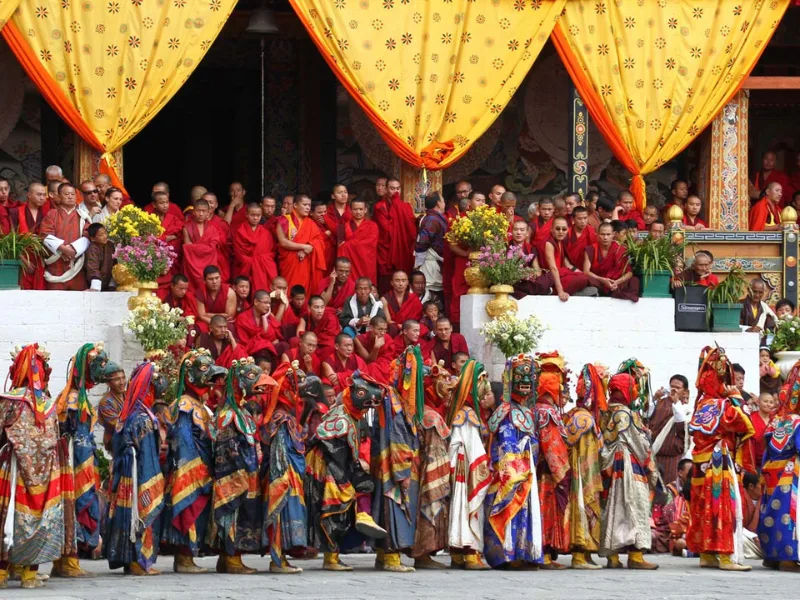
The warriors who perform the re-enactment, called Pazaps, dress in red and black combat attire with yellow silk skirts, coloured ribbons, and white, blue, and red felt boots, led by eight generals known as Magpon. Only residents of the Wang Tshochenye villages are eligible to take on this role — meaning the men marching through Punakha Dzong’s courtyard each February are not actors hired for the occasion, but descendants of the same communities whose ancestors actually fought in 1639.
“Most Bhutanese festivals re-enact the deeds of a saint through symbolic dance. The Punakha Drubchen re-enacts an actual battle, fought by actual villages, won through an actual trick — and the men performing it today come from the same families who performed it then.”
For 2026, the Punakha Drubchen is confirmed for 24 to 26 February, and is immediately followed by the Punakha Tshechu, held 27 February to 1 March at the same magnificent dzong — meaning a single visit can take in both Bhutan’s most historically unique festival and one of its grandest religious celebrations, back to back.
⚔️ Both festivals back to back
We can extend this itinerary to cover both the Drubchen and the Tshechu that follows immediately after — please ask if you want the complete back-to-back experience.
Tour at a Glance
Everything you need to know about this Punakha Drubchen Festival Tour at a glance.
🗓️ Duration
8 Days / 7 Nights
📍Destinations
Paro – Thimphu – Punakha
⚔️ Festival Focus
Punakha Drubchen + Tshechu
🏨 Accommodation
3-Star Hotels & Resorts
🚙 Throughout
Private Vehicle & Guide
👥 Group Size
1 – 10 Guests
💰 Starting Price
From USD $2,250 Per Person
🛂 Documents Needed
Entry Permit + Special Area Permit
The Zhabdrung's Deception — How Bhutan Won Without a Real Battle
The most remarkable part of this story is that the decisive moment of the 1639 victory was not combat — it was theatre. Realising that the Tibetan forces would never withdraw while believing the sacred Rangjung Kharsarpani relic remained inside Punakha Dzong, the Zhabdrung devised a ruse. He ordered his Pazap warriors to exit the dzong through one gate and re-enter through another, repeated morning and evening, creating the impression that a far larger garrison was stationed inside than actually existed.
Then came the masterstroke: a procession of monks in high red caps left the dzong carrying the sacred relic toward the Mo Chhu riverbank, accompanied by drums and trumpets. There, the Je Khenpo performed a ritual known as Luu Chok and threw a handful of oranges into the river — symbolically representing the immersion of the Rangjung Kharsarpani. Watching from their hiding place at Jili Gang, the Tibetan forces concluded the relic they sought had been lost forever in the river, with no way to recover it. Believing their objective unattainable, they withdrew from Punakha entirely.
2 Gates
Oranges
2 Invasions
The festival’s climax each year recreates this exact sequence — the ceremonial procession to the riverbank, the symbolic immersion of the relic, and the triumphant return of the Pazaps, who are dramatically pulled from their horses at the base of the dzong stairway and carried up into the courtyard amid celebration.
Drubchen vs. Tshechu — Why This Festival Is Genuinely Different
The Punakha Drubchen and the Punakha Tshechu that follows it are often bundled together in casual conversation — but they are fundamentally different categories of festival.
⚔️ Punakha Drubchen — Historical Re-Enactment
What it commemorates: An actual 1639 military victory over Tibetan invaders
Who performs it: Pazaps — eligible only to residents of specific Wang Tshochenye villages
Core content: Battle re-enactment, river relic ceremony, triumphant procession
Dedicated to: Yeshe Gompo and Palden Lhamo, Bhutan’s protective deities
2026 Dates: 24–26 February
🎭 Punakha Tshechu — Religious Mask Dance Festival
What it commemorates: Guru Rinpoche’s 8th-century introduction of Buddhism to Bhutan
Who performs it: Monks and lay dancers performing sacred Cham dances
Core content: Mask dances, the Zhana Cham (Black Hat dance), Thongdrel unveiling
Dedicated to: Guru Rinpoche, as with most Tshechus across the country
2026 Dates: 27 February – 1 March (immediately after the Drubchen)
Because the two festivals follow back to back at the same dzong, this itinerary covers the Drubchen in full and gives you the option to extend your stay to witness the Tshechu as well — two genuinely distinct festival experiences in a single visit to one of Bhutan’s most beautiful fortresses.
The Pazaps — Bhutan's Living Re-Enactors
What makes the Punakha Drubchen feel genuinely different from a staged historical performance is exactly who takes part.
👥 Eligibility by Village, Not Audition
Pazap roles are restricted to residents of the Wang Tshochenye — the eight great village blocks of the Thimphu and Punakha regions whose ancestors originally answered the Zhabdrung’s call in 1639. This is not a role open to professional performers or outsiders.
🗡️ Combat Attire & Ranks
Seventeen Pazap actors take part, dressed in ghos with distinctive patterns, yellow silk skirts with coloured ribbons, and felt boots in white, blue, and red. They are led by eight generals (Magpon), with heavy metal helmets adorned with flags marking their rank.
.💃 The Lengmag Dance
Each Pazap performs the Lengmag dance before His Holiness the Je Khenpo in the dzong’s grand courtyard — a ceremonial display of martial bearing that precedes the triumphant procession through the dzong gates.
🐎 Carried in Triumph
At the base of the dzong stairway, the generals (Zimpons) are dramatically pulled from their horses and carried jubilantly up the stairs into the courtyard — a moment of genuine spectacle that closes the festival’s main day.
Why Punakha Dzong Is the Perfect Setting for This History
The festival’s authenticity is reinforced by the fact that it takes place in the exact building where the events it commemorates actually occurred.
The Same Building, the Same Stairs
Punakha Dzong, built in 1637–38, is the literal site of the 1639 siege. The same courtyards and stairways featured in the festival's re-enactment witnessed the original events.
Home to the Actual Sacred Relic
The Rangjung Kharsarpani — the relic at the centre of the entire story — remains housed within Punakha Dzong today, alongside the embalmed remains of Zhabdrung Ngawang Namgyal himself.
February's Mild Punakha Climate
While western Bhutan's higher valleys remain cold in late February, Punakha's lower elevation offers notably milder, more pleasant weather for outdoor festival attendance.
A Festival Bhutanese Themselves Travel For
The Punakha Drubchen draws thousands of Bhutanese visitors from across the country specifically because of its unique historical character, distinct from the more numerous Guru Rinpoche Tshechus.
Architecturally One of Bhutan's Finest Dzongs
Set at the confluence of the Pho Chhu and Mo Chhu rivers, Punakha Dzong is widely regarded as the most beautiful fortress in the kingdom — a fitting stage for this particular history.
A Living Connection to National Survival
The festival commemorates not a religious legend but the literal defence of Bhutan's independence as a unified state — a distinction that gives it genuine national significance beyond its local setting.
What Makes This Punakha Drubchen Tour Different
Many operators treat the Drubchen as a generic add-on to a Punakha visit. We build this trip around its specific historical content.
The Real History, Properly Explained
The 1639 siege, the river deception, the Wang Tshochenye villages — all verified against multiple sources, because this festival's value lies entirely in understanding the genuine events it re-enacts.
A Complete Western Circuit
Paro, Thimphu, and Punakha are all properly covered, including the Tiger's Nest hike, not just the festival days.
Option to Add the Tshechu That Follows
We can extend your itinerary to witness both the Drubchen and the Punakha Tshechu immediately after, giving you two distinct festival categories in one trip.
A Guide Who Distinguishes Drubchen From Tshechu
We assign guides who can clearly explain the difference between this historical re-enactment and the religious Tshechus held elsewhere in Bhutan.
Accommodation Secured Early
February's mild Punakha weather and the festival's popularity mean hotel availability should be secured well in advance.
Full Support Before, During & After
Visa, SDF, all bookings — handled entirely. We remain available throughout your trip and after you return home.
8-Day Punakha Drubchen Tour Itinerary — Day by Day
Every site, every historical detail, every reason this route is sequenced this way — described in full.
DAY 1
Arrival Day · Paro
📍 Paro International Airport · Sightseeing
Arrival and sightseeing in the Paro Valley, including Rinpung Dzong (1646) and Ta Dzong (1649), now the National Museum.
DAY 2
Tiger’s Nest Day
📍Hiking to Paro Taktsang — Tiger's Nest Monastery
The hike to Paro Taktsang, built around the cave where Guru Rinpoche is said to have meditated in the 8th century.
DAY 3
Paro → Thimphu
📍 Drive to Thimphu · Capital Sightseeing
Drive to Thimphu for an afternoon exploring Tashichho Dzong and the National Memorial Chorten.
DAY 4
Thimphu → Punakha
📍Dochula Pass · Arrival in Punakha
Drive to Punakha via Dochula Pass, where 108 memorial chortens stand with Himalayan views on clear days. Settle into your Punakha hotel ahead of the festival.
DAY 5
The Drubchen · Day One
📍Witness Punakha Drubchen at Punakha Dzong — Opening Day
A full day at Punakha Dzong (built 1637–38), the actual site of the 1639 siege, witnessing the Pazap warriors in their distinctive red and black combat attire performing the opening sequences of the battle re-enactment.
⚔️ Standing Where the Siege Actually Happened
Watching the Pazaps move through the same dzong courtyards and stairways where the original 1639 events unfolded gives this festival a quality of authenticity that few other Bhutanese celebrations can match — this is not a re-enactment relocated for convenience, but performed exactly where history happened.
DAY 6
The Drubchen · Final Day
📍The River Procession & Triumphant Return — Final Day of the Drubchen
The festival’s climax: the ceremonial procession of red-capped monks to the Mo Chhu riverbank, the symbolic immersion of the Rangjung Kharsarpani relic, and the triumphant return of the Pazaps — generals dramatically pulled from their horses and carried up into the dzong courtyard amid jubilant celebration.
DAY 7
Punakha Sightseeing
📍Bazam Suspension Bridge · Chimi Lhakhang · Drive Toward Paro
Cross the 160-metre Bazam suspension bridge over the Pho Chhu river, and take the gentle walk through rice paddy fields to Chimi Lhakhang, the 1499 fertility temple. Begin the drive back toward Paro via Dochula Pass.
DAY 8
Departure Day
📍Final Breakfast · Paro International Airport Departure
A final breakfast before transfer to Paro International Airport, carrying with you a genuinely unique Bhutan experience — a festival built on real history, performed by the descendants of those who lived it.
Why Book With Us?
We provide authentic Bhutan experiences, expert guidance, and smooth planning. With us, you’ll enjoy Punakha Drubchen safely and comfortably while connecting with Bhutanese culture and traditions.
What’s Included
What's Included & Excluded
Complete transparency — exactly what your festival tour covers.
✓ Included in This Tour
- All meals — breakfast, lunch, dinner and evening tea throughout
- Accommodation throughout on twin/double sharing basis (single supplement available)
- All ground transportation, including airport transfers
- Licensed English-speaking guide for the entire trip
- Tiger’s Nest hike with guide
- Government Sustainable Development Fee (SDF)
- One-time non-refundable Bhutan visa processing fee
- All monument and dzong entry fees
- Full support before, during and after your tour
✕ Not Included
- International flights to/from Paro International Airport
- Extension to cover the Punakha Tshechu (quoted separately if requested)
- Bottled drinks and alcoholic beverages
- Travel and medical insurance (strongly recommended)
- Personal expenses — laundry, phone calls, shopping
- Tips and gratuities for guide and driver (appreciated, entirely your choice)
- Unforeseen costs from flight cancellations or weather disruption
This Tour Is Made for You If —
📜 You're Drawn to Genuine History, Not Just Religious Symbolism
If a festival re-enacting an actual documented battle interests you more than another Guru Rinpoche Tshechu, this is the one Bhutan offers.
⚔️ You Want to See Bhutan's Living Connection to Its Own Founding
The Pazaps' village-based eligibility makes this a genuinely unbroken link to the events of 1639, not a staged performance.
🏯 You Want to Combine History With Architecture
Punakha Dzong is widely regarded as Bhutan's most beautiful fortress, making the setting itself as rewarding as the festival.
📅 Your Dates Suit Late February
If you're already planning a winter or early spring Bhutan trip, this festival adds genuine depth, with Punakha's notably milder climate at this time of year.
🔄 You Want Two Festivals in One Trip
The option to extend and witness the Punakha Tshechu immediately afterward gives genuine additional value to the same journey.
✅ You Value Accurate Distinctions Over Generic Festival Marketing
If you'd rather understand exactly how a Drubchen differs from a Tshechu than receive a blurred general description, this tour is built on exactly that principle.
Why Book Your Punakha Drubchen Tour With Kingdom of Happiness Tours?
We provide authentic Bhutan experiences, expert guidance, and smooth planning. With us, you’ll enjoy the Punakha Drubchen safely and comfortably while genuinely understanding the history you’re witnessing.
We Explain the Real History Accurately
The 1639 siege, the river deception, the Pazap villages — explained correctly, not blurred into generic festival description.
Completely Private, Always
Every tour we run is private for your specific party — no merging with strangers.
A Guide Who Distinguishes Drubchen From Tshechu
We assign guides who clearly explain this festival's unique historical character.
Genuinely Researched Content
Every date, name, and historical detail on this page is accurate and verifiable.
Early Accommodation Booking
Given the festival's popularity, we prioritise securing your accommodation as early as possible.
Full Support Before, During & After
Visa, SDF, all bookings — handled entirely, with support throughout your trip and after you return.
Book Your Punakha Drubchen Festival Tour 2026
Complete the form below and our team will confirm current festival dates, availability, and send you full itinerary and pricing details within 24 hours.
February is a popular period for Punakha given the combined Drubchen and Tshechu dates. We recommend enquiring at least 10–12 weeks ahead.
USD $2,250
📞 +975 16108730
💬 WhatsApp: +975 16108730
✉ hello@kingdomofhappinesstours.com
Tour Highlights
- Punakha Drubchen — full battle re-enactment
- Mo Chhu river relic ceremony
- Punakha Dzong & Bazam bridge
- Tiger’s Nest hike included
- Optional extension to the Punakha Tshechu
- All meals, transport, visa, SDF included
⚔️ Festival Dates
Drubchen confirmed for 24–26 Feb 2026; Tshechu follows 27 Feb – 1 Mar. We reconfirm exact dates closer to your travel period.
Frequently Asked Questions
Honest, complete answers about Bhutan’s most historically distinctive festival.
It draws thousands of Bhutanese visitors specifically because of its unique historical character, but it remains genuinely less internationally known than festivals like Paro Tshechu or Thimphu Tshechu, giving it a somewhat more intimate atmosphere for foreign visitors even amid significant local attendance.
Yes — this itinerary combines the standard western Bhutan circuit (Tiger’s Nest, Punakha Dzong) most first-time visitors want with a genuinely unique historical festival, making it an excellent and distinctive introduction to the country.
This itinerary travels overland from Paro through Thimphu before reaching Punakha via Dochula Pass — a scenic drive of roughly 2–3 hours from Thimphu. There is no airport in Punakha itself.
Yes — most commonly, guests extend the itinerary to cover both the Drubchen and the Punakha Tshechu that follows immediately afterward. We can also adjust the days before or after the festival, or rearrange the western circuit to suit your interests. Please tell us your priorities when you enquire.
They are different categories of festival entirely, held back to back at the same dzong. The Drubchen re-enacts an actual 1639 military victory over invading Tibetan forces, performed by Pazap warriors eligible only from specific villages, dedicated to Bhutan’s protective deities. The Tshechu that follows immediately afterward is a religious festival of sacred Cham mask dances honouring Guru Rinpoche, similar in format to Tshechus held across the rest of the country. Many visitors choose to extend their stay to witness both.
Witness the Battle That Secured Bhutan, 2026
Eight days. A real 1639 siege, re-enacted by descendants of the villages that fought it. A river deception that fooled an invading army. This is Bhutan’s most historically grounded festival, accurately described and genuinely understood.
“Gross National Happiness is more important than Gross National Product.” — His Majesty Jigme Singye Wangchuck, Fourth King of Bhutan