Mongar Tshechu Festival Tour Eastern Bhutan, Genuinely Off the Tourist Route
Mongar sits in eastern Bhutan, reached either by an 8-hour drive over the 3,700-metre Thrumshingla Pass from Bumthang, or via Samdrup Jongkhar in the far east — a genuinely different journey from the standard Paro–Thimphu–Punakha circuit that defines most visitors’ entire experience of the country. The Mongar Tshechu, held annually at Mongar Dzong, draws attendees from as far as Trashigang and Lhuentse, and concludes with the unfurling of the Guru Tshengye Thongdrol. Few international tour itineraries make the journey east of Bumthang at all — this one does, deliberately.
Experience Bhutan's Eastern Region — A Genuinely Different Country Within the Same Kingdom
Mongar is not a minor detour from the standard Bhutan circuit — it is a genuinely separate undertaking. Eastern Bhutan is widely recognised, including by experienced regional guides, as suited to repeat visitors or travellers with at least two weeks available, precisely because reaching it requires real time: either an 8-hour drive from Bumthang across the 3,700-metre Thrumshingla Pass, or a multi-day overland journey from Samdrup Jongkhar near the Indian border in the far east. There is no quick way to add Mongar to a short Bhutan trip, and we won’t pretend otherwise.
What that distance buys you is a part of the country that operates differently from the well-developed western valleys. Eastern Bhutan has its own distinct languages — Khengkha in southwestern Mongar, Bumthangkha in the northwest, Chochangachakha along the Kuri Chhu valley in the north — its own architectural character, and a notably different lifestyle and pace from Thimphu or Paro. Mongar Dzong itself reflects this difference in an unusual way: unlike most of Bhutan’s great dzongs, which date to the 17th century or earlier, Mongar Dzong is a genuinely modern structure, built in the 20th century — a rare case of a Bhutanese dzong continuing a centuries-old architectural and spiritual tradition in recent memory rather than ancient history.
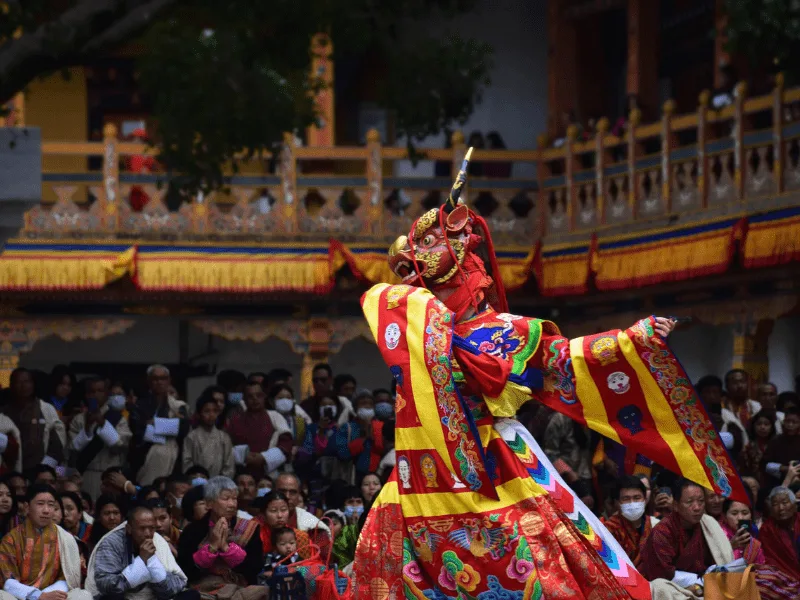
The Mongar Tshechu itself draws devotees from across the wider eastern region — as far as Trashigang and Lhuentse districts — making it as much a regional gathering point as a single-town celebration. The festival features mask dances distinctive to this part of the country, and concludes with the unfurling of the Guru Tshengye Thongdrol, the sacred tapestry depicting the eight manifestations of Guru Rinpoche.
“Most Bhutan trips never cross Thrumshingla Pass. This one does — not as a stunt, but because the eastern half of the country is genuinely, substantially different, and the Mongar Tshechu is a real reason to see it.”
This 12-day journey takes the full west-to-east route — Paro, Thimphu, Punakha, Wangdue, Trongsa, and Bumthang — before crossing into Mongar specifically for the festival, with time built in for the UNESCO-recognised Drametse Ngacham mask dance heritage site nearby. Festival dates follow the Bhutanese lunar calendar and can shift slightly year to year; we confirm the current dates with official sources before finalising your booking.
🎭 We confirm exact dates before booking
As a lunar-calendar festival, the Mongar Tshechu date can shift slightly. We verify against current published sources before finalising your itinerary.
Tour at a Glance
Everything you need to know about this Mongar Tshechu Festival Tour at a glance.
🗓️ Duration
12 Days / 11 Nights
📍Destinations
Paro–Thimphu–Punakha–Wangdue–Trongsa–Bumthang–Mongar
🎭 Festival Focus
Mongar Tshechu
🏨 Accommodation
3-Star Hotels & Resorts
🚙 Throughout
Private Vehicle & Guide
👥 Group Size
1 – 10 Guests
💰 Starting Price
From USD $2,650 Per Person
🛂 Documents Needed
Entry Permit + Special Area Permit
Drametse Ngacham — A UNESCO-Recognised Mask Dance, 18km From Mongar
There is no shortcut to eastern Bhutan, and we’d rather explain the real logistics than understate them.
Via Bumthang & Thrumshingla Pass
The classic overland route used by this itinerary: drive east from Bumthang through Ura Valley, crossing Thrumshingla Pass — at roughly 3,700 metres, the second-highest pass in Bhutan — before descending into Mongar District. This single drive typically takes around 7–8 hours, passing through Thrumshingla National Park’s dense rhododendron and coniferous forest.
~200 km
Bumthang to Mongar
7–8 hrs
Driving time
3,700m
Pass elevation
Via Samdrup Jongkhar (Far East Gateway)
For travellers entering or exiting via India’s Assam region, Samdrup Jongkhar serves as Bhutan’s eastern gateway, connected to Guwahati Airport. This route is genuinely suited to a one-way “across Bhutan” itinerary — entering from the west via Paro and exiting through the east, or vice versa — rather than a standard round trip, and adds significant additional travel time.
~900 km
Full west-east crossing
6 passes
Major mountain crossings
Multi-day
One-way journey only
A domestic flight alternative exists via Yonphula Domestic Airport near Trashigang, with a further drive on to Mongar — this can shorten the journey for travellers with limited time, though it sacrifices the overland experience of crossing Thrumshingla Pass. We’re happy to discuss this option if your schedule requires it.
How Mongar Is Actually Reached — Two Honest Routes
A short distance from Mongar, on the highway toward Trashigang, sits Drametse Lhakhang — one of the largest and most important Nyingma monasteries in eastern Bhutan, established in the 16th century by Ani Choten Zangmo, granddaughter of the revered Buddhist treasure-revealer Pema Lingpa. This monastery is the site of origin for the Drametse Ngacham — the “Mask Dance of the Drums” — a dance performed annually in tribute to Guru Rinpoche, and one of only a small number of Bhutanese cultural traditions formally inscribed on UNESCO’s Representative List of the Intangible Cultural Heritage of Humanity.
We build a visit to Drametse Lhakhang into this itinerary as a natural extension of your time in Mongar District — not as the central festival of this trip (the Drametse Ngacham itself is performed on its own separate festival schedule, not necessarily timed to the Mongar Tshechu), but as a genuinely significant cultural site that very few standard Bhutan itineraries include, given how few visitors travel this far east at all.
Why Eastern Bhutan Is Worth the Distance
The journey to Mongar is genuinely long. Here is what it delivers in return.
A Distinct Linguistic and Cultural Region
Eastern Bhutan is home to languages found nowhere else in the country — Khengkha, Chochangachakha, and others closely related to but distinct from Dzongkha, the national language.
A Genuinely Modern Dzong
Mongar Dzong, built in the 20th century, offers a different architectural story from the 17th-century fortresses of the western valleys — proof that Bhutan's dzong-building tradition continued well into the modern era.
One of Bhutan's Most Dramatic Mountain Crossings
Thrumshingla Pass, at roughly 3,700–3,800 metres, is the second-highest pass in the country and forms the watershed between two major river systems — a genuinely significant geographic and scenic landmark.
UNESCO-Recognised Heritage Within Reach
The Drametse Ngacham, just 18km from Mongar, is among Bhutan's most internationally significant cultural traditions — and almost entirely unknown to visitors who never travel this far east.
A Regional Gathering, Not Just a Local One
The Mongar Tshechu draws attendees from Trashigang and Lhuentse districts as well as Mongar itself — meaning the festival reflects the wider character of eastern Bhutan, not one town alone.
Genuinely Minimal International Visitor Presence
Eastern Bhutan receives a small fraction of the visitors that western Bhutan does. This is not a marketing claim — it is a direct consequence of the travel time required to get here.
What Makes This Mongar Tshechu Tour Different
Few operators properly account for the real time and logistics that eastern Bhutan requires. We build this trip around them honestly.
An Honest 12-Day Structure, Not a Compressed Rush
We do not pretend Mongar can be reached and explored properly in a short add-on. This itinerary gives the full west-to-east journey the days it actually requires.
The Complete Western & Central Route Included
Paro, Thimphu, Punakha, Wangdue, Trongsa, and Bumthang are all properly covered before the eastward crossing — not rushed past on the way to the festival.
The Drametse Ngacham Connection Built In
Few operators mention Drametse Lhakhang at all. We include it specifically because it is one of Bhutan's most significant cultural heritage sites and sits right beside this itinerary's main destination.
Genuinely Researched Content
Every distance, pass elevation, and historical fact on this page is accurate and verifiable — because a journey this substantial deserves accurate description.
A Guide Who Knows Eastern Bhutan
We assign guides with genuine familiarity with the eastern districts, their languages, and their specific cultural traditions — not generalist knowledge of the western circuit only.
Full Support Before, During & After
Visa, SDF, all bookings — handled entirely. We remain available throughout your trip and after you return home.
12-Day Mongar Tshechu Tour Itinerary — Day by Day
Every site, every pass crossing, every reason this route is sequenced this way — described in full.
DAY 1
Arrival Day · Paro
📍Paro International Airport · Sightseeing
Arrival and sightseeing in the Paro Valley — including Rinpung Dzong, built in 1646, and time to acclimatise before the journey ahead.
Paro International Airport arrival
DAY 2
Tiger’s Nest Day
📍Hiking to Paro Taktsang — Tiger's Nest Monastery
The hike to Paro Taktsang, built around the cave where Guru Rinpoche is said to have meditated in the 8th century, sitting roughly 900 metres above the valley floor at an altitude of 3,120 metres.
Tiger’s Nest hike
DAY 3
Paro → Thimphu
📍Drive to Thimphu · Capital Sightseeing
Drive to Thimphu (around 1 hour) for an afternoon exploring Tashichho Dzong, the National Memorial Chorten, and the capital’s markets and institutions.
Tashichho Dzong
DAY 4
Thimphu → Punakha
📍Dochula Pass · Punakha Dzong (1637)
Drive to Punakha via Dochula Pass (108 chortens). Visit Punakha Dzong, built in 1637 by Zhabdrung Ngawang Namgyal, and the 160-metre suspension bridge over the Pho Chhu river.
Dochula Pass
Punakha Dzong 1637
DAY 5
Punakha → Wangdue → Trongsa
📍Wangdue Phodrang Dzong · Drive Toward Trongsa, the Ancestral Royal Seat
Visit Wangdue Phodrang Dzong (built 1638) before the drive to Trongsa, ancestral home of Bhutan’s monarchy — both the first and second kings ruled the country from this fortress.
Wangdue Phodrang Dzong 1638
Trongsa — royal ancestral seat
DAY 6
Trongsa → Bumthang
📍Trongsa Dzong (1648) · Ta Dzong · Drive to Bumthang via Yotongla Pass
Visit Trongsa Dzong, built in 1648 by Chogyal Minjur Tempa, and the Ta Dzong watchtower, now a royal heritage museum. Continue to Bumthang via Yotongla Pass (3,551m).
Trongsa Dzong 1648
Ta Dzong royal heritage museum
DAY 7
Bumthang Sightseeing
📍Jakar Dzong · Jambay Lhakhang · Kurjey Lhakhang
A day exploring Bumthang’s concentration of ancient sites, including Jambay Lhakhang (7th century) and Kurjey Lhakhang, where Guru Rinpoche’s body imprint is said to remain visible in the rock.
Jakar Dzong
Jambay Lhakhang 7th century
DAY 8
The Crossing · Bumthang → Mongar via Thrumshingla Pass
📍Ura Valley · Thrumshingla Pass (3,700m) · Arrival in Mongar
The defining drive of this itinerary: through Ura Valley, then over Thrumshingla Pass — the second-highest pass in Bhutan, forming the watershed between two major river systems and bisecting Thrumshingla National Park’s rhododendron and coniferous forest.
🏔️ Crossing Into a Different Bhutan
The descent from Thrumshingla Pass into Mongar District is a genuine transition — the dense temperate forest of the pass gives way to a markedly different landscape and climate as you drop toward Mongar town. This single day’s drive, typically 7–8 hours, is the geographic and cultural hinge of this entire journey.
DAY 9
The Festival · Mongar Tshechu
📍Witness the Mongar Tshechu — Full Day at Mongar Dzong
A full day at the festival, with mask dances distinctive to eastern Bhutan performed by monks in elaborate costume, alongside attendees who have travelled from as far as Trashigang and Lhuentse.
🎭 The Guru Tshengye Thongdrol
The festival concludes with the unfurling of the Guru Tshengye Thongdrol — a sacred tapestry depicting the eight manifestations of Guru Rinpoche, believed by devotees to grant liberation and blessings simply through the act of witnessing it.
DAY 10
Drametse Ngacham · Second Festival Day · Return Begins
📍Drametse Lhakhang — The UNESCO-Listed Mask Dance Origin Site · Festival Day Two
A short drive (around 18km) to Drametse Lhakhang, the 16th-century monastery where the Drametse Ngacham — the “Mask Dance of the Drums” — originated, and which is inscribed on UNESCO’s Representative List of the Intangible Cultural Heritage of Humanity. Return to Mongar for the festival’s second day if timing allows.
🎭 The Guru Tshengye Thongdrol
The festival concludes with the unfurling of the Guru Tshengye Thongdrol — a sacred tapestry depicting the eight manifestations of Guru Rinpoche, believed by devotees to grant liberation and blessings simply through the act of witnessing it.
DAY 11
Return Journey Begins
📍Mongar → Bumthang → Thimphu · Westward Return
After breakfast, begin your westward journey from Mongar, travelling through some of Bhutan’s most spectacular mountain landscapes. Pass through the scenic valleys of central Bhutan, crossing high mountain passes and charming rural villages that showcase the country’s untouched natural beauty.
Continue through Bumthang, the spiritual heartland of Bhutan, before proceeding further west towards Thimphu. Along the way, enjoy breathtaking views of forests, rivers, and traditional settlements nestled in the Himalayan foothills. Arrive in Thimphu by evening and check in to your hotel.
DAY 12
Departure
📍Thimphu → Paro · Departure
After breakfast, enjoy a scenic drive from Thimphu to Paro, following the beautiful Wang Chhu River through picturesque valleys and traditional villages. Depending on your flight schedule, you may have time for a final stroll through Paro town, some last-minute shopping, or simply relax and reflect on your Bhutan journey.
Later, transfer to Paro International Airport for your departure flight. As you bid farewell to the Kingdom of Bhutan, take with you unforgettable memories of breathtaking landscapes, ancient monasteries, vibrant culture, and the warm hospitality of its people.
Why Book With Us?
We offer a real and authentic Bhutan experience, especially in Eastern Bhutan where fewer tourists travel. With expert guides, smooth planning, and personal service, you can enjoy the Mongar Tshechu comfortably while connecting deeply with local culture and traditions.
What’s Included
What's Included & Excluded
Complete transparency — exactly what your festival tour covers.
✓ Included in This Tour
- All meals — breakfast, lunch, dinner and evening tea throughout
- Accommodation throughout on twin/double sharing basis (single supplement available)
- All ground transportation, including the full Thrumshingla Pass crossing
- Licensed English-speaking guide for the entire trip
- Government Sustainable Development Fee (SDF)
- One-time non-refundable Bhutan visa processing fee
- All monument and dzong entry fees
- Full support before, during and after your tour
✕ Not Included
- International flights to/from Paro International Airport
- Optional Yonphula Airport domestic flight if chosen over overland route
- Bottled drinks and alcoholic beverages
- Travel and medical insurance (strongly recommended)
- Personal expenses — laundry, phone calls, shopping
- Tips and gratuities for guide and driver (appreciated, entirely your choice)
- Unforeseen costs from road closures (Thrumshingla Pass can close briefly in poor winter weather), flight cancellations or other disruption
This Tour Is Made for You If —
🗺️ You've Already Experienced Western Bhutan
If you've done a previous Bhutan trip covering Paro, Thimphu, and Punakha, this is the natural next journey into genuinely new territory.
⏳ You Have at Least 11–12 Days Available
This is not a trip to compress — eastern Bhutan requires the time this itinerary actually allocates to it.
🏛️ You Care About UNESCO-Level Cultural Heritage
The Drametse Ngacham connection makes this tour relevant to anyone with a serious interest in intangible cultural heritage, not just festival photography.
🚗 You Enjoy Genuinely Scenic, Substantial Overland Journeys
The Thrumshingla Pass crossing is a destination in its own right, not simply a means of getting somewhere else.
📅 Your Dates Align With Mid-to-Late November
If you're already considering a late-autumn Bhutan trip, this festival and region add genuine substance to that window.
✅ You Want Honest Logistics, Not Oversimplified Marketing
If you'd rather understand the real distances and driving times involved than be sold a vague "easy add-on," this tour is built on exactly that principle.
Why Book Your Mongar Tshechu Tour With Kingdom of Happiness Tours?
We offer a real and authentic Bhutan experience, especially in eastern Bhutan, where fewer tourists travel. With expert guides, smooth planning, and honest logistics, you’ll connect deeply with local culture and traditions.
Honest Logistics, Always
We will never understate how far Mongar actually is or how long the journey takes.
Completely Private, Always
Every tour we run is private for your specific party — no merging with strangers.
A Guide Who Knows Eastern Bhutan
We assign guides with genuine familiarity with this region's languages, history, and festival calendar.
Genuinely Researched Content
Every distance, date, and historical detail on this page is accurate and verifiable.
Comfortable Accommodation Throughout
Carefully selected hotels even on the less-developed eastern leg of this route.
Full Support Before, During & After
Visa, SDF, all bookings — handled entirely, with support throughout your trip and after you return.
Book Your Mongar Tshechu Festival Tour 2026
Complete the form below and our team will confirm current festival dates, availability, and send you full itinerary and pricing details within 24 hours.
Given the longer duration and the importance of road conditions on Thrumshingla Pass, we recommend enquiring at least 10–12 weeks ahead.
USD $2,650
📞 +975 16108730
💬 WhatsApp: +975 16108730
✉ hello@kingdomofhappinesstours.com
Tour Highlights
- Mongar Tshechu — full festival days
- Drametse Ngacham — UNESCO heritage site
- Thrumshingla Pass — 3,700m crossing
- Tiger’s Nest hike included
- Punakha, Trongsa & Bumthang fully covered
- All meals, transport, visa, SDF included
🎭 Festival Dates
Confirmed for 17–19 November 2026 at Mongar Dzong. We reconfirm exact dates closer to your travel period.
Frequently Asked Questions
Honest, complete answers about this distant but genuine eastern Bhutan festival.
No — it is significantly less crowded than western festivals like Paro Tshechu or Thimphu Tshechu, primarily because of how far eastern Bhutan is from the international airport. The festival does draw a meaningful regional crowd, with attendees travelling from Trashigang and Lhuentse districts, but international visitor numbers remain genuinely low.
Photography is generally permitted at most Bhutanese Tshechus, including Mongar’s. As always, it’s respectful to ask before photographing monks directly and to avoid flash photography during the dances. Your guide will advise on any specific customs at this particular festival.
This itinerary uses the overland route from Bumthang via Thrumshingla Pass (around 200km, 7–8 hours driving). Alternative options include flying to Yonphula Domestic Airport near Trashigang and driving the remaining distance, or entering/exiting via Samdrup Jongkhar in the far east if you’re combining this with travel to or from India’s Assam region. We’re happy to discuss which option suits your schedule and preferences.
Yes — we can extend further east to Trashigang and Lhuentse, adjust the number of days in Bumthang or Punakha, or arrange a one-way itinerary exiting via Samdrup Jongkhar rather than returning the same way. Please tell us your priorities and time constraints when you enquire.
The pass can occasionally close briefly during heavy winter snowfall, though November — the timing of this festival — is generally before the most severe winter conditions set in. Our guides monitor road conditions closely and will advise of any need to adjust timing. We recommend travel insurance that covers itinerary disruption for any trip involving high mountain pass crossings.
Cross Into Bhutan's Eastern Frontier
Eleven days. Seven districts. A 3,700-metre mountain pass most visitors never cross. A festival that draws communities from across the eastern region, and UNESCO-recognised heritage almost no tourist ever sees. This is the Bhutan beyond the well-worn western circuit.
“Gross National Happiness is more important than Gross National Product.” — His Majesty Jigme Singye Wangchuck, Fourth King of Bhutan