Bhutan dress code & packing guide · Updated October 2026
What to Wear in Bhutan: Dress Code, Temple Rules and Packing List
Licensed operator No. 1052914
Dress briefing for every guest
Local team in Thimphu
The short answer
What should you wear in Bhutan?
Cover your shoulders and your knees, every day, everywhere you go. That one habit takes care of most of the Bhutan dress code for tourists. Long trousers or a long skirt, tops with sleeves, closed shoes you can slip off easily, and three thin layers rather than one heavy coat – that is the whole capsule.
The rest of this guide is the detail that matters at the door: the collar-and-sleeve rule almost nobody mentions, what happens at Tiger’s Nest, how to dress for a festival, why Bhutanese wear the gho and kira, and how to pack for a country where one day’s drive can take you from frost on a 3,100 m pass to short-sleeve weather in a subtropical valley.
We are a small Bhutanese team in Thimphu, and we walk guests into dzongs and temples almost every day. Everything here is what we actually see enforced, checked against the Department of Tourism’s own visitor advice.
Bhutan dress code at a glance
Golden rule
Shoulders and knees covered
Shorts
Not at any temple, dzong or festival
Sleeveless tops
Not at religious sites
Skirts / dresses
At least knee length; ankle length is safest
Collarless shirts
Full-length sleeves
Collared shirts
Half sleeves are acceptable
Hats
Off inside religious precincts
Shoes
Closed; removed before shrine rooms
National dress
Optional for visitors; warmly welcomed
Quick reference
Bhutan dress code for tourists: the rules in one table
Item
Rule at temples, dzongs and festivals
Why it trips people up
Shorts
Not permitted at any religious site, for men or women.
Hikers often wear them on the Tiger’s Nest trail and are turned back at the top.
Sleeveless tops
Not permitted – this includes vests, tank tops and spaghetti straps.
Fine at the hotel, but you will be in and out of temples all day.
Skirts and dresses
Must cover the knee; ankle length is safest.
A skirt that reaches the knee standing up can ride above it when you sit on the floor.
Collarless shirts and T-shirts
Need full-length sleeves.
A short-sleeve T-shirt is the most common problem we see.
Collared shirts
May have half sleeves.
The collar is what makes the shorter sleeve acceptable – a polo shirt works.
Hats and caps
Off inside dzong and temple precincts.
Sun hats on the trail are fine; take them off at the gate.
Footwear
Closed shoes; no flip-flops. Removed before entering shrine rooms.
You will take shoes off many times a day – easy laces help.
Umbrellas
Furled and left outside shrine rooms.
In monsoon, a hooded rain jacket is simpler than an umbrella.
Fit
Modest and not tight or see-through.
Leggings alone are too form-fitting; wear them under a tunic or dress.
Strict vs relaxed
Where is the Bhutan dress code actually enforced?
The dress code is enforced at religious and government sites, and relaxed almost everywhere else. The catch is that religious sites are most of what you will visit.
Strictly enforced:
- Dzongs – the fortress-monasteries such as Punakha, Tashichho in Thimphu, Rinpung in Paro, Trongsa and Jakar
- Temples and lhakhangs – Kyichu, Chimi Lhakhang, Changangkha, Kurjey, Jambay and the many village temples
- Paro Taktsang (Tiger’s Nest)
- Tshechu festival grounds
- Government offices, if you have reason to enter one
Relaxed: hotels, restaurants and cafés; the streets and markets of Thimphu, Paro and Punakha; hiking trails, until you reach the temple at the end of them; and your own room.
What this means in practice: Bhutan is not a trip where you see one monastery on day four. On a typical cultural tour you might enter three or four religious sites before lunch. So dress to temple standard every morning and stop thinking about it – changing outfits between stops just eats into your day.
What happens if you get it wrong? Nobody will shout at you. Bhutanese people are very polite about this, which is exactly why it matters to get it right without being asked. What usually happens is quieter: your guide looks uncomfortable, you wait outside while the group goes in, or someone finds you a jacket or shawl to borrow. At Tiger’s Nest, after a two- to three-hour climb, being turned back at the gate for wearing shorts is a genuinely disappointing outcome – and it does happen.
Why it is not a “tourist rule”. Bhutanese citizens are held to a stricter standard than visitors. National dress is expected in government offices, schools and on formal occasions, and when a Bhutanese man enters a dzong he wears his gho with a ceremonial scarf over it. You are being asked for considerably less than the people around you. Getting it right is read, correctly, as respect.
Dzongs, monasteries and lhakhangs
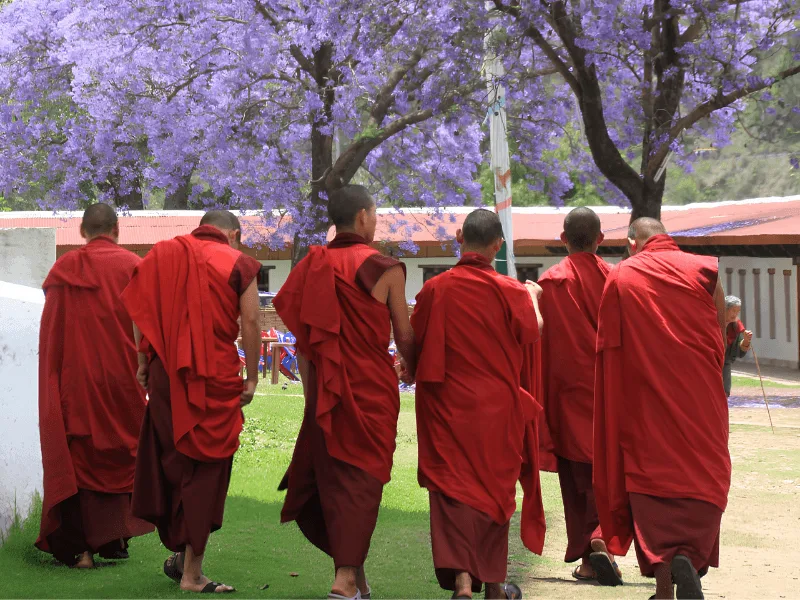
Bhutan temple dress code for men and women
Item
Men
Women
Top
Collared shirt (half sleeves acceptable) or a collarless shirt with full-length sleeves. No vests or sleeveless tops.
Sleeves that cover the shoulders. Long sleeves are best; a short-sleeve top is usually fine with a collar or with a shawl over it.
Bottom
Full-length trousers. No shorts, and no cropped trousers that show the knee.
Full-length trousers, or a skirt or dress that covers the knee – ankle length is safest when you sit on the floor.
Fit
Clean and neat. Hiking trousers are perfectly fine.
Modest, not tight or see-through. Leggings only under a long tunic, dress or skirt.
Footwear
Closed shoes, no flip-flops. Off before entering shrine rooms.
Closed shoes or neat flats, no flip-flops. Off before entering shrine rooms.
Head
No hat or cap inside the precincts.
No hat or cap inside the precincts.
Useful extra
A light long-sleeved layer in your daypack for days you start in a T-shirt.
A large scarf or pashmina: warmth outside, instant shoulder cover inside.
National dress
Optional. If you wear a gho into a dzong, your guide can arrange a plain white kabney.
Optional. A kira with a rachu over the shoulder is welcomed, especially at festivals.
Rules beyond clothing
What other etiquette rules apply at Bhutanese temples?
Walk clockwise
Never step over a prayer flagpole
No smoking
Photos outside, not inside
Ask before photographing people
Feet away from altars
Don’t touch
Keep your voice low
Hat off for monks and officials
Paro Taktsang
What to wear for the Tiger’s Nest hike
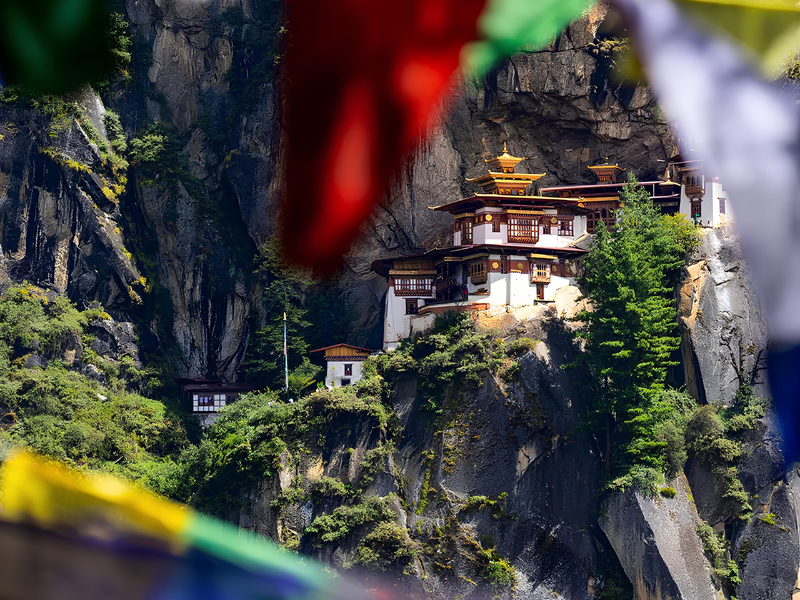
Hike in long trousers from the start, and carry a long-sleeved layer to put on before the monastery gate. The full temple dress code applies at Paro Taktsang, with one added complication: you arrive hot and sweaty after climbing roughly 520 m from the trailhead (about 2,600 m) to the monastery at 3,120 m, and the instinct is to strip down.
Don’t hike in shorts planning to change at the top. There is nowhere to change, and you will be turned away at the entrance. Technical hiking trousers are ideal and nobody minds them.
- Long, breathable hiking trousers – non-negotiable for temple entry
- Trail shoes or light boots with good grip, already broken in; the path is dusty in the dry season and slippery after rain
- Layers: cold at an 8 am start, warm by mid-morning, cool again at the monastery
- A long-sleeved top to pull on before the security check
- Sun hat for the trail, taken off at the gate
- A small daypack – daypacks, phones, cameras and water bottles are all left in lockers at the entrance, and photography is not allowed inside the temples
In winter, after snowfall, the upper path can be icy; microspikes or boots with deep tread make a real difference. Walking poles are useful on the way down. Our Tiger’s Nest hike guide covers timings, fitness and the horse option in detail.
Festival days
What should you wear to a tshechu festival?
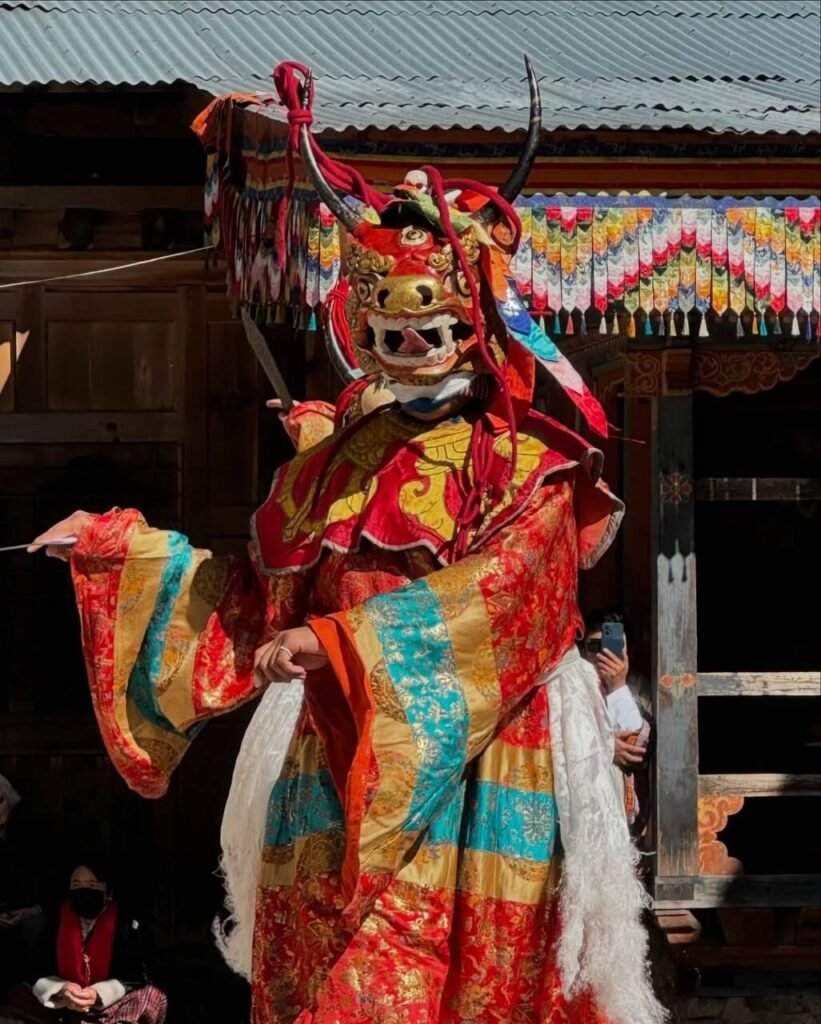
Wear the smartest version of the standard temple rules – and consider national dress. Tshechus are held in dzong and temple courtyards, so the full dress code applies. But they are also the days when Bhutanese families dress in their very best: silk kiras, brocade ghos, coral and turquoise jewellery handed down through generations. It is a formal religious occasion, not a street fair.
Many visitors wear a gho or kira to a festival, and it is genuinely appreciated rather than seen as costume. We arrange national dress for guests on our festival tours who would like to wear it, with someone to help dress you in the morning.
- Layers matter. Festival days start early and cold, warm up fast in the sun, and you will sit for hours. A warm layer and sun protection are both essential.
- Bring something to sit on – a folded shawl or small cushion. Seating is often on steps or the ground.
- Sit where you’re directed, don’t block anyone’s view, and stand when the crowd stands.
- Never walk onto the dance ground for a photo, even between dances.
Dates move with the lunar calendar – check our Bhutan festivals calendar for 2026–2027, or look at the Paro Tshechu tour for the best-known spring festival.
A little history
Why does Bhutan have a dress code? Driglam namzha explained
Driglam namzha is Bhutan’s code of etiquette and dress. The words roughly mean “order, discipline and custom” (driglam) and “system” (namzha) – often rendered in English as “the rules for disciplined behaviour”. It covers how to dress, how to greet, how to sit and eat, how to behave in a dzong and even how buildings should look.
Its roots go back to the 17th century and Zhabdrung Ngawang Namgyal, the lama who unified Bhutan. Codes of conduct and dress were part of building a shared, distinctly Bhutanese identity alongside the dzongs and the state monastic body he founded.
In 1989 the government made the dress code mandatory rather than recommended, requiring citizens to wear national dress in public during business hours. Like most national policies it was not universally welcomed at the time – some communities in southern Bhutan, with their own dress traditions, objected to it. Today the gho and kira are worn daily by office workers, students and officials, while plenty of Bhutanese wear jeans and jackets in their own time.
For visitors, none of this is a legal requirement. It is simply the context: the clothes you see around you are a living tradition, and respectful dress at a dzong is your part of it.
National dress
Gho and kira: what Bhutanese wear and why
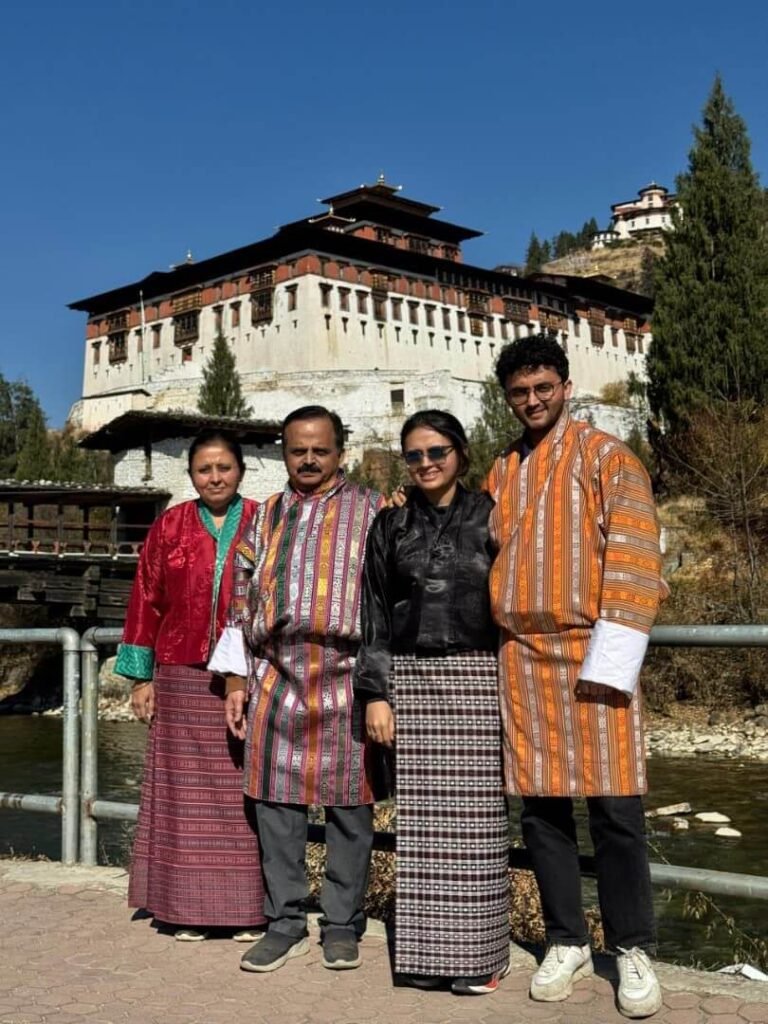
The gho is the men’s national dress; the kira is the women’s. You will see both everywhere – in offices, schools, dzongs and on the road – and after a day or two you will start to notice how much variety there is in fabric, pattern and quality.
The gho is a knee-length robe, wrapped, folded at the back and tied tightly at the waist with a woven belt called a kera. The fold above the belt forms a deep pouch, the hemchu, that works as a giant pocket: phones, wallets, papers, sometimes a packed lunch. White cuffs (lagey) are turned back over the sleeves, and it is worn with knee-length socks and smart shoes.
The kira is a large rectangle of woven cloth wrapped around the body to make an ankle-length dress, fastened at the shoulders with a pair of brooches (koma) and belted at the waist. It is worn over a long-sleeved blouse (wonju) and under a short jacket (toego). Many younger women now wear a two-piece version, which is easier to put on.
Everyday ghos and kiras are cotton or wool in simple checks and stripes. Formal ones are patterned silk, and a fully hand-woven silk kira from central or eastern Bhutan can take a weaver many months to finish – they are treated as heirlooms. If textiles interest you, the weaving villages of Bumthang and the east, and the Royal Textile Academy in Thimphu, are worth building into your trip.
Kabney and rachu
What do the coloured scarves mean in Bhutan?
Kabney colour
Who wears it
Saffron (yellow)
His Majesty the King (Druk Gyalpo) and the Je Khenpo, the chief abbot
Orange
Ministers (Lyonpos)
Red
Holders of the title Dasho – senior officials and others honoured by the King for service to the nation
Green
Judges
Blue
Members of Parliament
White, without fringes
Senior civil servants such as ministry secretaries, and certain distinguished individuals
White with red stripes
Gups – elected heads of local gewogs (village blocks)
White
Ordinary citizens
For visitors
Should tourists wear a gho or kira?
Getting one
Rough costs
You will need help
Where to buy
What goes underneath
One caution
The weather reality
Why elevation decides what you pack for Bhutan
The biggest packing mistake in Bhutan is treating it as one climate. Temperatures fall by roughly 6–7°C for every 1,000 m you climb, and a normal itinerary crosses two or three climate bands in a week – sometimes in a single day.
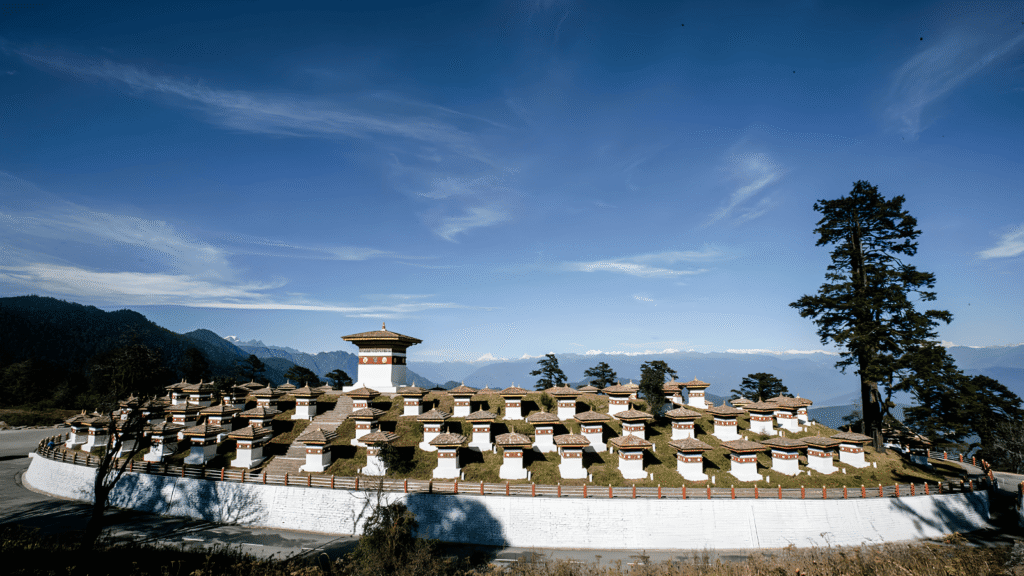
Take the classic drive from Thimphu to Punakha. You leave Thimphu at about 2,320 m in a fleece, stop at Dochula pass at about 3,100 m where the wind makes you reach for a proper jacket, and arrive in Punakha at about 1,240 m wanting short sleeves. That is completely normal, and it is why layers are not just advice here – they are the only system that works.
The other number that matters is the daily swing. In March or October a Paro morning can start just above freezing, reach the low 20s by lunch, and drop sharply the moment the sun slips behind a ridge. One warm coat is wrong for most of that day. Three thin layers are right for all of it.
Our Bhutan weather by month guide has month-by-month NCHM averages for each valley, and the tables below summarise what they mean for your suitcase. If you are still choosing dates, our guide to the best time to visit Bhutan weighs up each season.
Where you will be
How high are the main places in Bhutan?
Place
Elevation
What it feels like
Punakha / Wangdue
about 1,240 m
The warm valley. Mild winters, hot and humid in summer.
Paro
about 2,250 m (airport 2,235 m)
Cool temperate; frosty winter mornings.
Thimphu
about 2,320 m
Cool temperate with cold nights for much of the year.
Bumthang (Jakar)
about 2,500–2,600 m
Properly cold from November to March.
Haa
about 2,700 m
Cooler and windier than Paro.
Phobjikha / Gangtey
about 2,900–3,000 m
Likely the coldest place you will sleep; frost most winter nights.
Tiger’s Nest (Paro Taktsang)
3,120 m
Hot on the climb, cool at the top.
Dochula pass
about 3,100 m
Windy and often far colder than Thimphu.
Chele La pass
close to 4,000 m
Cold and windy in any season; snow in winter.
Typical temperatures
How cold does Bhutan get? Temperature bands by season
Season
Thimphu / Paro
Punakha (warmer)
Bumthang (colder)
Winter (Dec–Feb)
about −2 to 16°C
about 6 to 21°C
about −4 to 13°C
Spring (Mar–May)
about 4 to 24°C
about 11 to 29°C
about 2 to 20°C
Monsoon (Jun–Aug)
about 15 to 27°C
about 20 to 31°C
about 13 to 23°C
Autumn (Sep–Nov)
about 4 to 25°C
about 11 to 29°C
about 1 to 22°C
Month by month
What to wear in Bhutan by season
01
Spring (March–May)
Mild days, cool nights, flowers, some showers
02
Monsoon (June–August)
Warm, humid, green and wet
03
Autumn (September–November)
The classic season: clear skies, cold mornings
04
Winter (December–February)
Cold, bright, quiet
Activity by activity
What to wear for hiking, trekking, rafting and evenings
Day hikes
Trekking
Rafting in Punakha
Hot stone bath
Monastery or farmstay
Evenings and dinners
The master list
Bhutan packing list: what to pack for a 7-day trip
Clothing
Footwear
Accessories
Electronics
Health and comfort
Documents
Leave it at home
What not to wear or pack for Bhutan
Shorts
Sleeveless tops and vests
Tight or revealing clothing
Ripped or distressed jeans
Slogan T-shirts
Flip-flops and heels
One heavy coat instead of layers
A drone
Too much luggage
From our guides
Practical tips for dressing well in Bhutan
- Laundry is easy. Most hotels offer same-day or next-day laundry at reasonable prices, so you can pack for about four days whatever the length of your trip. On a longer journey this is the biggest space saving there is.
- You can buy warm clothes in Thimphu. The capital has outdoor shops selling fleeces, jackets, gloves and hats at fair prices. If you have under-packed warmth, fix it in Thimphu before heading to Phobjikha or Bumthang, where choice is far more limited.
- The sun is strong at altitude. Above 2,000 m the UV is much stronger than the temperature suggests, and people regularly come home from a cool week in Bhutan sunburnt. Sunscreen every morning, sunglasses always.
- Shoes come off a lot. Slip-ons or boots with quick laces save real irritation. Wear socks without holes – you will be in your socks in front of strangers more often than you expect, and temple floors are cold, so thick ones help in winter.
- Modesty is cultural, not only religious. Bhutan is conservative in dress generally. You will never be told off in a café for wearing a T-shirt, but you will fit in – and be treated a little more warmly – in neat, covered clothes.
- Dress one notch up for special visits. A meeting with a lama, a home visit, an audience at a dzong office or a festival: a collared shirt or a neat blouse and clean shoes go a long way.
- Ask your guide. Every one of our guides will check your outfit before you leave the hotel on a temple day – that is part of the job, not an inconvenience. For everything else about planning, our Bhutan travel guide is the place to start.
The bottom line: pack one capsule that works everywhere – long trousers, tops with sleeves, three thin layers, shoes you can slip off and a big scarf. Do that, and the Bhutan dress code stops being something you manage and becomes something you simply meet, every temple, every dzong, every day. Nobody here wants you anxious about your clothes. They want you to walk into a 17th-century fortress and be present in it.
Questions we get asked
What to wear in Bhutan: frequently asked questions
Still unsure about something? Message us on WhatsApp at +975 16108730 or email hello@kingdomofhappinesstours.com – we answer packing questions all the time.
What is the Bhutan dress code for tourists?
Can I wear shorts in Bhutan?
What is the Bhutan temple dress code exactly?
Do tourists have to wear the gho or kira?
Where can I rent or buy a gho or kira?
What do the coloured scarves mean in Bhutan?
What should I wear for the Tiger’s Nest hike?
What should I wear in Bhutan in winter?
What should I wear in Bhutan in October?
What should I wear in Bhutan in March?
Is Bhutan cold?
Do I need a down jacket for Bhutan?
What shoes should I wear in Bhutan?
Can women wear jeans or leggings in Bhutan?
Are there rules about photography in Bhutan?
What is driglam namzha?
What plug adapter do I need for Bhutan?
How much luggage can I bring to Bhutan?
Plan your Bhutan trip
Not sure what to pack for your dates?
- Licensed operator, licence No. 1052914
- Bhutanese-owned, based in Thimphu
- Reply within 48 hours
Plan my trip to Bhutan
Free itinerary and itemised quote