
Bhutan monasteries guide · Updated October 2026
Top 10 Monasteries in Bhutan You Must Visit
Licensed operator No. 1052914
Bhutanese-owned, Thimphu-based
Entry fees included in our tours
Why monasteries matter here
What makes the monasteries in Bhutan so special?
The monasteries in Bhutan are not museums. They are working places of worship, where monks still study, chant and hold the masked-dance festivals that the rest of the country turns up to watch. Buddhism reached these valleys in the 7th century, according to Bhutanese tradition, and the temples built since then shaped the country’s architecture, its calendar and, through the dzongs, even its system of government.
We are a Bhutanese team based in Thimphu, and we take guests into these places every week. This guide covers the ten we think every visitor should consider. For each one you get the location, altitude where we could confirm it, who founded it and when, why it matters, what you will actually see, how to get there, and a practical tip from our guides. Further down there is a comparison table, a plain-English explainer on dzongs, lhakhangs and goembas, temple etiquette, a note on entry fees, a route that strings most of them together, and answers to the questions guests ask us most.
A quick word on dates: many founding dates in Bhutan come from religious histories rather than written records, so where a date rests on tradition we say so.

Bhutan monasteries at a glance
Valleys covered
Paro, Thimphu, Punakha, Phobjikha, Bumthang
Oldest temples
Kyichu & Jambay Lhakhang (7th century, by tradition)
Highest of the ten
Taktsang, about 3,120 m
Hardest to reach
Taktsang: 2–3 hour uphill hike
Main school
Drukpa Kagyu (state); Nyingma in central Bhutan
Best months
March–May and late September–November
Dress
Long sleeves, long trousers or skirt, no hats
Entry fees
Included in our tour packages
Side by side
Which Bhutan monasteries suit you? A quick comparison
Monastery
Valley
Effort to reach
Best for
1. Paro Taktsang (Tiger’s Nest)
Paro
Hard: 2–3 h uphill hike
The iconic view; a real mountain walk
2. Punakha Dzong
Punakha
Easy: drive and short walk
Architecture, history, spring jacarandas
3. Kyichu Lhakhang
Paro
Easy: 10 min drive from town
Ancient atmosphere, quiet devotion
4. Tashichho Dzong
Thimphu
Easy: in the capital
Seeing religion and state side by side
5. Gangtey Goemba
Phobjikha
Moderate: long drive, short walk
Wide valley views, black-necked cranes
6. Kurjey Lhakhang
Bumthang
Easy: once you are in Bumthang
Guru Rinpoche pilgrimage sites
7. Jambay Lhakhang
Bumthang
Easy: once you are in Bumthang
7th-century history, autumn festival
8. Tango Goemba
Thimphu
Moderate: about 1 h uphill
Monastic university life
9. Cheri Goemba
Thimphu
Moderate: about 1 h uphill
Forest walk, retreat atmosphere
10. Chimi Lhakhang
Punakha
Easy: 20–30 min flat walk
Folklore, rice-field walk, fertility blessing
Know the words
Dzong vs lhakhang vs goemba: what is the difference?
Short answer: a dzong is a fortress that houses both government offices and a monk body; a lhakhang is a temple; a goemba is a monastery where monks live and study, usually somewhere quiet. In everyday English all three often get called “monasteries”, which is why this list includes two dzongs.
- Dzong (fortress-monastery). Built from the 17th century onwards, many by Zhabdrung Ngawang Namgyal, who unified Bhutan. Each district has one. Half is the district administration, half is the district’s monastic community, divided by a central tower (utse). Think thick, sloping white walls and big courtyards. Examples here: Punakha Dzong and Tashichho Dzong.
- Lhakhang (temple). Literally “house of the gods”. It can be a tiny village shrine or a temple of national importance, and often has a caretaker monk or lama rather than a large community. Examples: Kyichu, Jambay, Kurjey and Chimi Lhakhang.
- Goemba or gonpa (monastery). From a word meaning a solitary place. Usually on a hillside away from villages, with resident monks, retreat cells and often a school. Examples: Tango, Cheri, Gangtey and Phajoding. Taktsang is a cluster of temples and hermitages, and Bhutanese call it Taktsang Pelphug or simply Taktsang.
- Chorten. A stupa: a solid shrine that holds relics or sacred objects. You walk around it clockwise.
Most dzongs and many temples belong to the Drukpa Kagyu school, Bhutan’s state religion, looked after by the Zhung Dratshang (Central Monastic Body) under the Je Khenpo. Much of central Bhutan, including Gangtey and many Bumthang temples, follows the older Nyingma school, closely tied to Guru Rinpoche and the treasure-revealer Pema Lingpa.

01 · Paro valley · about 3,120 m
1. Paro Taktsang (Tiger’s Nest Monastery)
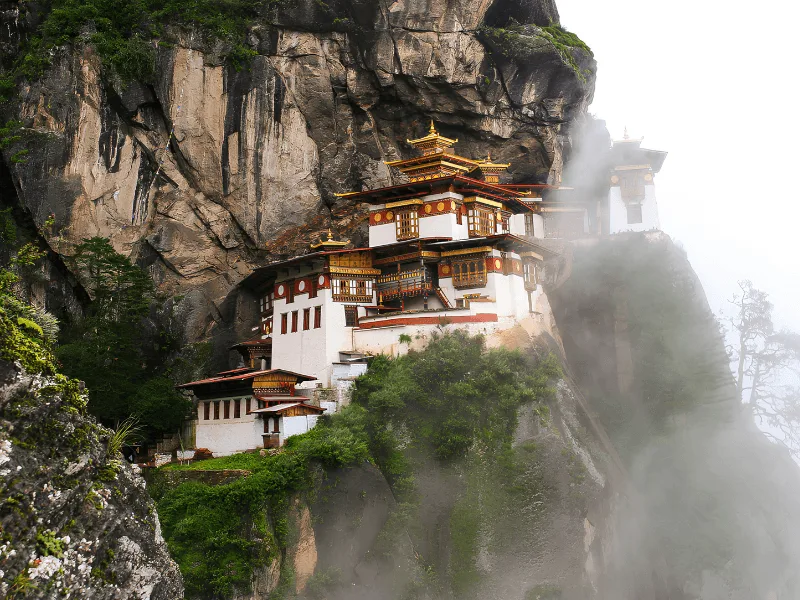
Tiger’s Nest is Bhutan’s most famous monastery and the one almost every visitor wants to reach. Its temples cling to a sheer cliff roughly 900 m above the floor of the Paro valley, at about 3,120 m above sea level, and you can only get there on foot.
Why it matters. Bhutanese tradition says that in the 8th century Guru Rinpoche (Padmasambhava) flew here on the back of a tigress to subdue a local demon, then meditated in a cave on the cliff. That cave, Taktsang Pelphug, is one of the most sacred places in the Himalayan Buddhist world. The temple complex was built around it in 1692 by Gyalse Tenzin Rabgye, the fourth temporal ruler (Desi) of Bhutan. A fire in 1998 destroyed much of the main building; it was carefully rebuilt and reconsecrated in 2005.
What you see. Several small temples linked by stone steps and wooden walkways, with statues of Guru Rinpoche in his different forms, butter lamps and wall paintings. Your guide will show you the shrine above the cave where Guru Rinpoche is said to have meditated.
How to visit. The trail starts at a car park about 20 minutes’ drive from Paro town, at roughly 2,600 m. Most people take 2–3 hours up and 1.5–2 hours down, so plan on 5–6 hours in total with your time inside. A cafeteria about halfway has the classic viewpoint and a welcome cup of tea. After the viewpoint the path drops down several hundred steps to a waterfall and climbs back up to the entrance. Ponies can carry you uphill as far as the cafeteria area, but you walk the rest and the descent. Read our full Tiger’s Nest hike guide or the Paro and Tiger’s Nest destination page for more.
Our guides’ tip: leave it until the last full day or two of your trip, after you have adjusted to the altitude, and start by 7:30–8 am. You climb in the shade, avoid the crowds, and reach the temples before the midday break.
Tiger’s Nest facts
Location
Paro valley, western Bhutan
Altitude
About 3,120 m
Built
1692, by Gyalse Tenzin Rabgye
Sacred because
Guru Rinpoche’s meditation cave
Hike
2–3 h up, 1.5–2 h down
Difficulty
Moderate to strenuous
Best time
Mar–May, late Sep–Nov
Inside
Shoes off, no photos, bags at locker
02 · Punakha valley · about 1,200 m
2. Punakha Dzong (Pungthang Dewachen Phodrang)
Punakha Dzong is the most beautiful dzong in Bhutan, and many Bhutanese would say the most important. It sits on the point where the Pho Chhu (“father river”) and Mo Chhu (“mother river”) meet, in a warm, low valley where rice grows and jacaranda trees around the dzong flower purple in spring.
Why it matters. Zhabdrung Ngawang Namgyal built it in 1637–38, making it the second dzong in Bhutan. Its full name means “Palace of Great Happiness”. It was the seat of government until the capital moved to Thimphu in the 1950s, and it is still the winter home of the Je Khenpo and the Central Monastic Body. Ugyen Wangchuck was crowned the first King of Bhutan here in 1907, and the present King, Jigme Khesar Namgyel Wangchuck, married Queen Jetsun Pema here in 2011. The dzong holds Bhutan’s most precious relic, the Rangjung Kharsapani, a self-arisen image of Avalokiteshvara, and the Machey Lhakhang, which enshrines the Zhabdrung’s preserved remains (not open to visitors).
What you see. You cross the Mo Chhu on a covered wooden cantilever bridge and climb steep wooden steps into the dzong. Inside are three courtyards, the towering central utse and a magnificent assembly hall with huge gilded statues of the Buddha, Guru Rinpoche and the Zhabdrung, and murals of the Buddha’s life.
How to visit. Punakha is about 2.5–3 hours by road from Thimphu over the Dochula pass (3,100 m). The dzong hosts the Punakha Drubchen and Punakha Tshechu, usually in February or March; check our Bhutan festivals calendar. More on the valley on our Punakha destination page.
Our guides’ tip: walk a few minutes upstream along the riverbank after your visit. The view back to the dzong across the water, especially in late afternoon light, is the best photo in the valley.

Punakha Dzong facts
Location
Punakha, western Bhutan
Built
1637–38, by Zhabdrung Ngawang Namgyal
School
Drukpa Kagyu; winter seat of the Je Khenpo
Key relic
Rangjung Kharsapani
From Thimphu
About 2.5–3 h drive
Effort
Easy; some steep wooden steps
Festival
Punakha Drubchen & Tshechu (Feb–Mar)
Best time
Mar–Apr for jacarandas; Oct–Nov
03 · Paro valley
3. Kyichu Lhakhang: one of Bhutan’s oldest temples
Kyichu Lhakhang is the Paro valley’s most sacred temple and, by tradition, one of the two oldest in Bhutan. It is small, low and quietly busy with local people walking around it and spinning its prayer wheels from early morning.
Why it matters. According to legend, the Tibetan emperor Songtsen Gampo built it in 659 as one of 108 temples raised across the Himalaya to pin down a giant demoness lying across the land. Kyichu is said to hold down her left foot (Jambay Lhakhang in Bumthang holds her left knee). The temple was later restored and extended, including in the 19th century. In 1968 Her Majesty Ashi Kesang Choden Wangchuck, the Royal Grandmother, added a second temple, the Guru Lhakhang, with a large statue of Guru Rinpoche.
What you see. In the old temple, a revered statue of Jowo Shakyamuni (the Buddha as a young prince), said to date from the temple’s founding. Look at the worn floorboards, polished by generations of prostrations. In the courtyard grow orange trees that local people say bear fruit all year round.
How to visit. About 10 minutes’ drive north of Paro town, so it fits easily into your first or last afternoon in Paro, or after the Tiger’s Nest hike if you still have the legs.
Our guides’ tip: come early in the morning or around sunset, when older Paro residents do their circuits (kora) of the temple. Join them, clockwise, and you will see a side of Bhutanese faith that no festival shows you.
Kyichu Lhakhang facts
Location
Paro valley, north of Paro town
Founded
659, by Songtsen Gampo (tradition)
Second temple
1968, by Ashi Kesang Choden Wangchuck
Main image
Jowo Shakyamuni
From Paro town
About 10 min drive
Effort
Easy, level ground
Best time
Year-round; early morning
Good to pair with
Rinpung Dzong, Tiger’s Nest
04 · Thimphu · about 2,320 m
4. Tashichho Dzong: the seat of government and faith
Tashichho Dzong is where Bhutan’s religion and state literally share a building. On the west bank of the Wang Chhu in Thimphu, it holds the throne room and offices of His Majesty the King, some government offices, and the summer residence of the Je Khenpo and the Central Monastic Body.
Why it matters. An earlier fortress on a nearby site dates from the early 13th century and was taken over and rebuilt by Zhabdrung Ngawang Namgyal in the 1640s. The dzong you see today was largely rebuilt from 1962 by the Third King, Jigme Dorji Wangchuck, after Thimphu became the capital, using traditional methods: no nails and no written plans. Its name means “Fortress of the Glorious Religion”.
What you see. Two great courtyards, one for administration and one for the monk body, tall whitewashed walls, painted wooden galleries and the assembly hall with its large statues. In autumn the courtyard fills for the Thimphu Tshechu, the capital’s biggest festival, usually held in September or October.
How to visit. Because it is a working government building, visiting hours for tourists are limited: usually late afternoon on weekdays once offices close, with longer hours on weekends and holidays. Hours shift slightly between summer and winter, so your guide confirms them on the day. See our Thimphu guide for what else to fit around it.
Our guides’ tip: time your visit for the end of the day and stay for the flag-lowering ceremony in the courtyard, then walk out as the lamps come on and the dzong glows against the dark hills.

Tashichho Dzong facts
Location
Thimphu, the capital
Current form
Rebuilt from 1962 by the Third King
Role
Throne room, offices, summer seat of the Je Khenpo
Tourist entry
Limited hours; mostly late afternoon on weekdays
Effort
Easy
Festival
Thimphu Tshechu (Sep–Oct)
Dress
Formal: long sleeves, collar, no hats
Nearby
Memorial Chorten, Buddha Dordenma
05 · Phobjikha valley · about 2,900–3,000 m
5. Gangtey Goemba: the monastery above the crane valley
Gangtey Goemba is the largest Nyingma monastery in western Bhutan, set on a forested ridge above the wide glacial valley of Phobjikha. Its full name is Gangtey Sang-ngag Choling.
Why it matters. It was founded in 1613 by Gyalse Pema Thinley, grandson of the great treasure-revealer Pema Lingpa, and it remains the seat of the Gangtey Tulku, one of the main lines of Pema Lingpa’s spiritual heirs. Between 2001 and 2008 the monastery was carefully restored, with local craftsmen replacing decayed timber using traditional techniques. It has a monastic school and a community of monks and lay practitioners in the village around it.
What you see. A large central temple with fine woodwork and statues, a courtyard looking out over the valley, and the small village of Gangtey spread below. From late October to February, several hundred endangered black-necked cranes winter on the valley floor. The Black-necked Crane Festival is held in the monastery courtyard every year on 11 November, with children’s crane dances and songs.
How to visit. About 3 hours from Punakha or 5 hours from Thimphu by road. You can drive almost to the door. Most guests stay two nights so there is time for the Gangtey Nature Trail (about 1.5–2 hours, mostly downhill through the valley). More on our Phobjikha valley page.
Our guides’ tip: Phobjikha is cold, even in October. Bring a warm layer for the evening prayers, and keep voices low near the crane roosting areas.

Gangtey Goemba facts
Location
Phobjikha valley, Wangdue Phodrang
Altitude
About 2,900–3,000 m
Founded
1613, by Gyalse Pema Thinley
School
Nyingma (Pema Lingpa tradition)
From Punakha
About 3 h drive
Effort
Easy once there
Festival
Black-necked Crane Festival, 11 Nov
Best time
Late Oct–Feb for cranes
06 · Bumthang (Chokhor valley)
6. Kurjey Lhakhang: where Guru Rinpoche left his body print
Kurjey Lhakhang is one of the holiest places in Bhutan, a complex of three temples in Bumthang’s Chokhor valley. Kur means body and jey means imprint.
Why it matters. Tradition says Guru Rinpoche came to Bumthang in the 8th century at the invitation of a local king, Sindhu Raja, whose life force had been stolen by the local deity Shelging Karpo. The Guru meditated in a cave here, subdued the deity, and left the imprint of his body in the rock. The cave is now inside the oldest temple.
The three temples. The first, the Guru Lhakhang, was built in 1652 by Chogyal Minjur Tenpa, the Penlop (governor) of Trongsa. The second, Sampa Lhundrup, was built in 1900 by Ugyen Wangchuck while he was Penlop of Trongsa, before becoming the first King. The third and largest was added in the late 20th century under the patronage of Her Majesty Ashi Kesang Choden Wangchuck. A wall of 108 small chortens surrounds the complex.
What you see. The cave with the body imprint, a huge statue of Guru Rinpoche, and a tall cypress tree said to have grown from his walking stick. The Kurjey Tshechu is held here on the 10th day of the 5th Bhutanese month, usually in June or July, with masked dances and the display of a large thangka.
How to visit. A short drive from Jakar, Bumthang’s main town. Bumthang is a long drive from Thimphu (most people break the journey in Phobjikha or Trongsa), and there are some domestic flights to Bathpalathang airport, though schedules change. See our Bumthang valley guide.
Our guides’ tip: cross the suspension bridge below Kurjey and walk about 30 minutes along the river to Tamshing Lhakhang, founded by Pema Lingpa. Your driver meets you on the other side.

Kurjey Lhakhang facts
Location
Chokhor valley, Bumthang
Oldest temple
1652, by Chogyal Minjur Tenpa
Second temple
1900, by Ugyen Wangchuck
Sacred because
Guru Rinpoche’s body imprint
From Jakar
A few minutes by road
Effort
Easy
Festival
Kurjey Tshechu (usually Jun–Jul)
Nearby
Jambay Lhakhang, Tamshing
07 · Bumthang (Chokhor valley)
7. Jambay Lhakhang: the temple of the future Buddha
Jambay Lhakhang is, with Kyichu, one of the two oldest temples in Bhutan, and the scene of one of its most unusual festivals.
Why it matters. Like Kyichu, it is said to have been built by Songtsen Gampo in 659, this time to hold down the demoness’s left knee. It is dedicated to Jampa (Maitreya), the Buddha of the future. Guru Rinpoche is said to have visited it on his journeys to Bumthang, and the temple was restored and added to by later rulers, including Chogyal Minjur Tenpa in the 17th century.
What you see. A low, ancient-feeling main temple with a statue of Jampa, and side chapels including one with images of Kalachakra. Around it are prayer wheels and an open courtyard where local people stop for a kora on the way to market.
The festival. The Jambay Lhakhang Drup is held in autumn, usually October or November. It includes the Mewang, a fire blessing where people run under a flaming arch of straw to be purified, and the midnight Tercham, a sacred dance by masked men wearing very little. Photographing the Tercham is not allowed, and our guides will make sure you are in a respectful spot.
How to visit. A short drive or a pleasant walk from Jakar; easily combined with Kurjey on the same morning. If you would like to time a trip around it, look at our Bhutan festival tours.
Our guides’ tip: ask the caretaker to show you the small spring-fed pool linked to the temple’s founding story. It is easy to miss and says a lot about how legend and place are tied together in Bumthang.
Jambay Lhakhang facts
Location
Chokhor valley, Bumthang
Founded
659, by Songtsen Gampo (tradition)
Dedicated to
Jampa (Maitreya), the future Buddha
From Jakar
About 10 min by road
Effort
Easy
Festival
Jambay Lhakhang Drup (Oct–Nov)
Special rites
Mewang fire blessing, Tercham dance
Nearby
Kurjey Lhakhang, Tamshing
08 · North of Thimphu
8. Tango Goemba: the monastic university above Thimphu
Tango is one of Bhutan’s leading centres of Buddhist higher learning, a hilltop monastery about 14 km north of central Thimphu that you reach on a steady forest walk.
Why it matters. The name means “horse head”, after a cliff here said to have revealed itself as Tamdrin (Hayagriva), the horse-headed form of Avalokiteshvara. The site was established in the 13th century by Phajo Drugom Zhigpo, who brought the Drukpa Kagyu school to western Bhutan. The present building was constructed in 1688–89 by Gyalse Tenzin Rabgye, the fourth Desi (the same ruler who built Tiger’s Nest), and it is the residence of his reincarnation. Since the 1960s Tango has housed a monastic college (shedra), where monks spend years on philosophy, ritual and scripture.
What you see. A curved main building tucked under the cliff, monks in debate or study, and a calm courtyard with views back down the Thimphu valley. Because it is a working college, what you see depends on the day; on some days the monks are in exams or retreat and parts are closed.
How to visit. About 30 minutes’ drive from Thimphu to the trailhead, then roughly an hour uphill on a well-built path through blue pine and rhododendron, and 30–45 minutes down.
Our guides’ tip: Tango makes a gentle warm-up hike for Tiger’s Nest. Do it on your second or third day and you will know exactly how your legs and lungs handle the altitude.
Tango Goemba facts
Location
Upper Thimphu valley
Founded
13th century, by Phajo Drugom Zhigpo
Present building
1688–89, by Gyalse Tenzin Rabgye
School
Drukpa Kagyu; monastic college
Hike
About 1 h up, 30–45 min down
Difficulty
Moderate
Best time
Mar–May, Sep–Nov
Good to pair with
Cheri Goemba (same road)
09 · North of Thimphu
9. Cheri Goemba: where Bhutan’s monk body began
Cheri (Chagri Dorjeden) is where the Zhabdrung founded Bhutan’s first community of monks, the forerunner of today’s Central Monastic Body. For history lovers, that makes it one of the most significant goembas in the country.
Why it matters. Zhabdrung Ngawang Namgyal arrived from Tibet in 1616 and built Cheri in 1620, spending long periods here in retreat. Inside is a silver chorten holding the ashes of his father, Tempai Nyima. It is still used for meditation retreats, some lasting three years or more, so it has a quieter, more inward feel than Tango.
What you see. The walk itself is part of the visit: you cross the Wang Chhu on a traditional covered bridge hung with prayer flags at Dodena, then climb through forest past small chortens and retreat huts. Near the top, look out for goral (a kind of mountain goat), which graze around the monastery and are used to people.
How to visit. The trailhead at Dodena is about 30 minutes’ drive from Thimphu, close to the Tango turn-off. Allow about an hour up and 40 minutes down. Many of our guests do Tango in the morning and Cheri after a picnic lunch, which makes a full and rewarding day.
Our guides’ tip: treat Cheri as a place to be quiet rather than to tick off. Sit for ten minutes on the bench outside and listen; on most days you will hear only prayer flags, the river below and the occasional bell.
Cheri Goemba facts
Location
Dodena, upper Thimphu valley
Founded
1620, by Zhabdrung Ngawang Namgyal
Key relic
Silver chorten with his father’s ashes
Known for
First monk community; retreats
Hike
About 1 h up, 40 min down
Difficulty
Moderate
Best time
Mar–May, Sep–Nov
Good to pair with
Tango Goemba
10 · Punakha (Lobesa)
10. Chimi Lhakhang: the Divine Madman’s temple
Chimi Lhakhang is Bhutan’s best-known fertility temple, a small temple on a round hillock between Wangdue and Punakha, reached by a pleasant walk through rice fields.
Why it matters. It is linked to Lama Drukpa Kunley (1455–1529), the “Divine Madman”, a much-loved Drukpa Kagyu master who taught through song, outrageous humour and deliberate shock. Legend says he subdued a demoness of the Dochula pass and buried her near this spot. The temple was built in 1499 by his cousin, Ngawang Chogyel, on a site the saint had blessed. The painted phalluses you see on houses all over Bhutan are part of his legacy: they are protective symbols, not jokes, and Bhutanese treat them that way.
What you see. A compact temple with a statue of Drukpa Kunley, his bow and arrow, and a wooden phallus with which the resident lama blesses visitors, especially couples hoping for a child. Many families come back after a baby is born and ask the lama to name the child. Inside you can usually see albums of photos sent by grateful parents from many countries.
How to visit. Park at Sopsokha on the Thimphu–Punakha road and walk 20–30 minutes along the edge of the fields and through the village. The walk is mostly level, with a short climb at the end. It pairs perfectly with Punakha Dzong on the same day.
Our guides’ tip: the walk is loveliest in spring, when the paddy fields are freshly planted, and in late September to October, when the rice turns gold just before harvest.
Chimi Lhakhang facts
Location
Lobesa, Punakha district
Built
1499, by Ngawang Chogyel
Linked to
Lama Drukpa Kunley, the Divine Madman
Known for
Fertility blessings
Walk
20–30 min, mostly level
From Punakha Dzong
About 20 min drive
Best time
Apr–May, late Sep–Oct
Good to pair with
Punakha Dzong, Dochula
Bonus for hikers
Is the Phajoding monastery hike worth adding?
Yes, if you enjoy a proper hill walk. Phajoding is a scattered complex of temples and retreat houses high on the ridge above Thimphu, at roughly 3,600–3,700 m, with the highest temple, Thujidrag, close to 4,000 m. On a clear day you look straight down on the capital and across to the snow peaks.
The site was founded in the late 13th century by Phajo Drugom Zhigpo, the same lama connected to Tango, and most of today’s buildings date from the 18th century. It was on the World Monuments Fund watch list in 2010, and Bhutan’s heritage department has since been working to conserve its old temples. A community of young monks lives here.
The hike: most people start near Sangaygang or Motithang above Thimphu and take about 3–4 hours up through blue pine and rhododendron, and 2–3 hours down, so it is a full day with a packed lunch. It is steeper and higher than Tiger’s Nest, so we only suggest it after a few days in the country. The trail is also the first day of the Druk Path trek between Thimphu and Paro; see our Bhutan trekking tours if you would like to keep going.
Our guides’ tip: go in October or November for the clearest views, and pack a warm jacket even if Thimphu feels mild in the morning.
Phajoding hike facts
Start
Above Thimphu (Sangaygang/Motithang area)
Altitude
About 3,600–3,700 m
Founded
Late 13th century, by Phajo Drugom Zhigpo
Time
3–4 h up, 2–3 h down
Difficulty
Strenuous; after acclimatising
Best time
Oct–Nov, Mar–May
If you have more time
Which other famous monasteries in Bhutan are worth seeing?
Rinpung Dzong, Paro
Dungtse Lhakhang, Paro
Trongsa Dzong
Tamshing Lhakhang, Bumthang
Jakar Dzong, Bumthang
Kila Goemba, Chele La
Respect
What should you wear and do when visiting Bhutan monasteries?
Cover up, take your hat off, walk clockwise and leave your camera in your bag inside. That covers most of it. Our guides will walk you through the rest before each visit; they wear their own formal scarf (kabney) inside dzongs, and you will notice how the mood changes as you go in.
- Dress code: long sleeves and long trousers or a long skirt. A collared shirt is ideal for dzongs. No shorts, sleeveless tops, short skirts, caps or hats, and take sunglasses off.
- Shoes: remove them where asked, usually at the door of a temple room. Slip-on shoes and clean socks make the day easier.
- Walk clockwise around temples, chortens, prayer wheels and mani walls, keeping them on your right.
- No photos inside temples or shrine rooms. Courtyards and exteriors are usually fine. Ask before photographing monks, and never photograph sacred rites when told not to.
- Keep your voice low and your phone on silent. If prayers are under way, wait quietly or ask your guide whether you can sit in.
- Do not touch statues, murals or offerings, and avoid pointing your feet towards an altar when you sit.
- No smoking near religious sites, and no drones without official permission.
- Some protector chapels (goenkhang) are closed to women or to all visitors. Your guide will tell you; it is about tradition, not about you.

Fees and paperwork
Do you pay to enter monasteries in Bhutan?
Yes, many of the main monuments charge foreign visitors an entrance fee, set by the government and revised from time to time. Tiger’s Nest is the highest, reported by BBS in 2026 at Nu 1,000 per adult, with half price for children. Working village temples often have no fee, but a small offering at the altar is always welcome.
With us, every monument entry fee on your itinerary is already included in the package price, along with your licensed guide, private car and driver, 3-star hotels and all meals. You pay the Sustainable Development Fee (US$100 per adult per night), the one-time US$40 visa and 5% GST on tour services on top. See our Bhutan travel cost guide and visa process for the full picture.
Seasons and festivals
When is the best time to visit monasteries in Bhutan?
Spring (March–May) and autumn (late September–November) are best for clear trails, comfortable temperatures and the big festivals. The monasteries are open all year, though, and each season has something to offer. Read more in our best time to visit Bhutan guide.
- Spring (Mar–May): rhododendrons on the Tiger’s Nest trail, jacarandas at Punakha Dzong, and the Paro Tshechu at Rinpung Dzong. Join our Paro Tshechu tour.
- Summer (Jun–Aug): monsoon rain, green valleys and fewer visitors. Trails get muddy and views come and go. Kurjey Tshechu falls in this season.
- Autumn (Sep–Nov): the clearest skies, Thimphu Tshechu at Tashichho Dzong, Jambay Lhakhang Drup in Bumthang, and the cranes arriving in Phobjikha.
- Winter (Dec–Feb): cold mornings but sunny days, quiet temples, cranes at Gangtey, the Druk Wangyel Tshechu at Dochula on 13 December, and Punakha’s festivals from February.

Bhutan monasteries tour
Can you see all ten in one trip? Our suggested 11-day route
01
Arrive Paro, drive to Thimphu
Day 1 · about 1 h drive
02
Tango and Cheri
Day 2 · two 1-hour hikes
03
Over Dochula to Punakha
Day 3 · about 3 h drive
04
Punakha to Phobjikha
Day 4 · about 3 h drive
05
Phobjikha to Bumthang
Day 5 · a long scenic day
06
Bumthang temples
Day 6 · easy walks
07
Bumthang back west
Day 7 · drive or flight
08
Return to Paro
Day 8 · drive
09
Tiger’s Nest
Day 9 · 5–6 h hike
10
Optional extra
Day 10 · your choice
11
Depart
Day 11
Go deeper
Can you stay in or learn from a monastery in Bhutan?
Overnight stays inside working monasteries are not generally open to tourists, but there are good ways to spend real time with monastic life. With advance notice we can arrange to sit in on morning or evening prayers, meet a monk or lama for a conversation about practice, join a butter-lamp offering, or take a short meditation session. Our Live Like a Monk tour is built around exactly this; you can read about what it is like in our live like a monk in Bhutan post.
If you would rather keep it simple, our 11-day Bhutan cultural tour follows close to the route above, and the 6-day cultural tour covers Tiger’s Nest, Kyichu, Tashichho, Punakha Dzong and Chimi Lhakhang.
Your questions answered
Bhutan monasteries: frequently asked questions
Still unsure about something? Message our Thimphu team on WhatsApp at +975 16108730 or email hello@kingdomofhappinesstours.com.
What is the most famous monastery in Bhutan?
How many monasteries are there in Bhutan?
What is the oldest monastery in Bhutan?
How long does the Tiger’s Nest monastery hike take?
Is the Tiger’s Nest hike difficult?
Do you need a guide to visit monasteries in Bhutan?
What is the dress code for Bhutan monasteries?
Can I take photos inside Bhutanese temples?
Are monastery entry fees included in your tours?
What is the difference between a dzong and a monastery?
How long do I need to see the top monasteries in Bhutan?
How much does a Bhutan monasteries tour cost?
Which monasteries can I visit during a festival?
Can women enter all monasteries in Bhutan?
Is the Phajoding monastery hike harder than Tiger’s Nest?
Which monastery in the Paro valley should I visit besides Tiger’s Nest?
Can I attend prayers or meet monks?
Is it OK to give donations at monasteries?
Plan your monastery journey
Want to see these monasteries with a local guide?
- Licensed operator, licence No. 1052914
- Bhutanese-owned, based in Thimphu
- Reply within 48 hours
Plan my trip to Bhutan
Free itinerary and itemised quote