Bhutan festival guide · Updated 16 October 2026
Druk Wangyel Tshechu 2026: The Dochula Festival on 13 December
Written by a licensed Bhutanese operator · Licence No. 1052914
Why stop at Dochula
A reason to stay longer at Bhutan's most famous pass
Most travellers stop at Dochula for twenty minutes on the drive between Thimphu and Punakha. They walk around the white chortens, look for the mountains and carry on down into the valley. On 13 December there is a reason to stay all day.
The Druk Wangyel Tshechu, better known to visitors as the Dochula festival, brings mask dances, music and thousands of Bhutanese families to a festival ground at about 3,100 metres. Behind the colour lies a story of courage, remembrance and gratitude that gives this one-day celebration a special place in Bhutan’s cultural calendar.
It is also one of the few tshechus held outside a dzong, the only one danced largely by soldiers, and one of the youngest: the first edition took place in 2011. This guide covers the 2026 and 2027 dates, the history, each dance, the setting, weather, etiquette, photography and how to build a December trip around the day.
Festival at a glance
2026 date
Sunday 13 December 2026
2027 date
Monday 13 December 2027
Duration
One day, held every year on 13 December
Location
Festival ground below Druk Wangyel Lhakhang, Dochula Pass
Altitude
About 3,100 m (3,116 m is often quoted)
From Thimphu
About 45 minutes to 1 hour by road
From Punakha
About 2 hours by road
Entry
Free; tourists attend with their licensed guide
First held
2011
Also called
Dochula festival, Druk Wangyal Tsechu
The story behind the festival
A festival of remembrance and gratitude
Druk Wangyel Tshechu was instituted in 2011 under the patronage of Her Majesty the Queen Mother Ashi Dorji Wangmo Wangchuck. It honours His Majesty the Fourth Druk Gyalpo, Jigme Singye Wangchuck, and Bhutan’s armed forces for their leadership and service during the December 2003 operation against insurgent groups that had set up camps in southern Bhutan.
“Druk Wangyel” means roughly “victory of the Druk”, the thunder dragon that gives Bhutan its name. Knowing this changes how you watch. The dances carry a sense of national remembrance alongside their colour and movement, and for Bhutanese spectators the day means far more than entertainment. Ask your guide about the history on the drive up: even a short introduction connects the dances, the memorial chortens and the place itself.
Timeline
December 2003
2004
2008
13 December 2011
Today
What makes it different
Not held in a dzong, and danced by soldiers
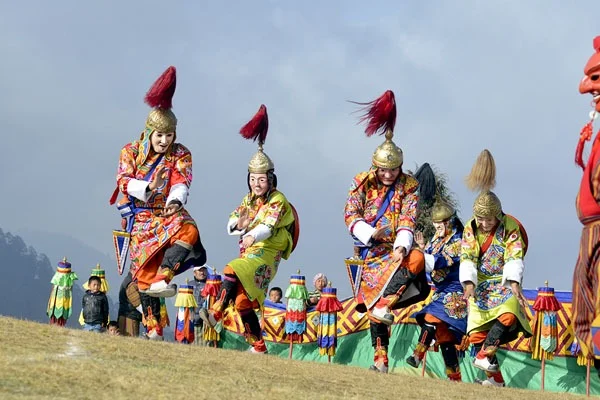
Most tshechus take place in a dzong courtyard and are danced by monks and lay dancers following centuries-old texts. Druk Wangyel Tshechu is performed on an open, raised mound at the pass, and its mask dances were created for the festival. The original dancers were members of the Royal Bhutan Army’s band troupe, who trained for months before the first edition. Reporting on the inaugural festival also records the Royal Academy of Performing Arts and the Central Monastic Body taking part.
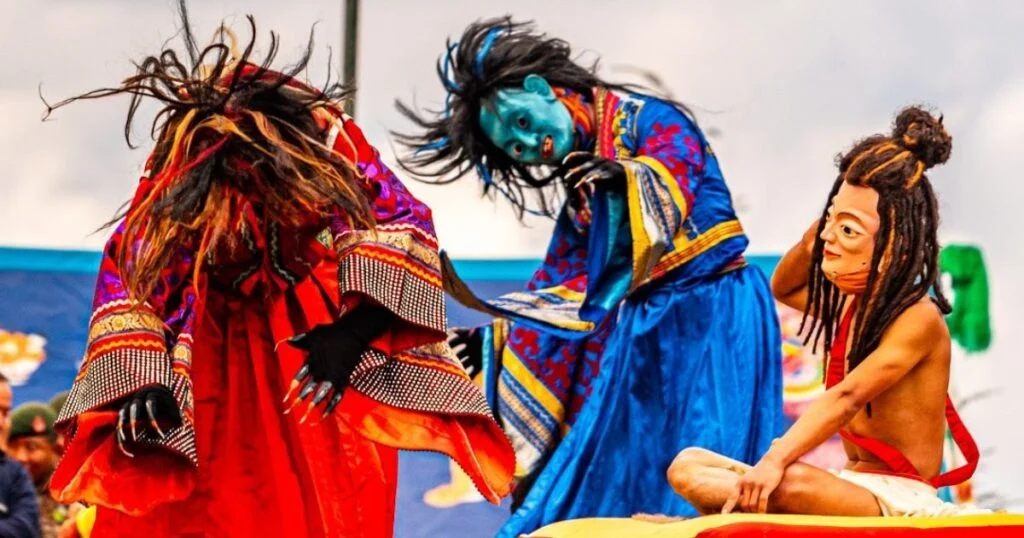
Short folk dances fill the gaps between the mask dances, so there is rarely a quiet moment. These are the dances usually seen, in the order they are normally performed:
01
Dance of Gadpo Ganmo (the old couples)
Opening dance · long life and prosperity
02
Dance of Milarepa and the rock demons
Athletic · dramatic leaps
03
Dance of the Deities
Protector deities · feathered wings
04
Dance of the Heroes
Royal Bhutan Army · three episodes
05
Vision of the Bodhisattvas
Closing dance · Guru Rinpoche
A day at the festival
What festival day at Dochula usually looks like
Early morning
Opening
Morning dances
Midday
Afternoon
Close
Dochula: a setting with its own meaning
108 chortens, a royal temple and the eastern Himalaya
Dochula sits at about 3,100 metres on the road from Thimphu to Punakha, surrounded by forest of hemlock, fir and rhododendron. On a clear day the pass looks north-east onto the snow peaks of the eastern Himalaya, including Masagang (7,194 m) and Gangkar Puensum (7,570 m), the highest mountain in Bhutan and the highest unclimbed peak in the world. December often brings clear skies, but cloud and mist can roll in at any time.
The 108 Druk Wangyel chortens were built under the patronage of the Queen Mother to honour the Bhutanese soldiers who lost their lives in 2003. They were completed in 2004 and stand in three tiers of 45, 36 and 27 around a central chorten. Above them, Druk Wangyel Lhakhang was completed in 2008 to mark a century of Bhutan’s monarchy. Its murals mix classic Buddhist themes with scenes from modern Bhutan, including the Fourth King’s campaign and even a Druk Air plane.
Just below the pass, the Royal Botanical Park at Lamperi protects 46 species of rhododendron and is home to red pandas and blood pheasants. The short Dochula nature trail starts near the cafe if you arrive early.
108
Memorial chortens in three tiers (45, 36, 27)
2004
Year the chortens were completed
2008
Druk Wangyel Lhakhang consecrated
7,570 m
Gangkar Puensum, Bhutan's highest peak
7,194 m
Masagang, also visible on clear days
46
Rhododendron species in nearby Lamperi park
Getting there
How to get to Dochula for the festival
From Thimphu
From Punakha
Transport
Winter roads
Weather and what to expect
Cold, colourful and busy
Come prepared for an outdoor festival in the mountains. Sitting or standing through the performances feels much colder than a quick photo stop. Early mornings at the pass are often around or below freezing, daytime temperatures usually stay in single digits Celsius, and the wind can bite once the sun goes behind cloud.
Snow is possible but cannot be promised: BBS reported snowfall during the 2023 celebration, when hundreds of people and tourists still attended. The festival ground seats about 4,000 people and draws big crowds, so don’t expect a quiet day. Arrive early for a spot on the grass slope facing the mound.
At 3,100 metres some visitors feel the altitude. Walk slowly, drink water and avoid alcohol the night before.
What to bring
- Warm layers: thermal base layer, fleece and an insulated or down jacket
- Hat, gloves and warm socks for hours outdoors
- Comfortable shoes with good grip for frosty grass
- A small mat or cushion to sit on the slope
- Sunscreen, sunglasses and lip balm: the mountain sun is strong
- Water, a flask and snacks; we arrange lunch in advance
- Camera and spare batteries: cold drains them fast
- Cash in ngultrum for snacks or small offerings
Attending respectfully
Festival etiquette: six simple rules
Dress modestly and warmly
Keep the dance ground clear
Photograph with care
Inside sacred buildings
Quiet during prayers
No drones
Photography tips
How to photograph the Dochula festival
- Use a zoom lens. 70–200 mm lets you fill the frame from the slope without stepping onto the dance ground.
- Shoot early. Morning light is soft and the mountains are most often clear before midday.
- Fast shutter for the leaps. 1/1000 s freezes the Milarepa and Heroes dancers mid-air.
- Step back for context. From the chorten terraces you can frame dancers, crowd and Himalaya together.
- Keep batteries warm. Carry spares in an inside pocket.
- Ask first. A smile and a gesture is enough; most people say yes, but respect a no.

Combine festivals
Other Bhutan festivals in November and December
2026
Festival
Place
Dates
Black-necked Crane Festival
Gangtey, Phobjikha
11 Nov
Mongar Tshechu
Mongar Dzong
17–19 Nov
Trashigang Tshechu
Trashigang Dzong
18–20 Nov
Jambay Lhakhang Singye Cham
Bumthang
24 Nov
Nalakhar Tshechu
Bumthang
24–26 Nov
Druk Wangyel Tshechu
Dochula, Thimphu
13 Dec
Trongsa Tshechu
Trongsa Dzong
17–21 Dec
Lhuentse Tshechu
Lhuentse Dzong
17–21 Dec
Nabji Lhakhang Drup
Nabji, Trongsa
24–26 Dec
2027
Festival
Place
Dates
Goenpai Drupchen
Trongsa Dzong
3–5 Dec
Mongar Tshechu
Mongar Dzong
6–8 Dec
Trashigang Tshechu
Trashigang Dzong
7–9 Dec
Druk Wangyel Tshechu
Dochula, Thimphu
13 Dec
Jambay Lhakhang Singye Cham
Bumthang
13 Dec
Nalakhar Tshechu
Bumthang
13–15 Dec
How to include the festival in your trip
A sample 8-day December itinerary built around 13 December
Date
Plan
Details
10 Dec
Arrive in Paro, drive to Thimphu
Fly into Paro, one of the world's most scenic landings, then drive about an hour to the capital. Gentle evening walk.
11 Dec
Thimphu sightseeing
Buddha Dordenma, the Memorial Chorten, the Folk Heritage Museum and Tashichho Dzong.
12 Dec
Thimphu at your own pace
Weekend market, crafts and an early night before festival day.
13 Dec
Druk Wangyel Tshechu at Dochula
Early drive to the pass for the festival, then down to the warmer Punakha valley (about 1,200 m) for the night.
14 Dec
Punakha
Punakha Dzong at the river confluence and the walk to Chimi Lhakhang through rice fields.
15 Dec
Punakha to Paro
Cross Dochula again and drive to Paro; visit Rinpung Dzong.
16 Dec
Tiger's Nest hike
Hike to Paro Taktsang, about 4–6 hours return.
17 Dec
National Day or departure
Fly home, or stay on for Bhutan's National Day celebrations on 17 December.
Make more of December
Other reasons to visit Bhutan in December
Bhutan National Day, 17 December
Black-necked cranes in Phobjikha
Clear winter skies
What a Dochula festival trip costs
Druk Wangyel Tshechu FAQ
Questions about the Dochula festival
When is Druk Wangyel Tshechu 2026?
Where is the Dochula festival held?
Is Druk Wangyel Tshechu the same as the Dochula festival?
Why is the festival held?
Who performs the dances?
What is the Dance of the Heroes?
Do I need a ticket to attend?
What time does the festival start?
How cold is Dochula in December?
Will I see the Himalaya from Dochula?
Is there food at the festival?
Can I take photographs?
Is the festival suitable for children and older travellers?
How many days do I need for a festival trip?
Can Indian travellers attend?
What else is happening in Bhutan in December?
How much does a Bhutan festival tour cost?
When should I book?
Book your Druk Wangyel Tshechu journey
Experience Druk Wangyel Tshechu on 13 December 2026
- Licensed operator, licence No. 1052914
- Bhutanese-owned, based in Thimphu
- Reply within 48 hours
Plan my trip to Bhutan
Free itinerary and itemised quote