
Bhutan Photography Tour
Capture the Beauty of the Himalayas
Bhutan is the most photographable country in Asia. It has never been colonised, never homogenised, and never allowed mass tourism to dilute the authenticity of what it is. The result is a country where every frame — a monk crossing a 17th-century courtyard, prayer flags against snow-capped peaks, the golden light of dawn on the Tiger’s Nest cliff face — feels like a photograph that does not exist anywhere else on earth. This 8-day Bhutan photography tour is designed to put you in front of the finest landscape photography, cultural photography, and wildlife photography opportunities in the kingdom, at the right time, in the right light, guided by someone who knows exactly where to stand and when.
Experience the Best Bhutan Photography Tour — Where Every Frame Tells a Story
The Bhutan Photography Tour has been specifically designed for photographers, travel writers, content creators, and creatives who want to capture the true beauty of Bhutan without being steered toward tourist traps. Bhutan is one of the most photographically rich countries in the world — and it is still largely undiscovered by the photographic community. Its architecture has never been reconstructed for tourism. Its festivals are never staged. Its monks are genuinely at prayer, not performing for cameras. Its landscapes are genuinely untouched, because Bhutan has kept them that way by constitutional mandate.
This 8-day guided photography tour in Bhutan covers five of the kingdom’s most photographically productive regions: the Paro Valley, Thimphu, the Punakha Valley, the Phobjikha (Gangtey) Valley, and the Bumthang Valley. Each region produces completely different photography — from the iconic Tiger’s Nest dawn shots in Paro, to Dochula Pass landscape photography with 108 chortens and snow-capped peaks, to the Gangtey Valley wildlife photography of Black-Necked Cranes, to the Bumthang cultural photography of ancient temple festivals and rural farming life.
Every session on this tour is timed to the best available light. Dawn shoots are positioned before the tourists arrive. Golden hour landscape sessions are planned around the specific orientation of each site. Overcast days are redirected to the cultural and portrait sessions that actually benefit from soft, diffused light. This is not sightseeing with a camera — this is a genuine Bhutan photography expedition led by someone who understands both photography and Bhutan at the deepest level.
“Bhutan does not need a filter. It does not need enhancement. Every frame here simply needs to be found — and this tour is designed to find every one of them.”
Whether you shoot with a professional DSLR, a mirrorless system, or a smartphone — whether you are a published travel photographer or someone taking your first serious photography holiday — this tour delivers the access, the guidance, the timing, and the locations that make extraordinary images possible. Bhutan photography holidays do not get more comprehensive or more deeply guided than this.
📷 Best light seasons are March–May & Sept–Nov
Spring brings rhododendron bloom and crisp mountain clarity. Autumn delivers the clearest skies and the most golden light of the year. Both seasons fill quickly — book 4–6 weeks ahead.
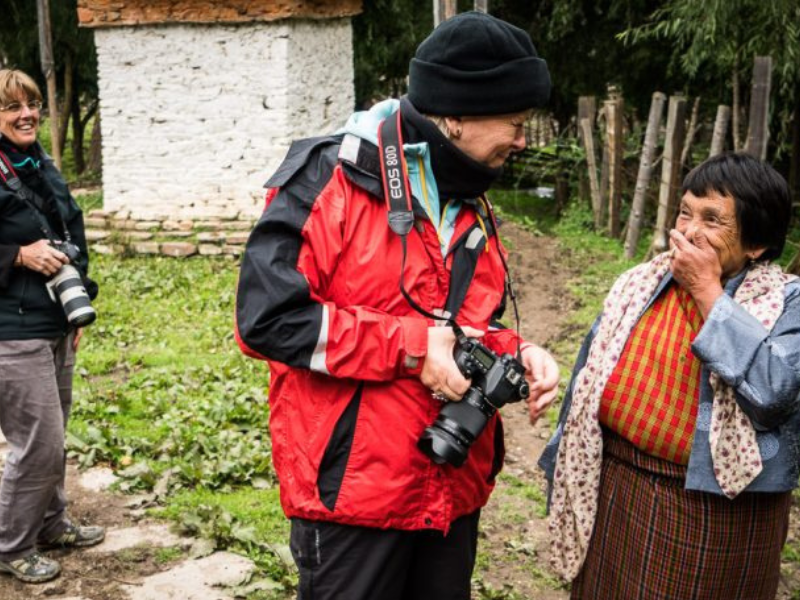
What You Will Photograph — Three Complete Photography Worlds in One Country
Bhutan offers three completely distinct categories of extraordinary photography within a single tour itinerary. No other destination in Asia delivers this breadth of photographic subject matter in such concentrated, accessible, and authentic form.
🏔️ Bhutan Landscape Photography
Mountains · Valleys · Rivers · Forests · Alpine Passes
- Tiger’s Nest — dawn light on the cliff face
- Dochula Pass — 108 chortens with Himalayan panorama
- Punakha Dzong — reflected in two rivers at sunrise
- Phobjikha Valley — mist over the open glacial basin
- Chelela Pass — Jhomolhari peak at 3,988 m
- Paro Valley — harvest season golden paddy fields
- Bumthang — buckwheat fields in full pink bloom
- Forest trails — prayer flags in ancient blue pine
🏯 Bhutan Cultural Photography
Monks · Dzongs · Festivals · Villages · Portraits
- Monks at prayer in early morning dzong courtyards
- Elderly devotees at the National Memorial Chorten
- Farmstay families — daily rural Bhutanese life
- Traditional archery — Bhutan’s national sport
- Village women weaving on traditional looms
- Harvest rituals in the Paro and Bumthang valleys
- Ancient temple interiors — butter lamps and thangkas
- Festival costumes and masked dance (season dependent)
🦅 Bhutan Wildlife Photography
Birds · Mammals · Insects · Flora · Alpine Species
- Black-Necked Cranes — Phobjikha Valley (Oct–Feb)
- Himalayan Birds — 700+ species nationwide
- Rhododendron bloom — Dochula and Chelela passes
- Butterflies — 800+ species across altitude zones
- Yaks — high pastures above 3,500 m
- Takins — Bhutan’s national animal
- Himalayan wildflowers in alpine meadows
- River birds — kingfishers, dippers, mergansers
Best Places to Photograph in Bhutan — Iconic & Hidden Locations
From the most photographed sites in the country to locations that almost no visiting photographer has ever found — this tour covers them all. Here are the key photography destinations on this itinerary.
🏔️ Landscape + Architecture
Tiger's Nest — Paro Taktsang Photography
The single most photographed site in Bhutan — and arguably one of the most photographed buildings in all of Asia. Paro Taktsang clings to a vertical cliff 900 metres above the valley floor, and the quality of light on its whitewashed walls changes dramatically through the day. Tiger's Nest photography requires both timing and position: the pre-dawn hike to the classic viewpoint at first light produces images in the warm golden hour that are incomparably richer than midday shots. Your guide knows the exact viewpoint, the precise timing, and the lesser-known secondary angles that produce compositions most photographers never find. The monastery interior — gilded statues, butter lamps, centuries-old thangka paintings — offers extraordinary close-up opportunities inside.
🏔️ Landscape + Wildlife
Dochula Pass — 108 Chortens & Himalayan Panorama
Dochula Pass photography is among the finest landscape photography opportunities in the Himalayas. At 3,100 metres, the 108 white Druk Wangyal Chortens stand in a clearing of ancient blue pine forest, and on clear days the full sweep of snow-capped Himalayan peaks fills the northern horizon. Dawn photography from Dochula — when the first light hits the chortens against a blue-grey sky before the tourists arrive — produces images of genuine grandeur. Fog photography in the early morning produces a completely different and equally beautiful set of images with the chortens emerging from the mist. The forest itself is superb for macro photography — lichen, rhododendrons, and Himalayan bird species on the forest trails.
📸 Architecture + Culture + Landscape
Punakha Dzong — The Palace of Great Happiness
Punakha Photography Tour centred on the magnificent 1637 dzong is one of the most productive single-location photography sessions in Bhutan. The fortress rises from the confluence of the Pho Chhu and Mo Chhu rivers with an elegance that rewards photography from multiple positions: from the traditional cantilever bridge for the classic long-lens compression shot; from the river level for reflections in early morning calm water; from the dzong grounds for the extraordinary architectural details of carved wooden windows and painted corridor murals; and from the hilltop nunnery above the valley for the finest aerial composition of the dzong with both rivers visible. Jacaranda bloom in March–April adds extraordinary purple foreground to every angle.
🦅 Wildlife + Landscape
Phobjikha Valley — Gangtey Photography Tour
Phobjikha Valley photography — also the Gangtey Photography Tour experience — is unlike anything else on this itinerary. The wide glacial basin at 2,900 metres, ringed by mountains and filled with open marsh and hay meadow, is one of Bhutan's most photographically open and spacious landscapes. For wildlife photographers, the arrival of the globally vulnerable Black-Necked Cranes from October to February makes the valley extraordinary — tall, elegant, black-and-white birds moving through golden meadow grass with mountain ridges behind them. The monastery on its wooded ridge above the valley floor provides both a foreground subject and a classic landscape framing element in almost every composition.
🏯 Cultural + Architecture
Bumthang Valley — Bhutan's Spiritual Heart
Bumthang photography tour sessions reveal a completely different cultural face of Bhutan from the western valleys. Bumthang's ancient temples — Jambay Lhakhang (7th century), Kurjey Lhakhang, and Jakar Dzong — are among the oldest continuously active religious sites in the Himalayan world, and their butter-lamp-lit interiors and devotee-filled courtyards offer intimate cultural photography that is available nowhere else. The Bumthang Valley agricultural landscape — buckwheat fields in pink bloom in summer, apple orchards in harvest gold in autumn, yak grazing the high pastures — is extraordinary for rural landscape and portrait photography.
🏔️ Landscape + Culture
Haa Valley — Bhutan's Hidden Photography Gem
Haa Valley photography is among the most rewarding and least-photographed experiences available in western Bhutan. The Haa Valley — a narrow, steep-sided valley accessible from Paro through a dramatic mountain pass — is far less visited than the other western valleys and preserves a quality of traditional Bhutanese village life and landscape that is increasingly rare elsewhere. The drive to Haa through the Chele La Pass (3,988 m) produces extraordinary landscape photography of its own — sweeping views of the Paro Valley below and the Himalayan peaks above, with thousands of pilgrims' prayer flags in the mountain wind.
Why Bhutan Is the World's Most Extraordinary Photography Destination
Photographers who visit Bhutan consistently say the same thing: nothing in Asia — not Bali, not Myanmar, not Nepal — prepares you for what Bhutan actually looks like. Here is why.
01
Authenticity That Cannot Be Staged
Bhutan's culture is not preserved for tourism — it simply continues. Monks chanting in dzongs built in 1637 are genuinely at prayer, not performing. Farmers ploughing with yaks in the Paro Valley use traditional methods because that is how farming is done here, not because it photographs well. The authenticity that travel photographers spend their careers searching for is simply the everyday reality of Bhutan — and it shows in every frame you take.
02
No Crowds — Access to Iconic Sites in Quiet
Bhutan's Sustainable Development Fee limits visitor numbers dramatically compared to every other major Asian photography destination. The result: Tiger's Nest in the dawn hour with nobody else on the trail. Punakha Dzong in the early morning before tour groups arrive. The Dochula Pass chortens in morning mist with the forest entirely to yourself. This absence of crowds is not a minor convenience — it is the difference between a remarkable photograph and an impossible one.
03
The Light Is Different Here
At altitude, in a country with minimal air pollution and over 70% forest cover, the quality of Himalayan light is extraordinary. The thin, clean air produces a crispness and colour saturation that flatland photography simply cannot replicate. The golden hour at 2,320 metres in Thimphu, the blue-hour alpenglow on the peaks above Chelela Pass, the soft diffused light on monastery courtyards in early morning — Bhutan's light is, in the most literal photographic sense, exceptional.
04
Architecture Untouched by the Modern World
Bhutan's dzongs, temples, and traditional farmhouses follow construction rules and aesthetic principles that have been maintained for centuries. There are no corrugated iron roofs on Bhutan's sacred buildings, no concrete additions to 14th-century temple complexes, no advertising boards in front of monasteries. The architectural photography available in Bhutan is of a quality that other Himalayan destinations lost decades ago — and Bhutan has kept it.
05
Festivals — Living Ceremonial Photography
Bhutan's religious festivals — Tshechus — are among the most spectacular and least commercially altered festival photography opportunities in Asia. The masked cham dances, the hand-sewn ceremonial costumes, the temple courtyards packed with devotees in traditional dress, the thangka unveilings at dawn — these are genuine religious events attended by local people, not staged shows. A Bhutan cultural photography tour timed to coincide with a festival produces images that are categorically beyond what any non-festival visit can achieve.
06
The People — Portrait Photography of Extraordinary Warmth
Bhutan's population is genuinely, warmly welcoming to photographers — not accustomed to being treated as photographic subjects for tourism, not performing, and not demanding payment for portraits. The elderly devotee circumambulating the National Memorial Chorten who accepts your presence with a smile, the young monks who welcome photography with curiosity, the farmer in the Bumthang fields who pauses to talk through your guide — portrait photography in Bhutan has a human quality that is increasingly rare in the world's most-visited destinations.
What Makes This Photography Tour in Bhutan Different
This is not a sightseeing tour with a camera. It is a dedicated Bhutan photography expedition designed around light, access, and the specific needs of photographers at every level.
🌅 Dawn & Golden Hour Sessions — Every Day
This tour is built around the light, not around convenience. Every site visit is timed to its optimal photographic window. Tiger's Nest at pre-dawn. Punakha Dzong at sunrise before the river mist burns off. Dochula Pass in the blue hour before the tour buses arrive. Phobjikha Valley at golden hour when the light turns the meadow grass amber. The itinerary is deliberately structured to capture the finest light at every location — which means some early starts, and some extraordinary images.
🧑🏫 Expert Photography Guide — Not a Generic Tour Guide
Your guide on this tour is a photographer first — someone who understands composition, light, focal length, and the specific technical requirements of landscape, cultural, and wildlife photography. They know the exact position at Punakha for the classic reflection shot, the precise time to be at Dochula for the light on the chortens, and the hidden temple courtyard in Bumthang that almost no visiting photographer has ever found. This is guided photography in Bhutan at its most expert.
🗺️ Five Regions — Fifty Locations — Eight Days
This tour covers more photographic ground than any other single itinerary available in Bhutan. Five complete valleys — Paro, Thimphu, Punakha, Phobjikha, Bumthang — each with its own distinct landscape, cultural, and wildlife photography character. Over 50 locations selected from the iconic to the entirely hidden. The result is a gallery of images that represents the full breadth of what Bhutan photography travel can produce — not just the Tiger's Nest and the Dzong, but the complete visual story of the kingdom.
📐 Photography Workshop Elements Built In
Each evening, your guide conducts a brief image review and planning session for the following day — reviewing the day's best frames, discussing what worked technically and compositionally, and planning the next day's locations, light windows, and specific shots to aim for. This Bhutan photography workshop element means your technique, your eye, and your approach improve continuously through the tour — not just on the final day when the habits are already formed.
🔓 Access to Locations at Optimal Times
A licensed Bhutanese tour operator with strong local relationships can do things that independent travellers cannot. Early morning access to dzong courtyards before public opening hours. Permission to photograph inside certain temple spaces. Access to farmstay families who welcome photographers into their daily routines — milking, cooking, weaving, farming — with genuine hospitality rather than tourist-oriented performance. The best photography tour in Bhutan is one with the right local relationships.
🌿 Suitable for All Cameras — All Levels
You do not need a professional camera system to get extraordinary images in Bhutan. The country's visual richness is so great that a smartphone photograph taken at the right time in the right place produces genuinely remarkable results. Your guide works with whatever equipment you bring — DSLR, mirrorless, compact, or smartphone — and provides technical guidance appropriate to your gear and your experience level. Bhutan photography rewards the photographer who knows where to look, more than the one with the most expensive equipment.
8-Day Bhutan Photography Tour Itinerary — Day by Day
Every location. Every light window. Every photography session described in full — so you know exactly what images this Bhutan photography expedition is designed to produce.
DAY 1
📍Arrival · Paro Airport · Paro Valley Golden Hour · First Shoot
Paro International Airport · Paro Chhu Valley · Rinpung Dzong · Evening Golden Hour
Your Bhutan photography holiday begins with one of the most visually dramatic airport arrivals in the world. The descent through Himalayan peaks into the narrow Paro Valley is itself a visual experience — forested ridges, terraced farmland, prayer flags catching the mountain wind, and the white towers of Rinpung Dzong visible from the final approach. Your photography guide meets you at arrivals: the khadar welcome is your first portrait opportunity if you wish to use it.
The drive to your hotel follows the Paro Chhu river through a valley of ancient farmhouses, apple orchards, and irrigated paddy fields — Paro Valley photography begins immediately. Your guide knows the finest roadside pull-out points for valley landscape shots at various times of day, and the drive to the hotel is itself a structured observation session.
📷 Late Afternoon & Golden Hour — Paro Valley Landscape & Rinpung Dzong
The late afternoon golden hour in the Paro Valley is extraordinary — the low-angle light hits the whitewashed walls of Rinpung Dzong from the west, turning the fortress a warm amber-gold while the pine forest behind it remains cool green. Your guide positions you at the finest viewpoints above the traditional covered bridge for the classic Rinpung Dzong composition, and at the riverbank below for the river-foreground shot that few visitors bother to take. The farmland in the valley floor provides natural leading lines toward the dzong in the background. This first session calibrates your eye to the quality of Bhutanese light.
DAY 2
📍Full Day · Tiger’s Nest + Paro Valley + Kyichu Lhakhang
Pre-Dawn Tiger's Nest Hike · Paro Taktsang Photography · Kyichu Lhakhang · Paro Town Portraits
The most anticipated photography day of the entire tour — and the one that consistently produces the images guests carry for the rest of their lives. A 4:30am departure from the hotel puts you on the Tiger’s Nest trail before first light, headtorches illuminating the pine forest path, arriving at the viewpoint as the sky begins its pre-dawn transition from deep indigo to gold.
📷 Pre-Dawn to Morning — Tiger’s Nest Photography · Paro Taktsang
Tiger’s Nest photography
in the dawn hour is a completely different experience from the midday visit that most tourists make. In the pre-dawn, the monastery is lit only by its own interior lights — warm gold windows against the dark cliff face, with the emerging sky above. As the sun rises, the first golden light catches the whitewashed towers from the east while the valley below is still in shadow. This is the shot: the monastery fully lit in warm morning gold against a deep blue sky, the valley floor a dark green below, the Himalayan ridges beginning to catch the light on the horizon. Your guide knows the exact position and the precise 15-minute window when this image is at its peak. After sunrise, you hike to the monastery itself for interior photography — gilded statues, butter lamps, thangka paintings — before the tour groups begin arriving from below.
📷 Afternoon — Kyichu Lhakhang & Paro Town Street Photography
Kyichu Lhakhang — founded in the 7th century, one of the oldest sacred temples in the Himalayan world — is a supreme subject for architectural and cultural photography. Its ochre-painted courtyard walls, the garden orange tree catching afternoon light, the prayer wheels along the entrance path worn smooth by centuries of hands — every detail rewards close attention. The afternoon session in Paro town: street photography of the beautifully maintained traditional shopfronts, artisans at work in their studios, monks moving between the monastery and the market, and the ordinary daily life of a Bhutanese town that happens to look unlike any other town in Asia.
DAY 3
📍Paro → Thimphu · Chelela Pass · Haa Valley Photography
Chelela Pass (3,988 m) · Haa Valley Photography · Thimphu Arrival · Evening Cultural Shoot
A dawn departure from Paro for the high-altitude Chelela Pass — the finest mountain panorama in western Bhutan — before descending into the Haa Valley for a morning of landscape and cultural photography in one of Bhutan’s least-photographed valleys.
📷 Dawn — Chelela Pass Landscape Photography (3,988 m) · Jhomolhari Peak
Chelela Pass at dawn is one of the finest landscape photography positions in all of Bhutan. At 3,988 metres — the highest motorable road in the kingdom — the pass offers an unobstructed view of the sacred Jhomolhari peak (7,326 m) filling the northern horizon in the early morning light, thousands of prayer flags in the mountain wind providing foreground colour and movement, and the first alpenglow turning the snow-capped peaks from grey to pink to brilliant white as the sun rises. This isBhutan landscape photographyat its most dramatic and most distinctly Himalayan.
📷 Morning — Haa Valley Photography · Rural Bhutan’s Hidden Landscape
The descent from Chelela into the Haa Valley reveals one of the most pristine and least-photographed rural landscapes in western Bhutan. The valley’s narrow floor, traditional village farmhouses, ancient temples, and surrounding mountain walls produce a quality of rural Bhutanese authenticity that the more-visited valleys have partly lost to tourism development.Haa Valley photography
sessions focus on the village architecture, the farming community at work, and the extraordinary mountain backdrop that frames every composition. Afternoon: drive to Thimphu, evening cultural photography session at the National Memorial Chorten — devotees in prayer, spinning prayer wheels, butter lamps illuminating the white walls in the fading light.
DAY 4
📍Full Day · Thimphu Cultural Photography Tour
Thimphu Cultural & Portrait Photography — Tashichho Dzong · Zorig Chusum · Textile Academy · Farmers' Market · Buddha Dordenma
A full day dedicated to the Thimphu Photography Tour — one of the most culturally rich photography days on the entire itinerary. Thimphu is a fascinating photographic subject: a capital city that has no traffic lights, maintains traditional architectural standards across all new construction, and functions as the nerve centre of a country that has chosen to remain fundamentally itself despite the pressures of the modern world.
📷 Thimphu Cultural Photography — Six Key Locations
Tashichho Dzong
— the golden Royal Government fortress in the early morning, with monks emerging from the residential quarters for early prayer, the dzong’s whitewashed towers catching the first direct light of the day.
National Institute for Zorig Chusum (13 Traditional Arts)
— students mastering thangka painting, wood carving, lacquerwork, and embroidery: portrait photography in natural workshop light that documents a living artistic tradition.
Royal Textile Academy
— weavers at traditional looms, the extraordinary geometry of Bhutanese kira fabric designs, pattern and colour studies in a photography-friendly environment.
Centenary Farmers’ Market
(weekends) — one of the finest street and food photography opportunities in Bhutan: fresh chillies, handwoven baskets, regional produce, elderly farmers in traditional gho dress.
Folk Heritage Museum
— the interior of a traditional farmhouse lit entirely by natural light through wooden windows.
Buddha Dordenma
— the 51.5-metre gilded statue above the city, the finest viewpoint for aerial photography of the entire Thimphu Valley.
DAY 5
📍Thimphu → Dochula Pass → Punakha · Iconic Landscape Day
Dochula Pass Photography (3,100 m) · Punakha Dzong Sunrise · Mo Chhu Valley Farmstay
The most photographically anticipated travel day of the tour — the drive from Thimphu to Punakha via Dochula Pass produces iconic landscape images at both ends of the journey.
📷 Dawn — Dochula Pass Photography · 108 Chortens & Himalayan Panorama
A pre-dawn departure from Thimphu positions you at Dochula Pass as the sky begins to colour behind the Himalayan peaks to the north. The 108 Druk Wangyal Chortens stand in the clearing as silhouettes against the brightening sky in the first minutes, then as detailed subjects in the warm early light as the sun rises. On clear mornings — most common in spring and autumn — the full sweep of named Himalayan peaks is visible on the horizon: a landscape photography composition of extraordinary scale and drama. The forest surrounding the pass is excellent for macro photography of lichen-covered trees and Himalayan bird species in the early morning quiet.
📷 Morning — Punakha Dzong Photography · The Palace of Great Happiness
Arriving at Punakha by mid-morning for the finest
Punakha Photography Tour
session. The Punakha Dzong from multiple positions: from the traditional bridge for the classic long lens shot; from the river level for the reflection in the Mo Chhu’s calm morning water; from the approach pathway for the architectural detail of the entrance gate. The jacaranda trees around the dzong bloom in spectacular purple from March to May — when these trees are in flower, the Punakha Dzong is possibly the most photographable building in all of Bhutan. Afternoon: the Chimi Lhakhang walk through golden rice paddy fields — a landscape photographer’s dream of leading lines, natural frames, and working farmland with the valley ridges in the distance. Evening at the certified farmstay — documentary photography of evening farm life, the traditional hot stone bath preparation, and the warm light of the farmhouse kitchen.
DAY 6
📍Punakha → Phobjikha Valley · Wildlife & Landscape Photography
Punakha Valley Morning · Drive to Phobjikha Valley (2,900 m) · Gangtey Photography · Black-Necked Cranes
The dramatic altitude transition from warm subtropical Punakha at 1,200 metres to cool, open Phobjikha at 2,900 metres produces a completely different landscape and wildlife photography environment within a two-hour drive.
Morning: a final Punakha Valley photography session at the Bazam suspension bridge and along the Mo Chhu river corridor — excellent light on the valley farmland in the morning sun, river reflections in the calm water, and often the finest aerial-style views of the Punakha Dzong from the hilltop nunnery above the valley.
📷 Afternoon & Golden Hour — Phobjikha Valley Photography & Gangtey Photography Tour
The
Phobjikha Valley photography
session in the late afternoon golden hour is among the finest landscape photography sessions on the entire tour. The wide, open glacial basin turns golden in the low-angle light — hay meadows, marshland, traditional village farmhouses, and the wooded ridge of Gangtey Goemba monastery all illuminated in the same warm light. Wildlife photography in the valley: the Black-Necked Cranes (October–February) are the headline species — photographed against the meadow and mountain backdrop in the golden hour, these tall, elegant birds are extraordinary subjects. Outside crane season, the valley is productive for Himalayan bird species, mountain wildflowers in summer bloom, and the high-altitude agricultural landscape photography that is unique to this elevation.
DAY 7
📍Phobjikha → Bumthang Valley · Ancient Temple Photography
Trongsa Dzong · Bumthang Valley Arrival · Jambay Lhakhang · Kurjey Lhakhang · Evening Agricultural Landscape
The drive from Phobjikha to Bumthang passes through Trongsa — home to one of the most dramatically situated dzongs in all of Bhutan — and then climbs over passes above 3,300 metres through a succession of forest zones before descending into the broad Bumthang Valley at 2,600 metres. Every section of this drive is photographically productive.
📷 En Route — Trongsa Dzong Photography · The Clifftop Fortress
Trongsa Dzong sits on a clifftop spur above the Mangde Chhu gorge in one of the most dramatically positioned locations of any building in Bhutan — possibly in all of Asia. The dzong commands the entire gorge below it, with the river visible far below through the forest. Photography from the road above and the viewpoint below produces composition opportunities that are completely unlike any other dzong in the country. The interior — if open — provides architectural photography of corridors, courtyards, and painted temple facades in extraordinary condition.
📷 Afternoon — Bumthang Cultural Photography · Jambay Lhakhang & Kurjey Lhakhang
Bumthang photography tour
sessions begin with the two most ancient and sacred temples in the valley.
Jambay Lhakhang
— believed founded in the 7th century, contemporary with the first Buddhist temples in Tibet — has a butter-lamp-lit interior of extraordinary photographic richness: gilded statues, centuries-old scroll paintings, and the warm amber light of devotion that no artificial studio can replicate.
Kurjey Lhakhang
— believed to contain Guru Rinpoche’s body imprint in the rock — has a courtyard setting of remarkable beauty, with ancient juniper trees and the sound of monks chanting drifting from the prayer hall. Evening: the Bumthang Valley agricultural landscape in the golden hour — the buckwheat fields (pink bloom in August) or the apple orchards (harvest gold in October) providing the most distinctive seasonal landscape photography available in Bhutan.
DAY 8
📍Final Day · Bumthang · Return to Paro · Airport
Bumthang Dawn Session · Tang Valley Photography · Return to Paro · Paro International Airport
The final photography morning begins before sunrise in the Bumthang Valley — the pre-dawn mist that often fills the valley floor in the cooler autumn mornings produces extraordinary atmospheric photography, with farmhouse rooftops emerging from mist and the mountain ridges catching the first alpenglow above the cloud layer. This is Bhutan landscape photography in its most ethereal form — and it is available only in the early morning before the mist burns off.
📷 Morning — Tang Valley Photography & Final Bumthang Landscape Session
The Tang Valley — a remote side valley of the Bumthang complex accessible by a short drive — is one of the finest rural landscape photography locations in central Bhutan. Traditional village farmhouses with hand-painted wooden windows, hay stacked in traditional ricks, the river running beside ancient mani walls, and the valley walls rising steeply to forested ridges on both sides: this is documentary rural photography at its most authentic. The drive back from Bumthang to Paro retraces the dramatic landscape photography route of Days 6–7 in reverse, with different light and often different cloud conditions producing entirely different images from the same locations.
Your guide facilitates a final image review over lunch — the complete list of locations photographed, species documented, and compositions achieved over eight days. Your photography has recorded a country that is genuinely unlike anything else on earth. The images in your camera represent not just a holiday, but a document of Bhutan as it actually exists — and will reward you for years to come as you return to them.
Best Time for Bhutan Photography — When the Light Is at Its Finest
Photography conditions in Bhutan vary significantly through the year. Here is when each season delivers the finest results for the different photography categories on this tour.
Rhododendron Bloom · Jacaranda · Crystal Mountain Views
Spring is the most visually spectacular season for Bhutan photography holidays. The rhododendron hillsides at Dochula Pass and Chelela bloom in pink, red, and white from March to May — extraordinary landscape photography colour that lasts only a few weeks. The jacaranda trees at Punakha Dzong flower in purple, creating the most photographed view in Bhutan. Mountain visibility from Dochula and Chelela is at its clearest in March and April, before the atmospheric haze of late spring builds. The Paro Tshechu festival in late March/April is the finest festival photography opportunity in western Bhutan — masked cham dances, ceremonial thangka unveilings, and thousands of traditionally dressed devotees in the dzong courtyard.
Golden Light · Crystal Clarity · Harvest Landscapes · Crane Season
Autumn delivers the finest overall photography conditions of the year. Post-monsoon clarity produces the sharpest mountain visibility — every Himalayan peak razor-defined against a cobalt sky. The light in October and November has a golden warmth and low angle that is extraordinary for both landscape and cultural photography. Harvest season in the Paro and Bumthang valleys produces the finest agricultural landscape photography of the year — golden paddy fields and apple orchards in full harvest colour. The Black-Necked Cranes arrive at Phobjikha Valley from late October — the finest wildlife photography opportunity on the tour. The Thimphu Tshechu festival in September/October is Bhutan's most spectacular cultural event and delivers extraordinary festival photography.
What's Included & Excluded
Complete transparency — everything covered and everything you arrange separately. No hidden costs in your Bhutan photography travel package.
✅ What’s Included
- Expert photography guide throughout — specialist in landscape, cultural and wildlife photography in Bhutan
- Daily evening image review and next-day planning session (Bhutan photography workshop element)
- All photography location access, timed to optimal light windows
- Pre-dawn and golden hour sessions at all key locations
- 8 destinations across 5 valleys: Paro, Thimphu, Punakha, Phobjikha, Bumthang
- Tiger’s Nest hike with photography guide — timed to best light
- Private SUV with professional driver throughout all 8 days
- Accommodation: 3-star hotels + 1 night certified Bhutanese farmstay in Punakha
- All three daily meals — Breakfast, Lunch and Dinner every day
- Government Sustainable Development Fee (SDF)
- One-time Bhutan visa processing fee
- All monument, dzong, temple and site entry fees
- Full support before, during and after your tour
❌ What’s Not Included
- International flights to/from Paro International Airport
- Your camera equipment and personal accessories
- Optional professional photo printing or album production (available on request)
- Festival shoot supplements if your dates coincide with a major Tshechu (ticket fees vary)
- Travel and medical insurance (strongly recommended)
- Bottled drinks and alcoholic beverages
- Personal expenses — laundry, phone calls, souvenirs
- Tips and gratuities for guide and driver (appreciated, entirely your choice)
Why Book Your Bhutan Photography Tour With Kingdom of Happiness Tours?
We are a licensed Bhutanese tour operator who built this photography programme around a single belief: the finest images of Bhutan come from being in the right place at the right time with someone who genuinely knows both.
🌅 Light-Led Scheduling — Not Tourist-Led
Every element of this itinerary is scheduled around the photographic light, not around operational convenience. If the finest light at Dochula is at 5:30am, that is when you are at Dochula. If the finest portrait photography at the dzong is in the first 45 minutes after it opens, that is when you are at the gate. The entire itinerary is built on this principle — and it shows in the quality of images guests return with.
🧑🏫 Photography Guide — Photographer First
Your guide understands aperture, shutter speed, ISO, focal length, composition, and post-processing discussion at whatever level you engage. They can help a beginner understand the exposure triangle with Punakha Dzong as the teaching subject, and discuss lens choice and hyperfocal distance with an experienced professional at the Chelela Pass. This is genuine professional photography tour in Bhutan guidance, not generic tour leading.
🔓 Access Others Cannot Get
Local relationships built over years of operating in Bhutan give us access to locations and timings that visiting photographers cannot arrange independently. Early dzong access, permission in certain temple interiors, farmstay photography that feels genuinely documentary rather than tourist-arranged — these details come from local relationships, not from a guidebook.
🛡️ Completely Private — Your Own Programme
Groups capped at 8 photographers. Your own guide, your own vehicle, your own schedule. If the light is extraordinary at a location and you want to stay longer, you stay longer. If a session is not productive, you move on. This flexibility — only possible in a private format — is what makes the difference between a good photography tour and an exceptional one.
🗓️ Festival-Timed Options Available
For photographers whose primary interest is festival and cultural photography, we can time your tour to coincide with specific Tshechu festivals — Paro Tshechu (March/April), Thimphu Tshechu (September/October), or Punakha Tshechu (March) — that transform the cultural photography potential of the relevant days from excellent to extraordinary. Please mention festival interest in your enquiry.
💬 Full Support — Before, During & After
Visa, SDF, all bookings, all permits — handled entirely. We are available throughout your tour and after you return home. Your Bhutan photography expedition with us begins from the moment you make an enquiry and continues for as long as you have questions about what you experienced and photographed.
Book Your 8-Day Bhutan Photography Tour
Complete the form below and our photography team will confirm availability, discuss your photographic interests and equipment, and send you full tour details within 24 hours.
Peak photography season (March–May and September–November) fills 4–6 weeks in advance. Festival-timed departures book fastest. We recommend enquiring early.
USD $1,580
📞 +975 77 123 456
💬 WhatsApp: +975 77 123 456
✉ hello@kingdomofhappinesstours.com
Tour Highlights
- Tiger’s Nest pre-dawn photography session
- Dochula Pass 108 chortens + Himalayan panorama
- Punakha Dzong sunrise + river reflection
- Phobjikha Valley + Black-Necked Cranes
- Bumthang ancient temples + agricultural landscape
- Chelela Pass + Haa Valley photography
- Daily workshop reviews + light-led scheduling
📷 Best Photography Seasons
Spring (Mar–May): Rhododendron bloom, jacaranda, Paro Tshechu.
Autumn (Sept–Nov): Finest light clarity, harvest landscapes, cranes arrive, Thimphu Tshechu.
Frequently Asked Questions
Complete answers to everything we hear from photographers planning a Bhutan photography vacation.
You can absolutely join this tour with any camera — including a smartphone. Bhutan’s visual richness is so extraordinary that excellent images are achievable with any device. What matters on this tour is being in the right place at the right time with the right guidance — and that applies equally to a smartphone photographer and a professional with a €10,000 lens system. Your guide provides technical advice appropriate to your specific equipment at every session.
That said, if you are considering investing in photographic equipment before this tour, Bhutan rewards wide-angle lenses for landscape and architecture (16–35mm equivalent), a telephoto for wildlife and compressed landscape compositions (200–400mm equivalent), and a fast 50mm or 85mm equivalent for portrait and cultural photography in the lower light of dzong interiors.
Absolutely — and we would argue it is one of the finest places in the world to develop as a photographer precisely because the subject matter is so rich and so forgiving. A beginner at Punakha Dzong at sunrise, with a guide explaining the basic exposure settings for the scene, will produce better photographs here than they would from months of practice in a photographic studio. The guide works with your current level, explains what they are doing and why, and helps you understand the connection between your camera settings and the results you are getting. Many guests describe this tour as the moment their photography genuinely developed.
This tour covers all of the following key photography locations:
- Tiger’s Nest (Paro Taktsang) — pre-dawn and morning
- Paro Rinpung Dzong — golden hour and river reflections
- Kyichu Lhakhang — 7th-century architectural photography
- Chelela Pass (3,988 m) — Jhomolhari peak panorama
- Haa Valley — hidden rural landscape
- Tashichho Dzong and Buddha Dordenma, Thimphu
- Dochula Pass — 108 chortens with Himalayan panorama
- Punakha Dzong — the most photographed dzong in Bhutan
- Chimi Lhakhang — rice paddy landscape walk
- Phobjikha Valley / Gangtey — wildlife and open valley landscape
- Trongsa Dzong — the most dramatically sited dzong in Bhutan
- Bumthang — Jambay Lhakhang, Kurjey Lhakhang, agricultural landscape
- Tang Valley — the finest rural documentary photography in central Bhutan
Photography rules vary by location. In most dzong courtyards and exterior areas, photography is freely permitted. Inside the main temple halls and certain sacred shrines, photography may be restricted or require special permission. Your guide navigates these rules for every location and ensures you understand and respect the policies throughout the tour. In many cases, your guide’s established local relationships allow access to temple interiors for photography that is not available to general visitors — this is one of the specific advantages of a dedicated photography tour with a local operator.
Yes — and we strongly recommend it if festival photography is among your primary interests. The major festivals with the finest photography opportunities are Paro Tshechu (late March/early April), Punakha Tshechu (late February/early March), and Thimphu Tshechu (September/October). We can schedule your departure to coincide with any of these — please mention your preference when enquiring. Festival dates are set by the lunar calendar and change slightly each year, so we confirm the exact dates when planning your specific tour.
YOUR JOURNEY BEGINS HERE
Begin Your Bhutan Photography Journey
Eight days. Five valleys. Fifty locations. Tiger’s Nest at dawn, Punakha at sunrise, the Himalayas above Chelela Pass, monks at prayer in a 17th-century courtyard, Black-Necked Cranes in the golden hour. Bhutan is the most photographable country in Asia — and it is waiting for your lens.
“To photograph Bhutan is to document a world that still believes in the things worth believing in.”